Strong food safety management starts on day one. This guide explains what induction training should cover in UK catering businesses and how a food safety app helps you stay compliant and organised.
- Why induction training matters
- UK legal duties for food safety management
- What to include in induction training
- Role-specific training and allergen management
- Common compliance issues
- Using digital food safety records
Why induction training matters
When a new starter joins your kitchen, café or catering operation, they immediately become part of your food safety management system.
Induction training isn’t just paperwork. It sets standards, protects customers, and reduces the risk of mistakes that could damage your reputation.
In busy hospitality settings, new staff often learn by watching others. Without structured guidance, they may copy shortcuts or misunderstand critical controls. A clear induction ensures everyone understands how your business keeps food safe.
It also shows Environmental Health Officers that you take compliance seriously from day one.
UK legal duties for food safety management
Under the Food Safety and Hygiene (England) Regulations 2013, and equivalent legislation across the UK, food handlers must receive supervision and instruction appropriate to their role.
The Food Standards Agency (FSA) states that staff must be trained in food hygiene matters relevant to the work they carry out.
This doesn’t always mean formal qualifications immediately. It does mean they must understand the hazards and controls linked to their job.
Inspectors can request evidence of training during visits. Poor or undocumented induction may affect your compliance rating and your ability to improve food hygiene rating outcomes.
What to include in induction training
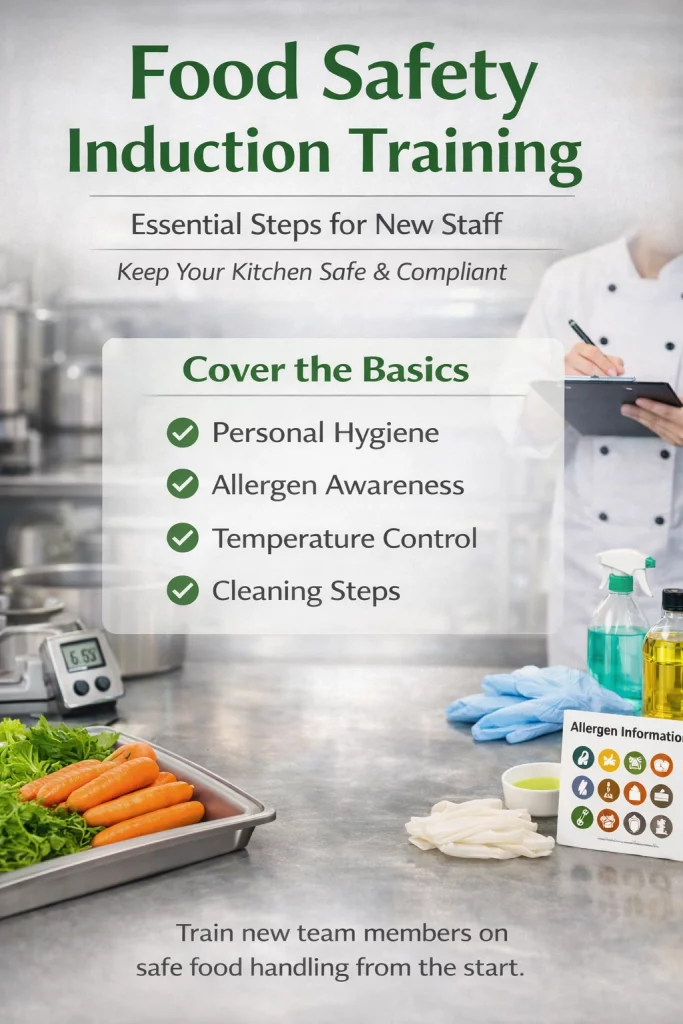
Induction content should reflect your operation, but most catering businesses should cover the following areas.
Personal hygiene and illness reporting
- Effective handwashing technique
- When hands must be washed
- Rules on jewellery, nails and uniforms
- Illness reporting, including the 48-hour exclusion rule for vomiting and diarrhoea
For example, a chef returning too soon after sickness can pose a serious contamination risk.
Food hazards and cross-contamination
Explain the basics of biological, chemical and physical hazards in simple terms.
- Separating raw and ready-to-eat foods
- Correct fridge storage order
- Using colour-coded equipment
Demonstrating these in your actual kitchen makes expectations clear.
Temperature control and HACCP records
If staff are responsible for cooking, chilling or hot holding, they must know safe temperature ranges and how to monitor them.
They should also understand how to complete your HACCP records accurately. Recording temperatures incorrectly, or not at all, is a common inspection finding.
Make sure they know what to do if a critical limit isn’t met.
Cleaning and disinfection procedures
- Which chemicals to use
- Correct dilution
- Required contact times
- Where cleaning equipment is stored
A kitchen porter, for instance, needs clear instruction on sanitising food contact surfaces, not just washing up.
Allergen management responsibilities
Effective allergen management must be part of induction for both kitchen and front-of-house teams.
- The 14 regulated allergens
- Where allergen information is recorded
- How to prevent cross-contact
- What to do if a customer declares an allergy
Front-of-house staff should never guess. They must know who to check with and how to communicate clearly.
Introduction to your food safety management system
- Daily opening and closing checks
- Probe calibration
- Waste handling
- Pest awareness
Keep explanations practical and linked to daily tasks.
Role-specific training and allergen management
Induction should be proportionate.
A delivery driver needs to understand temperature control during transport. A bar supervisor must know allergen procedures for drinks and garnishes. A head chef requires deeper knowledge of monitoring and verification.
Avoid overwhelming new starters with irrelevant detail, but don’t leave gaps in critical areas such as allergen management or cross-contamination.
Always check understanding. Ask staff to demonstrate tasks rather than simply asking if they’ve understood.
Common compliance issues
No documented induction. If it isn’t written down, it’s difficult to prove training happened.
Relying solely on online courses. Generic certificates don’t replace site-specific instruction.
Unclear allergen processes. Staff uncertainty around allergen questions can lead to serious incidents.
Out-of-date procedures. Training must reflect your current menu and processes.
Addressing these points strengthens your overall food safety management approach.
Using digital food safety records
Good record keeping supports consistent compliance.
- Date of induction
- Topics covered
- Trainer and trainee details
- Any follow-up training required
Paper systems can become disorganised, especially across multiple sites. Using digital food safety records makes it easier to track who has completed induction and when refreshers are due.
Food-Safety.app is a food safety management system for UK catering businesses. It helps you manage training logs, monitoring checks and compliance records in one place. That visibility supports better oversight and can make inspections more straightforward.
Conclusion
Effective induction training lays the foundation for strong food safety management. By clearly covering hygiene, temperature control, allergen management and HACCP responsibilities, you reduce risk and build a stronger food safety culture.
Keeping structured, accessible records then brings everything together. If you’re looking for a more reliable way to manage training and compliance, exploring a dedicated food safety app could help you make the process simpler and more consistent across your business.
