If you run a busy kitchen, you already know that food safety management takes time. This guide breaks down what that time really costs and how smarter systems can protect margins using digital food safety records.
- How many hours are you really covering?
- How many chefs do you actually need?
- What does food safety admin time cost?
- Why marginal gains matter in kitchens
- A practical next step for busy operators
How many hours are you really covering?
Let’s take a realistic example. Your business opens from 6:00am to 9:00pm, seven days a week. That’s 15 hours a day. Over a week, that’s 105 trading hours. Across a full year, that becomes 5,460 hours that must be covered by a competent chef.
It sounds manageable when you say “one chef on shift”. But once you factor in annual leave, it changes quickly.
A full-time chef on a 40-hour contract is paid for 2,080 hours per year. Yet statutory leave means they’re only available to work around 1,856 of those hours in reality.
Now divide your annual opening hours by what one chef can genuinely cover.
5,460 ÷ 1,856 = 2.94
You can’t employ 0.94 of a person. So you need three full-time chefs just to keep one chef position covered across the year, including holiday.
How many chefs do you actually need?
That three-chef figure only keeps one chef in the kitchen at any time. Most catering businesses need more than that, especially across breakfast, lunch and evening service.
If you need two chefs on for most of the day, that effectively doubles your headcount. If you need an extra chef for busy lunch and dinner periods, your rota quickly climbs to seven or eight chefs on payroll to stay stable throughout the year.
Labour is usually your largest cost. That’s why small workflow inefficiencies matter more than many owners realise.
What does food safety admin time cost?
Now let’s look at something that feels small: paperwork.
With three services a day, you complete food safety checks three times daily. That’s 21 services per week.
If each service takes 15 minutes to complete checks and HACCP records, that’s 315 minutes per week. Just over five labour hours.
Across the year, that becomes 273 hours of paid time.
At £15 per hour, that’s £4,095 per year in wages. Once you factor in employer on-costs, supervision time and general overhead, the real cost comfortably moves beyond £5,000.
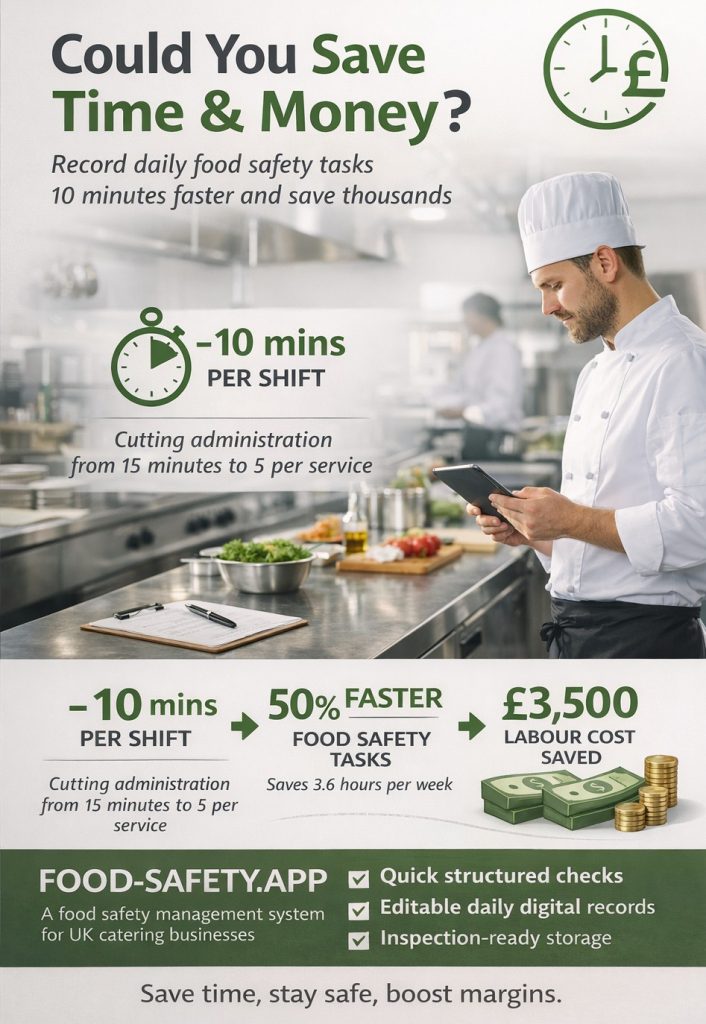
Now imagine reducing that to five minutes per service using structured digital food safety records.
Five minutes per service equals 91 hours per year. That’s £1,365 in wages.
The difference is 182 hours saved annually. Around £2,730 in direct wages. Closer to £3,500 once you consider the true employer cost.
For many independent operators, that’s not small change. It could cover equipment servicing, offset energy bills or simply strengthen your margin.
Why marginal gains matter in kitchens
Food safety management isn’t optional. It protects customers and helps you improve food hygiene rating outcomes. The Food Standards Agency makes clear that documented systems are expected in every food business.
But the way you manage it can either support your workflow or quietly slow it down.
In a 15-hour-a-day kitchen, ten minutes here and five minutes there compounds. Over a week, it’s noticeable. Over a year, it’s significant.
This isn’t about cutting corners. It’s about tightening systems so your team spends more time cooking and less time chasing paperwork.
Paper diaries get misplaced. Handwriting takes longer than tapping a screen. Rewriting temperature logs because something was missed wastes even more time. Small friction points stack up.
When systems are structured, time stamped and simple to complete, compliance becomes part of the workflow rather than an interruption to it.
A practical next step for busy operators
Food-Safety.app is a food safety management system for UK catering businesses. It’s designed to replace paper logs with fast, structured digital records that are inspection ready.
Opening and closing checks are built in. Temperature logs take seconds. allergen management records are clear and printable. Everything is stored in one place.
The goal isn’t to make compliance more complicated. It’s to make it consistent.
If you can reduce food safety admin from 15 minutes per service to five, without lowering standards, you’re not trimming safety. You’re removing wasted motion.
When you’re already employing three chefs just to keep one position covered across the year, every efficient process matters. Marginal gains in workflow can protect thousands of pounds over time.
If you’re reviewing your systems or looking to tighten margins without compromising standards, it’s worth taking a closer look at how your food safety management is handled.
Have a look at Food-Safety.app and see whether it suits your kitchen. Even small improvements in how you record compliance can make a measurable difference over the year.