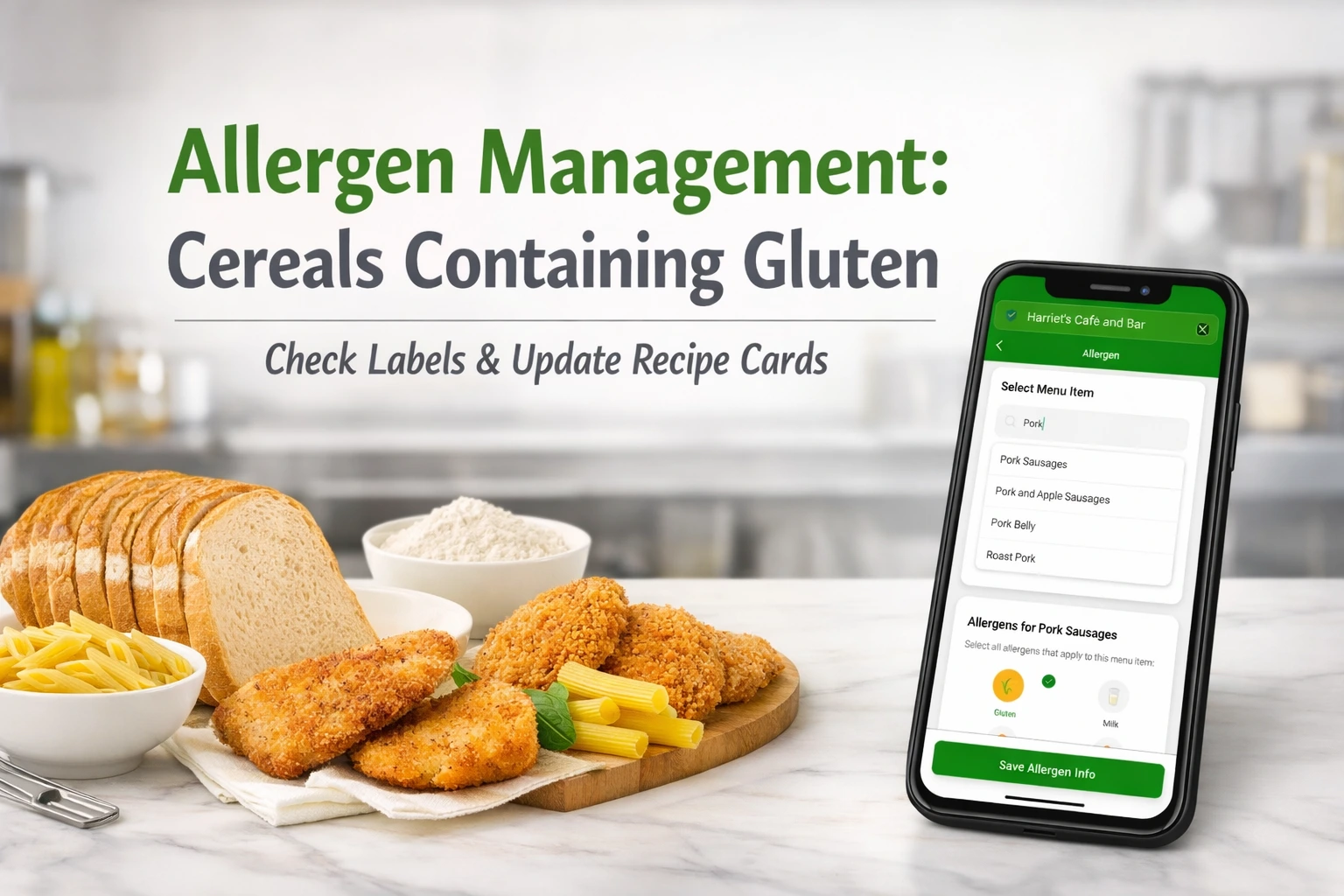
Managing cereals containing gluten in your kitchen can feel complicated, but clear allergen management and accurate recipe records make it much easier. This guide explains which foods may contain cereal allergens and why checking labels and updating recipe information is essential for UK catering businesses.
Table of Contents
- What are cereal allergens?
- Which foods may contain cereal allergens?
- Why checking labels matters
- Why recipe cards and allergen matrices must be updated
- Practical allergen management in catering kitchens
- How digital food safety records help keep allergen data accurate
What are cereal allergens?
In UK food law, cereals containing gluten are one of the 14 major allergens that must be declared to customers.
This group includes:
- Wheat
- Rye
- Barley
- Oats
- Spelt
- Khorasan wheat (Kamut)
These cereals contain gluten proteins that can trigger reactions in people with coeliac disease, wheat allergy, or gluten intolerance.
For food businesses, it’s important to understand that allergen information must identify the specific cereal used, not simply state “contains gluten”.
Official guidance from the Food Standards Agency explains that the individual cereal, such as wheat or barley, must be declared when present in a dish.
Because cereals are used in many everyday ingredients, they’re one of the allergens most likely to appear across multiple menu items.
Which foods may contain cereal allergens?
Some foods clearly contain cereals, while others include them in less obvious ways.
Common cereal-based foods
These are usually easy to identify:
- Bread, rolls and baguettes
- Cakes, muffins and pastries
- Biscuits and cookies
- Pizza bases
- Pasta and noodles
- Breakfast cereals
Because these foods are so common in hospitality, staff should always assume cereal allergens are present unless confirmed otherwise.
Battered or breaded foods
Many coatings and batters contain wheat flour or breadcrumbs.
Examples include:
- Fish in batter
- Breaded chicken
- Chicken goujons
- Onion rings
- Breaded vegetables
Even when the main ingredient is meat or vegetables, the coating can introduce cereal allergens.
Processed ingredients and sauces
Cereals are often used as thickeners, fillers or flavourings.
You may find them in:
- Gravies and sauces thickened with flour
- Stuffing mixtures
- Sausages or burgers containing breadcrumbs
- Soup mixes
- Stock cubes
- Soy sauce (many contain wheat)
Because these ingredients may arrive from suppliers, kitchens must rely on accurate ingredient labels.
Why checking labels matters
One of the most common causes of allergen mistakes in catering kitchens is assuming ingredients haven’t changed.
Suppliers may change recipes, switch ingredients, or update formulations without much warning. A sauce that previously contained no cereal ingredients may suddenly include wheat starch or malt extract.
This is why it’s so important to check the label every time a new product is delivered.
If an ingredient contains a cereal allergen such as wheat or barley, that information must be reflected in your kitchen documentation.
This is a key part of responsible food safety management. Accurate allergen information protects customers and helps demonstrate due diligence if an inspection takes place.
Why recipe cards and allergen matrices must be updated
Checking labels is only the first step. The next step is ensuring that your recipe cards and allergen matrix are updated immediately.
Recipe cards should clearly list:
- All ingredients used in the dish
- Any allergens present
- The specific cereal involved, for example wheat or barley
Your allergen matrix then pulls this information together so staff can quickly confirm which allergens appear in each dish.
If an ingredient changes and the recipe card isn’t updated, the allergen matrix will also be incorrect.
This creates a risk that staff may give customers the wrong allergen information, even if they are trying to follow the correct procedures.
Keeping these records accurate is why organised HACCP records are so important. They ensure your allergen controls remain reliable and consistent.
Practical allergen management in catering kitchens
Managing cereal allergens effectively usually comes down to a few consistent habits.
Always verify ingredients
Check labels for cereal-derived ingredients such as:
- Wheat flour
- Semolina
- Bulgur wheat
- Couscous
- Malt extract
- Barley malt
These ingredients sometimes appear in products where you might not expect them.
Prevent cross-contamination
Cereal allergens can easily spread during food preparation.
High-risk areas include:
- Shared toasters
- Shared fryers used for battered foods
- Preparation surfaces with flour dust
- Shared utensils
Careful cleaning and separation procedures help reduce the risk of cross-contact.
Make allergen information easy for staff to access
When a customer asks about allergens, staff should always refer to written or digital allergen records rather than relying on memory.
Good allergen management means staff can quickly check the correct information with confidence.
How digital food safety records help keep allergen data accurate
Paper systems can make allergen management harder than it needs to be. Updating recipe cards, allergen matrices, and kitchen records manually often leads to inconsistencies.
Using digital food safety records allows businesses to update ingredient information once and keep everything aligned.
Food-Safety.app is a food safety management system for UK catering businesses that helps simplify allergen management by linking ingredient checks, recipe cards and allergen matrices in one place.
When labels change, updating the recipe information becomes quick and straightforward. This makes it much easier to keep allergen information accurate and accessible for the whole team.
Conclusion
Cereals containing gluten appear in many everyday kitchen ingredients, from bread and pasta to sauces and coatings. Because of this, accurate allergen control relies on a simple but essential process: check the label, update the recipe card, and keep the allergen matrix correct.
These steps ensure staff always provide the right information to customers and help businesses meet their legal responsibilities.
With organised systems and clear documentation, managing cereal allergens becomes far more manageable. Food-Safety.app is a food safety management system for UK catering businesses designed to simplify allergen tracking, recipe updates and compliance records, helping kitchens keep allergen information accurate and easy to maintain.