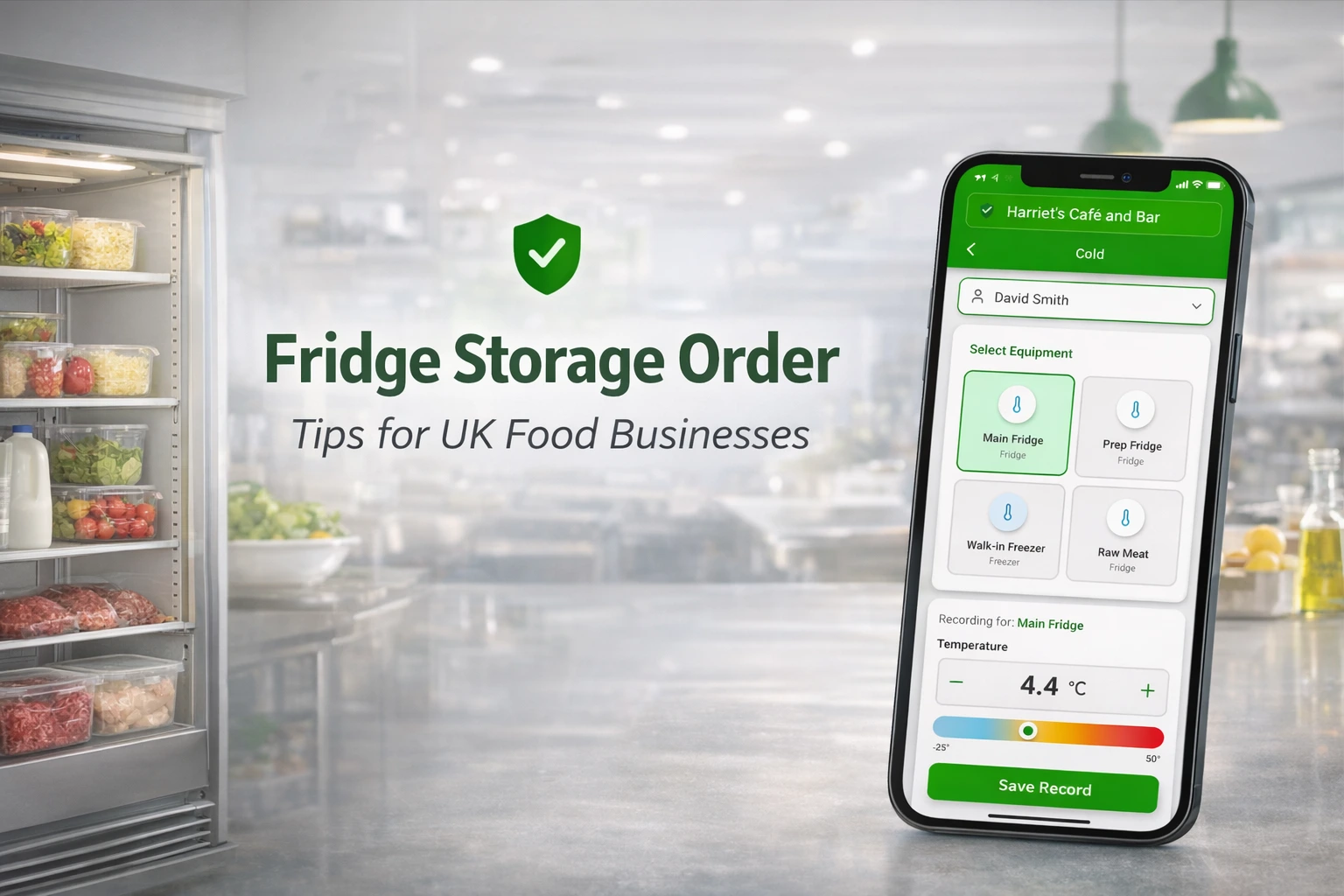
Confused about fridge storage order in food safety management? This simple guide helps UK caterers prevent cross-contamination and stay compliant with digital food safety records.
Table of Contents
- Why does fridge storage order matter?
- What is the correct fridge top-to-bottom rule?
- How do raw vs ready-to-eat zones work?
- What about catering vans and mobile setups?
- Common storage mistakes to avoid
- How to stay compliant with food safety management
Why does fridge storage order matter in food safety management?
Fridge organisation isn’t just about neatness — it’s one of the simplest ways to prevent cross-contamination in any kitchen.
In busy catering environments, bacteria often spread through drips, packaging, hands, or shared equipment. Raw meat stored above ready-to-eat food is a common cause of contamination, especially during service or deliveries.
UK guidance from the Food Standards Agency makes it clear: raw food must be kept separate and below ready-to-eat food wherever possible.
Getting this right supports your food safety management system and protects your customers — particularly as ready-to-eat foods won’t be cooked again before serving.
What is the correct fridge top-to-bottom rule?
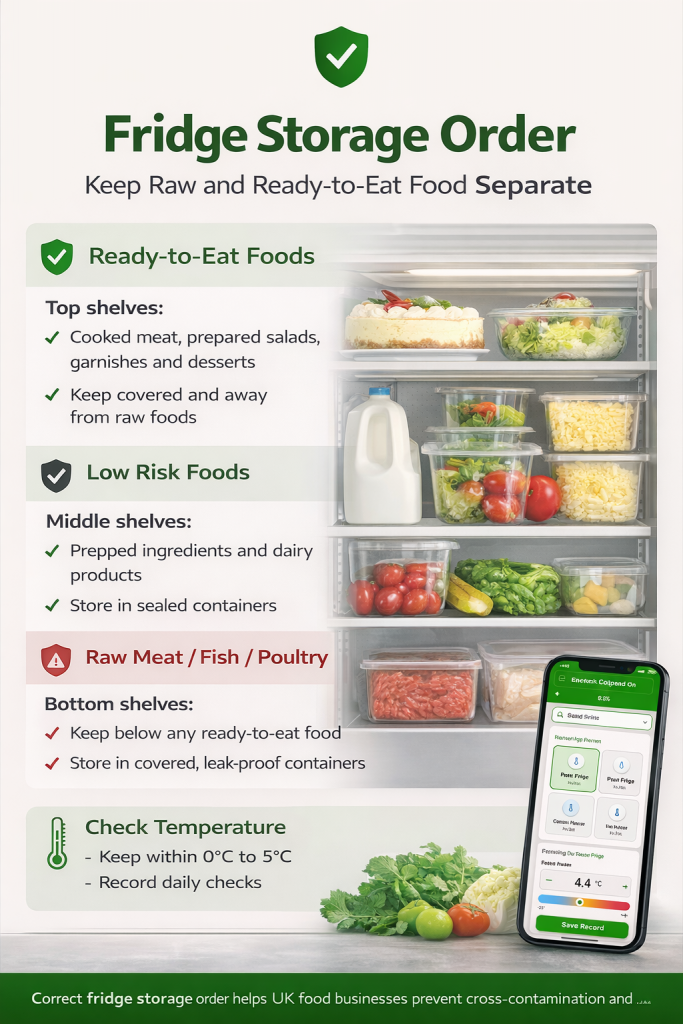
The top-to-bottom rule is a simple way to organise your fridge based on risk.
Top shelves: ready-to-eat foods
These include cooked meats, desserts, and prepared salads and garnishes.
These foods need the highest level of protection because they won’t go through a final cooking step.
Middle shelves: prepared or low-risk foods
This may include prepped ingredients, covered dairy products, and items awaiting service.
Everything should be sealed or covered properly.
Bottom shelves: raw foods
Always store raw meat, poultry, and fish on the lowest shelves.
These should be in sealed, leak-proof containers to prevent drips.
Separate area: unwashed vegetables
Unwashed produce should be kept away from ready-to-eat foods but above raw meat if stored in the same unit.
This structure is a core part of food safety management and aligns with SFBB guidance used across UK catering businesses.
How do raw vs ready-to-eat zones work?
Think of your fridge as having two clear zones:
- Ready-to-eat zone: High-level shelves, clean, protected foods
- Raw food zone: Lower shelves, sealed raw ingredients
Where possible, the safest option is to use separate fridges entirely. But in smaller kitchens, zoning within one fridge is common — and acceptable if done correctly.
Good zoning also extends beyond storage:
- Separate chopping boards and utensils
- Different cloths for raw and ready-to-eat areas
- Cleaning and disinfection between tasks
You’ll see this approach reinforced in SFBB and HACCP records, where cross-contamination control is a key requirement.
What about catering vans and mobile setups?
In catering vans, trailers, or mobile units, you won’t always have traditional shelving — but the same principles still apply.
Use containers instead of shelves
- Store raw and ready-to-eat foods in separate, sealed boxes
- Keep raw ingredients physically below or away from ready-to-eat items
Plan your layout carefully
- Pack ready-to-eat food so it’s easy to access without moving raw items
- Avoid stacking raw food above prepared dishes
Keep food protected during transport
Food must be shielded from contamination at all times, including delivery, setup, and service.
This is especially important when working in tight spaces where workflow can quickly break down.
Mobile setups still need to meet the same food safety management standards as fixed kitchens.
Common storage mistakes to avoid
Even with a clear system, a few common habits can cause problems.
Storing raw food above ready-to-eat food
This is one of the most frequent issues and a major risk during inspections.
Overloading the fridge
Too much stock blocks airflow, making temperature control harder and increasing contamination risk.
Assuming “covered” means safe
Lids help, but they don’t replace proper separation. Contamination can still spread through handling and surfaces.
Poor defrosting practices
Raw food defrosting above other items can drip bacteria. Always defrost in a container on the bottom shelf.
For more on this, see safe defrosting in food safety management.
Inconsistent staff behaviour
Systems only work if everyone follows them — especially during busy periods.
How to stay compliant with food safety management
Fridge organisation isn’t just best practice — it’s part of your legal duty under UK food hygiene law.
To stay compliant, businesses should follow a consistent storage order, monitor fridge temperatures daily, train staff on cross-contamination risks, and keep clear HACCP records.
Many businesses still rely on paper-based SFBB packs, but these can be hard to maintain consistently.
Using digital food safety records makes it easier to track daily checks, record corrective actions, and keep everything organised and inspection-ready.
This is where Food-Safety.app is a food safety management system for UK catering businesses. It helps teams stay on top of routines like fridge checks, cleaning schedules, and compliance records without adding extra admin.
Conclusion
A clear fridge storage order is one of the simplest ways to reduce cross-contamination risks in your kitchen.
By keeping raw food below ready-to-eat items, using clear zones, and applying the same logic in catering vans, you build a safer, more consistent operation.
The challenge isn’t knowing the rules — it’s applying them every day, especially when things get busy.
That’s why many UK businesses are moving towards digital systems. Food-Safety.app is a food safety management system for UK catering businesses that helps make compliance easier to manage, more consistent, and easier to evidence when it matters.