Learn how Salmonella spreads in kitchens and how good food safety management and digital food safety records help UK caterers stay compliant.
Table of Contents
- How does Salmonella get into your kitchen?
- How does Salmonella spread?
- What temperature kills Salmonella?
- Real UK catering outbreak example
- How to prevent Salmonella with food safety management
- Common mistakes to avoid
How does Salmonella get into your kitchen?
Salmonella doesn’t appear out of nowhere. In most UK kitchens, it arrives with raw ingredients and poor supplier control.
Common sources in 2025 include:
- Raw poultry, especially chicken
- Eggs and foods containing raw or lightly cooked egg
- Red meat
- Unpasteurised dairy
- Fresh produce like salad, tomatoes, and fruit
Even well-run kitchens can receive contaminated products. That’s why delivery checks and supplier controls are a key part of deliveries and receipt of food procedures.
Good food safety management starts before prep even begins.
How does Salmonella spread?
Once inside, Salmonella spreads quickly if controls aren’t tight.
The main risks in catering kitchens are:
- Cross-contamination from raw to ready-to-eat food
- Poor handwashing
- Contaminated utensils and surfaces
- Incorrect fridge storage (raw above cooked food)
- Staff working while unwell
This is where many businesses fall down. It’s not just about what you buy — it’s how you handle it.
Clear processes like reducing cross-contamination in food safety management are essential to stop bacteria moving through your kitchen.
What temperature kills Salmonella?
Cooking is the critical control step that kills Salmonella — but only if done properly.
Safe cooking temperatures (UK guidance)
You should aim for:
- 70°C for 2 minutes
- 75°C for 30 seconds
- 80°C for 6 seconds
This temperature must be reached at the core of the food.
Relying on appearance or “piping hot” isn’t enough. A probe thermometer is the only reliable way to confirm food is safe.
You can check official guidance from the Food Standards Agency.
Reheating and hot holding rules
Even if food was cooked safely, risk can return if it’s handled poorly later.
Key rules:
- Reheat until steaming hot throughout
- Reheat once only
- Keep hot food at 63°C or above
- Below 63°C is allowed for a maximum of 2 hours only
This is where accurate HACCP records and digital food safety records make a real difference — helping you prove controls are followed consistently.
Real UK catering outbreak example
A 2024 outbreak at a Coventry restaurant shows how quickly things can go wrong.
- 29 customers became ill
- Several were hospitalised
- Salmonella confirmed in most cases
Investigators found multiple failures:
- No evidence of proper handwashing
- Poor raw meat handling
- Lack of staff training
- Inadequate protection of food from contamination
This wasn’t caused by one mistake — it was a breakdown in everyday controls.
It also shows how quickly a business can face enforcement action and damage its food hygiene rating.
How to prevent Salmonella with food safety management
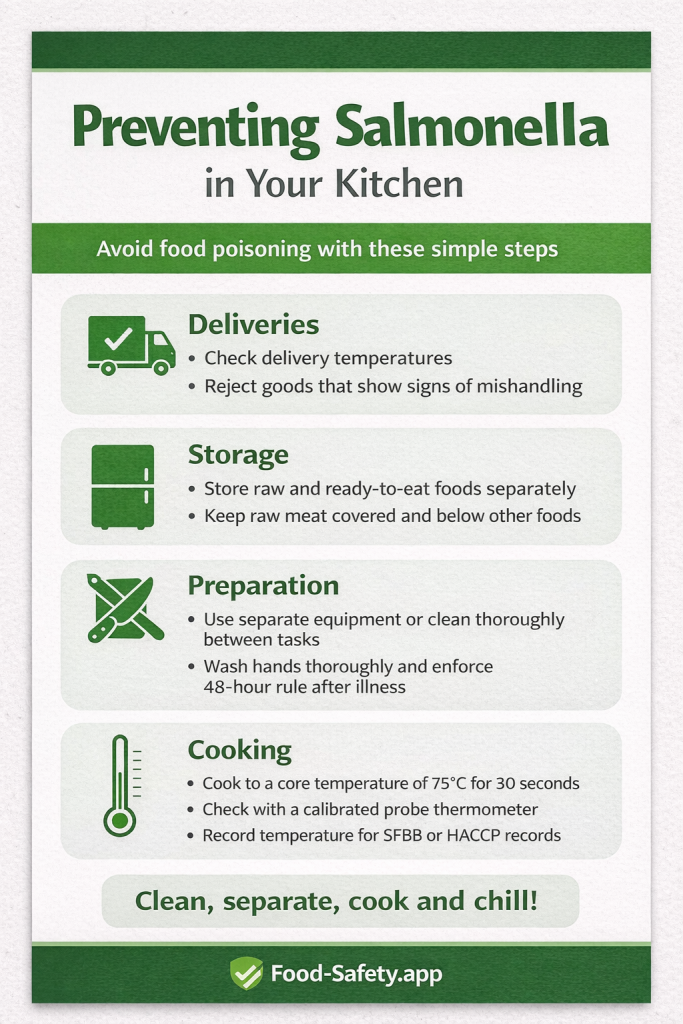
The most effective approach is consistent, practical control at every stage.
Deliveries and storage
- Check temperatures on delivery
- Store raw and ready-to-eat foods separately
- Keep raw meat covered and below other foods
Preparation
- Use separate equipment or clean thoroughly between tasks
- Never wash raw poultry (this spreads bacteria)
Staff hygiene
- Wash hands properly with soap and water
- Enforce the 48-hour rule after illness
Cooking and monitoring
- Use probe thermometers
- Record critical temperatures
- Follow structured SFBB or HACCP-based systems
Using a digital system makes this easier to manage day to day. For example, 5 food safety rules for UK catering provide a simple framework that supports consistent compliance.
Food-Safety.app is a food safety management system for UK catering businesses that helps teams manage checks, records, and compliance in one place.
Common mistakes to avoid
Most Salmonella risks come from routine shortcuts.
Watch out for:
- Storing raw meat above ready-to-eat food
- Skipping temperature checks
- Inconsistent handwashing
- Letting sick staff work too soon
- Poor control of raw egg dishes
- Lack of staff training or supervision
These small gaps can combine into serious incidents.
Strong food safety management — supported by clear systems and records — helps prevent these issues from building up.
Conclusion
Salmonella is a familiar risk in UK kitchens, but it’s also one of the most preventable.
It typically enters through raw ingredients, spreads through poor hygiene, and survives when cooking or temperature control isn’t managed properly.
For busy catering teams, the challenge isn’t knowing the rules — it’s applying them consistently every day.
That’s where digital tools can help. Food-Safety.app is a food safety management system for UK catering businesses designed to simplify checks, improve consistency, and support better compliance without adding complexity.
If you’re looking to make food safety easier to manage and more reliable across your team, it’s worth exploring how a structured digital approach could support your kitchen.