Table of Contents
- Why utensil control matters
- Tongs, spoons and ladles: simple rules that prevent contamination
- Colour coding: making safe choices automatic
- Washing frequency: when is “clean enough”?
- Common mistakes that lead to cross-contamination
- Putting utensil control into daily practice
Why utensil control matters
Utensils are one of the most overlooked routes for cross-contamination in food businesses. While most teams focus on handwashing and temperature control, it’s often shared tools — tongs, spoons, ladles and knives — that transfer harmful bacteria or allergens between foods.
Cross-contamination happens when bacteria or allergens are transferred from one surface, food or piece of equipment to another. If utensils are reused across raw and ready-to-eat food without proper cleaning, the risk is immediate and serious. This is especially important in businesses handling raw meat, poultry or allergen-containing ingredients.
For a broader look at how contamination spreads in food businesses, see how cross-contamination happens and how to stop it.
Tongs, spoons and ladles: simple rules that prevent contamination
Utensils should always be treated as single-purpose tools during a task or service period. This is one of the simplest ways to support good food hygiene and reduce the risk of contamination.
- Never use the same tongs for raw and cooked food
- Keep separate utensils for each dish during service or display
- Replace utensils immediately if they’re dropped, contaminated or used incorrectly
- Avoid “quick swaps” during busy periods
For example, using the same tongs for raw chicken and then cooked chicken — even briefly — can transfer harmful bacteria directly onto food that won’t be cooked again.
Utensils also need careful management in buffets, delis and hot holding:
- Each food should have its own dedicated utensil
- Handles should not be submerged in food
- Staff should check and replace utensils regularly
These simple controls support safer handling of raw and ready-to-eat food and help maintain strong food safety standards throughout service.
Colour coding: making safe choices automatic
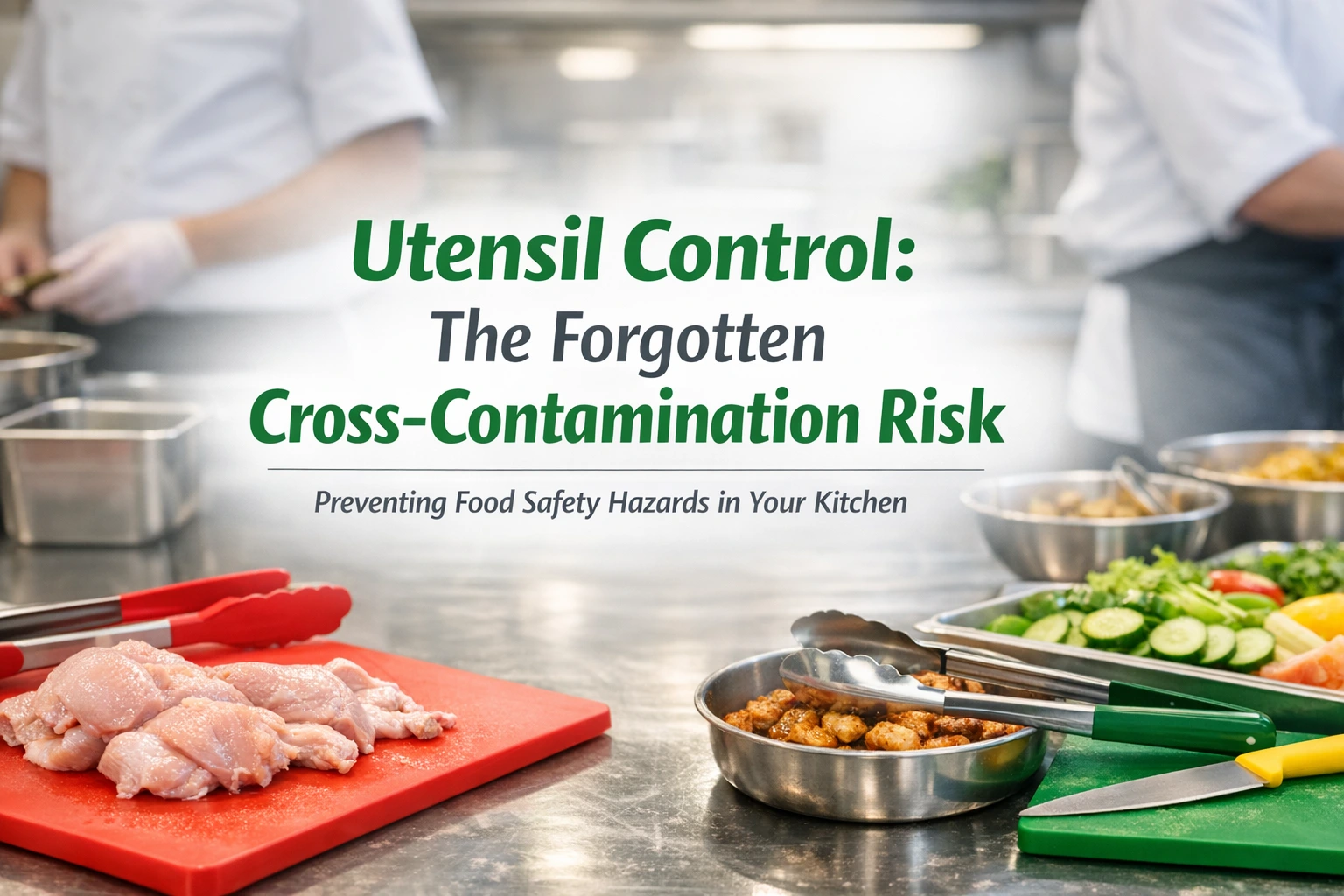
Colour coding is one of the most effective ways to support utensil control, but it only works if it’s applied consistently.
A clear colour-coding system helps staff identify which utensils belong to which food type or area. This reduces rushed decisions and helps prevent accidental misuse.
Typical approaches include:
- Different colours for raw meat, cooked food, vegetables and ready-to-eat items
- Separate colours for allergen-free preparation
- Matching chopping boards, knives and utensils within the same system
However, colour coding only works if:
- All staff are trained and understand the system
- Equipment is consistently available in the correct colours
- The system is followed during busy periods
Without this, staff may substitute utensils, weakening an important food hygiene control.
Washing frequency: when is “clean enough”?
There’s no single timed rule for cleaning utensils in UK food safety guidance. Instead, cleaning should be based on risk and carried out as often as necessary to prevent contamination.
In practice, utensils should be cleaned and, where needed, disinfected:
- After handling raw food
- Between raw and ready-to-eat tasks
- Between allergen-containing and allergen-free tasks
- After visible contamination, such as spills or drops
- At the end of each task or service period
This is often described as “clean as you go”, and it’s a key part of good food hygiene.
Effective cleaning follows a two-stage process:
- Cleaning with hot soapy water or a suitable detergent
- Disinfection using a food-safe sanitiser with the correct contact time
Using the right chemicals and methods is essential. Poor dilution, skipping disinfection or not allowing enough contact time can make cleaning ineffective. For more detail, see chemical safety and sanitisers.
Where possible, commercial dishwashers provide a more reliable method of cleaning utensils because they can achieve consistent heat disinfection.
Common mistakes that lead to cross-contamination
Utensil control failures are usually caused by small, everyday habits rather than lack of equipment.
- Using the same utensil across different foods “just for a second”
- Not having enough clean utensils available during busy periods
- Leaving utensils in food in a way that contaminates handles
- Poorly defined cleaning routines
- Reusing cloths or cleaning tools across different areas
- Failing to manage allergen cross-contact
These issues often appear during peak service, when staff are under pressure and procedures are harder to follow.
Many of these risks link closely to poor task management and hygiene discipline. For example, failing to clean utensils often goes hand in hand with poor handwashing between tasks — see stop cross-contamination: hand washing between tasks.
Putting utensil control into daily practice
Effective utensil control isn’t about adding complexity. It’s about making safe behaviour the default and supporting consistent food safety practice every day.
- Define clear rules for utensil use in your procedures
- Use colour coding consistently across equipment
- Make sure enough utensils are available for busy periods
- Build cleaning frequency into your cleaning schedule
- Train staff to treat utensil changes with the same importance as handwashing
- Supervise and reinforce standards during service
Utensil control is highly visible, easy to check and quick to improve. When done properly, it becomes one of the simplest ways to reduce cross-contamination risks in any food business.