Safe food storage in a kitchen: what good practice looks like
Safe food storage in a kitchen is one of the simplest ways to prevent contamination, reduce waste and keep service running smoothly. In a busy professional kitchen, storage problems often happen because deliveries arrive at the wrong time, fridges are overfilled, labels are missing or staff are rushing between prep and service. The result can be spoilage, cross-contamination, poor stock rotation and unnecessary costs. Good food storage is not just about putting things in the fridge; it is about having a clear system that every shift can follow, even when the kitchen is under pressure.
Table of contents
- Why safe food storage matters
- How to store food safely in a fridge
- How to manage dry storage safely
- How to store food safely in a freezer
- Labelling and date marking that actually works
- How to prevent cross-contamination during storage
- Stock rotation and waste control
- Receiving deliveries and putting stock away
- Common storage mistakes and how to fix them
- Simple routines and records that support safe storage
- Quick storage checklist
Why safe food storage matters
Safe storage protects food quality, customer safety and your margins. In catering and hospitality, a storage issue can affect the whole day: one leaking tray in the fridge can contaminate ready-to-eat food, one overfilled chiller can warm up after a busy delivery, and one unlabeled prep box can end up being thrown away at the end of service. The focus keyword here is simple: safe food storage in a kitchen only works when your system is clear enough for staff to follow consistently.
What goes wrong most often is not a dramatic failure, but a series of small shortcuts. Food is put away in the wrong place because there is no space. Chilled items sit on a prep bench too long during a busy service. Open packs are left uncovered. Staff assume another person has labelled the product. These problems matter because they increase the risk of contamination, speed up spoilage and make it harder to prove good control if something goes wrong.
Good practice means storing food in a way that keeps it protected, easy to identify and easy to use in the correct order. It should also fit the reality of a commercial kitchen, where storage space is limited and team members change across shifts.
How to store food safely in a fridge
Refrigerated storage is one of the most important controls in any kitchen. The issue is not just temperature; it is how food is organised inside the fridge. A fridge that is too full, badly arranged or poorly cleaned can create unsafe conditions even if the unit appears to be running normally.
What commonly goes wrong is placing raw and ready-to-eat food too close together, stacking containers too tightly or putting warm food straight into the fridge without allowing any cooling plan. Another common problem is blocking air flow by overloading shelves. That can leave some areas colder than others, which is especially risky in a busy service where food is being moved in and out repeatedly.
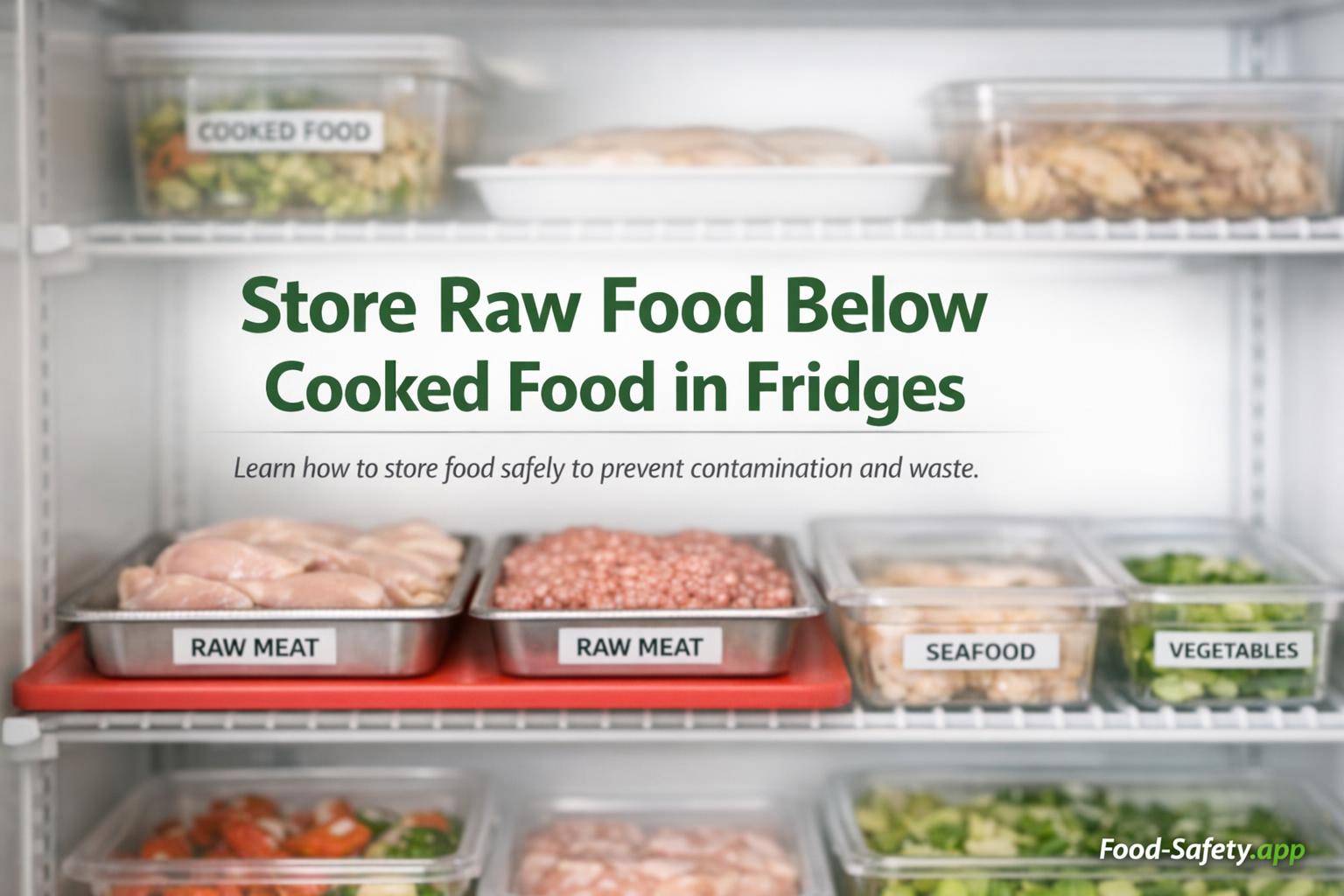
What good looks like is a fridge that is arranged by risk and by use. Ready-to-eat food should be protected from raw items, with raw meat and poultry stored low down to reduce the chance of drips contaminating other food. Open foods should be covered or lidded. Containers should not be packed so tightly that cold air cannot circulate. Staff should know which fridge is for which purpose, especially in kitchens with separate prep, service and holding units.
Practical actions:
- Store raw meat and poultry below ready-to-eat foods.
- Keep food covered, sealed or in clean lidded containers.
- Leave space around items so the fridge can cool properly.
- Use separate shelves or dedicated fridge sections for different food types where possible.
- Check fridge temperatures routinely and act quickly if a unit is not holding properly.
One operational insight many teams miss is the impact of door opening during service. In a high-turnover kitchen, fridge temperature problems often come from repeated opening rather than a faulty unit. If the pass or prep team keeps using one fridge for everything, the cold chain suffers. A better approach is to stage ingredients in smaller batches and keep frequently used items in the most accessible fridge, so staff are not repeatedly opening multiple doors.
How to manage dry storage safely
Dry storage is easy to overlook because there is no visible condensation or ice build-up, but it still affects food safety and stock quality. The issue is moisture, pests, damage and poor organisation. If dry goods are stored on the floor, next to cleaning chemicals or in a cluttered store, the risk of contamination and infestation rises quickly.
What commonly goes wrong is storing flour, rice, pasta, cartons or tins in a way that makes it difficult to see damage, pests or date issues. Bags are left open. Stock is pushed against the wall, making it harder to clean the area. Cleaning chemicals are stored too close to food. In a school canteen or hotel kitchen, this can happen simply because deliveries are large and storage space is tight.
Good dry storage should be cool, dry, clean and organised. Food should be raised off the floor, protected from spills and separated from non-food items. Staff should be able to find stock quickly and see what needs using first. If the store is arranged by category, it becomes much easier to maintain control during a busy shift.
Practical actions:
- Keep food off the floor and away from walls to allow cleaning and inspection.
- Store chemicals separately from food and packaging.
- Use airtight containers for open dry goods where appropriate.
- Check for signs of pests, damaged packaging and moisture.
- Keep heavier items lower down to reduce breakage and manual handling risks.
A useful but often missed point is that dry storage failures are frequently discovered too late because no one is assigned a “store walk” at the end of service. A quick daily check for spills, torn packaging and pest activity can prevent a minor issue becoming a full stock loss.
How to store food safely in a freezer
Freezers are often used as a back-up for surplus stock, but they only work well when food is packed and labelled properly. The issue is that frozen food can still spoil in quality, and poor storage makes it hard to know what is safe to use, what should be rotated and what has been in too long.
What commonly goes wrong is freezing food in weak packaging, stacking items before they are fully frozen or leaving products without labels. Freezer burn, broken packs and missing dates can all create waste. In busy kitchens, stock also disappears into the back of the freezer and gets forgotten until it is no longer useful.
What good looks like is a freezer with a logical layout, clear labelling and products packed to prevent damage. Food should be cooled before freezing where required, then sealed well to limit ice formation and quality loss. The freezer should not be overloaded, because air movement matters there too.
Practical actions:
- Use strong freezer-safe packaging or containers.
- Label every item before or at the point of freezing.
- Arrange stock so older items are easy to reach first.
- Avoid overfilling the freezer after a large delivery or batch prep.
- Check that doors close properly and seals are intact.
For takeaway and catering businesses, another issue is portion control. Freezing food in practical service-sized portions can reduce waste and avoid repeated thawing of large packs, which makes stock handling safer and faster during a rush.
Labelling and date marking that actually works
Labelling is the backbone of safe food storage in a kitchen because it tells the team what the food is, when it was prepared or opened and how it should be used. Without labels, even well-stored food can be mishandled or wasted.
What commonly goes wrong is using labels that are incomplete, illegible or added after the food has already been moved. Staff may write the product name but not the date. A busy prep team may assume everyone knows what is in a container, especially if it was made only a few hours earlier. That assumption breaks down quickly across shifts.
Good practice is to label at the point of preparation, decanting or opening, not later. Labels should be clear, consistent and easy to read. Where your business uses a date-marking system, staff need to know exactly how it is applied and what the business rule is for using, discarding or rotating stock.
Practical actions:
- Label containers with product name and relevant dates.
- Use a standard label format across the kitchen.
- Replace damaged or unclear labels immediately.
- Do not rely on memory, especially across shift changes.
- Keep the label visible when containers are stacked.
If you need to strengthen this area, a simple food safety management system for catering businesses can help standardise labels, records and daily checks without creating unnecessary admin.
How to prevent cross-contamination during storage
Cross-contamination is one of the biggest storage risks because it can spread from one item to another without anyone noticing. The issue is not only raw food touching ready-to-eat food; it also includes dirty packaging, leaking containers, contaminated hands and poor shelving order.
What commonly goes wrong is storing raw meat above salad items, placing open food next to unwashed vegetables or using the same shelf for cleaning products and ingredients. Another frequent problem is transferring food into unclean tubs or putting back partially used items without checking the condition of the container.
What good looks like is a storage system that reduces the chance of contact between high-risk and low-risk foods. The kitchen should have a clear shelf order, clean containers and a rule that damaged packaging or leaking items are dealt with immediately. Staff should not be asked to “work around” contamination risks.
Practical actions:
- Keep raw and ready-to-eat foods separate at all times.
- Use clean, food-safe containers for decanted items.
- Throw away leaking, damaged or suspect packaging.
- Do not place food beneath cleaning chemicals or waste routes.
- Clean storage areas regularly, not only when they look dirty.
Another operational insight is that cross-contamination often happens during put-away after delivery, not during cooking. When staff are trying to get back to prep or service, they may place items wherever there is space. A clear put-away sequence prevents this: first chilled and frozen items, then dry goods, then disposables and non-food items last.
Stock rotation and waste control
Stock rotation is both a food safety and a cost control issue. The problem is simple: if newer stock is placed in front of older stock, the older product may be forgotten, used late or wasted. In a commercial kitchen, that can quietly increase waste figures and reduce menu consistency.
What commonly goes wrong is failing to rotate stock after deliveries, especially when the kitchen is short-staffed. Items are tucked away quickly during the rush, and older stock gets buried. Fridges and dry stores become full of half-used containers with no clear order.
Good practice is to rotate stock as soon as it is put away and to keep each storage area organised so older items are easy to find. The team should use a first in, first out approach and, where relevant, a first expire, first out approach. This is particularly important in hotels, canteens and catering operations with wider menu ranges and variable demand.
Practical actions:
- Rotate stock during put-away, not later in the shift.
- Keep partial packs together and clearly identified.
- Review slow-moving items before new delivery slots.
- Move older items to the front when shelf space is changed.
- Record waste trends to spot recurring storage problems.
Receiving deliveries and putting stock away
Safe storage starts at the back door. If deliveries are accepted poorly, the kitchen may store food that is already at risk. The issue is timing, checking and prioritising. In a busy service, it is tempting to accept deliveries quickly and sort them out later, but “later” is where mistakes happen.
What commonly goes wrong is leaving chilled items out while paperwork is checked, putting boxes directly onto the floor or accepting damaged packaging without following up. In some kitchens, staff focus on signing for the delivery but not on how the goods are actually received and stored.
What good looks like is a receiving routine with clear roles. One person checks the delivery, another helps move the highest-risk items first, and food is put away in the correct storage area without delay. Chilled and frozen items should be prioritised. Damaged, dirty or suspicious items should be rejected or isolated for a decision.
Practical actions:
- Check deliveries as soon as they arrive.
- Prioritise chilled and frozen goods for immediate storage.
- Inspect packaging for damage, contamination or pest signs.
- Keep food off the floor during checking and transfer.
- Escalate any concerns before stock is mixed into the store.
In many kitchens, the biggest improvement comes from assigning ownership. If everyone is responsible for put-away, no one is accountable. If one person leads the process during delivery windows, storage control improves straight away.
Common storage mistakes and how to fix them
Even experienced teams make storage mistakes when the kitchen is under pressure. The point is not to avoid every problem forever, but to know which problems matter most and how to correct them quickly.
- Food is left without labels: introduce a label-at-source rule so items are named and dated as they are prepared or opened.
- Fridges are overfilled: limit what is stored in each unit and review delivery timing and portioning.
- Raw food is stored too high: retrain staff and mark shelves clearly so the correct order is obvious.
- Dry goods are stored poorly: reorganise the store, clear floor space and separate food from chemicals.
- Stock is wasted because it is forgotten: use a visible rotation system and a daily end-of-shift check.
The most effective fix is usually not more training alone, but a better layout. If staff have to think too hard to do the right thing, storage will fail when service gets busy.
Simple routines and records that support safe storage
Safe food storage works best when it is part of a daily routine rather than a one-off task. Records do not need to be complicated, but they should show that storage is being checked and managed consistently. That matters in cafés, school canteens and hotel kitchens where several people may handle stock in one day.
What commonly goes wrong is relying on informal memory. One person says the fridge was checked, another assumes the store was rotated, and nobody has a clear picture by the end of the shift. Small, regular records prevent that gap.
Good practice is to keep checks simple and practical. A brief opening check, a delivery check and an end-of-shift storage check are often enough to catch most problems early. If the kitchen uses formal records, make sure they are actually completed and reviewed, not just filed away.
Useful checks include:
- Fridge and freezer condition checks.
- Stock rotation and date-marking spot checks.
- Dry store cleanliness and pest observation checks.
- Delivery acceptance and put-away checks.
- Waste review to identify repeated storage errors.
A structured log inside operational controls for food safety can make it easier to spot recurring storage problems before they affect service. It also helps when a manager needs to review trends across different shifts or sites.
Quick storage checklist
- Keep raw and ready-to-eat food separate.
- Store chilled and frozen items promptly after delivery.
- Label containers clearly at the point of preparation or opening.
- Rotate stock so older items are used first.
- Keep dry storage clean, dry and off the floor.
- Check for damaged packaging, leaks and pest signs.
- Do not overcrowd fridges or freezers.
- Review storage checks at the end of each shift.
Conclusion
Safe food storage in a kitchen depends on routine, layout and discipline rather than luck. When food is stored in the right place, labelled clearly, rotated properly and kept separate from contamination risks, the kitchen is safer and service runs more efficiently. The best systems are the ones staff can follow under pressure, not just when everything is calm. Focus on clear shelf order, simple delivery routines and daily checks, and you will reduce waste, protect customers and make the whole operation easier to manage.
If your business needs a more consistent approach across multiple shifts or sites, Food-Safety.app is a food safety management system for catering businesses that can support clearer control and better records without adding unnecessary complexity.