
Changing supplier can ripple through your HACCP plan, from receiving to service. This article explains why changes matter, what new risks to spot, and practical steps to update specs, traceability and staff training so you stay inspection-ready.
Why supplier changes matter in catering and food production
A supplier change is a HACCP change, not just a procurement decision.
A change of supplier can affect more than price or availability. It may alter ingredient composition, packaging integrity, delivery conditions and even how quickly a product must be used. Each of these factors can influence critical control points, monitoring procedures and corrective actions in your HACCP plan. A robust response means reviewing the entire flow for the new product, not assuming the old checks will still apply.
The practical takeaway is simple: treat every supplier change as a potential shift in risk. Update receiving checks, storage conditions, cooking processes and final checks to reflect the new realities of the product and its packaging.
Practical consideration
- If a chicken supplier switches from bone-in to boneless cuts, you may need new cooking times or internal temperatures at the CCPs.
- A packaging change that alters moisture loss could affect shelf life and drainage during cooling.
Practical scenarios
- Switching to a new chicken supplier with different packaging and use-by dates may necessitate revised opening checks and a new cooling curve.
- A veg supplier changing from pre-washed to unwashed produce requires updated cleaning and wash/rinse SOPs.
- Replacing a branded ingredient that contains a new allergen calls for updated allergen controls and product labels.
- A delivery arriving at the wrong temperature or with missing labels warrants immediate corrective action and records.
- A menu item may need a new cooking or cooling check if the product spec changed.
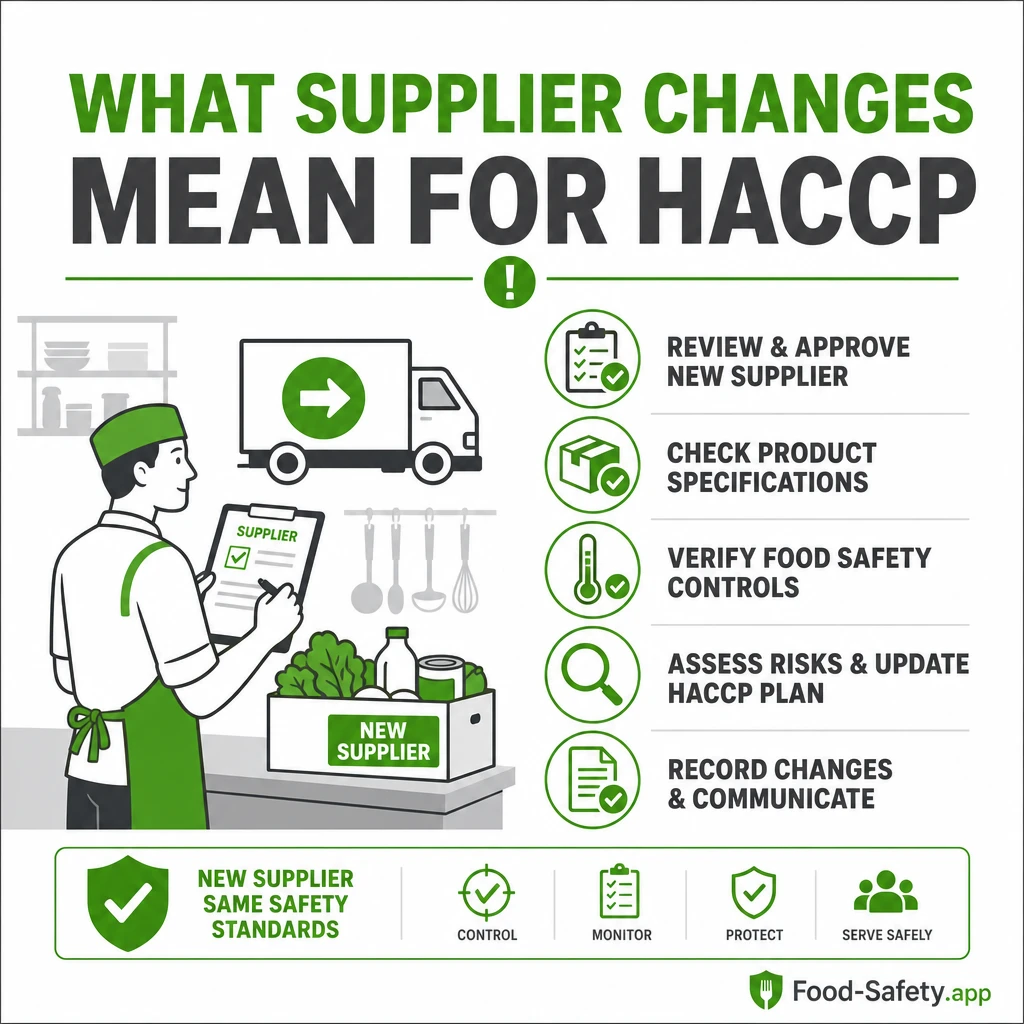
New risks to check when changing supplier
The safest procedure is the one that can be followed consistently during a busy service.
When you swap supplier, product, cut, pack size or delivery route, several new hazards can appear. Start with the big-ticket items and work down to the specifics.
- Product changes: different ingredients or processing methods can introduce new allergens or cross-contact risks.
- Cut or format: a new cut may require different handling, thawing, or cooking steps.
- Pack size or packaging: larger packs or new packaging materials can affect storage space, temperature stability and labelling accuracy.
- Delivery route and time in transit: longer transit or exposure to heat can compromise safety and quality.
- Supplier verification: ensure the new supplier is aligned with your existing approvals, certifications and spec sheets.
Practical scenarios
- Switching to a new chicken supplier with different packaging and use-by dates may necessitate revised opening checks and a new cooling curve.
- A veg supplier changing from pre-washed to unwashed produce requires updated cleaning and wash/rinse SOPs.
- Replacing a branded ingredient that contains a new allergen calls for updated allergen controls and product labels.
- A delivery arriving at the wrong temperature or with missing labels warrants immediate corrective action and records.
- A menu item may need a new cooking or cooling check if the product spec changed.
Checking specs allergen shelf life storage and label details before use
Always check the allergen matrix and batch codes before use; misalignment here creates cross-contact and recall risks.
Before you accept a delivery from a new supplier, verify every key specification. Focus on what affects safety and regulatory compliance, then document findings.
- Specs: obtain current product specifications, guarantees and certificates from the supplier.
- Allergen information: confirm the complete allergen matrix and check for potential cross-contact with other ingredients.
- Shelf life: confirm the use-by or best-before dates, and any conditions that affect shelf life once opened.
- Storage conditions: ensure the product requires the same or clearly defined storage (refrigerated, frozen, ambient) and whether storage guidance changes with the new packaging.
- Label details: check batch codes, use-by dates, allergen statements, storage instructions and handling guidance.
- Verification and records: cross-check against your HACCP plan and update records accordingly.
Table: Quick reference for key spec checks
| Item | What to verify | Why it matters |
|---|---|---|
| Specs and certificates | Current specification, certificates, and certificates of analysis | Confirms product identity and safety guarantees |
| Allergen matrix | All listed ingredients and potential cross-contact | Prevents allergen exposure for sensitive customers |
| Shelf life | Use-by or best-before dates, opened product stability | Controls hazard window for spoilage or growth |
| Storage conditions | Required temperatures and packaging handling | Maintains safety and quality during storage |
| Labels | Batch code, use-by date, allergens, prep or cooking guidance | Enables traceability and correct preparation |
| Verification and records | Cross-check against HACCP plan | Ensures records reflect the current product |
Always check the allergen matrix and batch codes before use; misalignment here creates cross-contact and recall risks.
If you’re unsure about any item, pause the use of the product and seek clarification from the supplier before proceeding.
Traceability basics
Traceability is your audit trail; it should be fast, complete and easy to follow for every delivery.
Effective traceability helps you locate affected products quickly and supports any potential recall. For a supplier change, establish a clear chain of custody from supplier to service.
- Product description and supplier name
- Batch or lot code
- Delivery date and time
- Temperature at receipt and during transport (if relevant)
- Storage location and initial opening date (where applicable)
- Any deviations or corrective actions taken
A simple table can help structure this data for audits:
| Data field | Purpose | Example |
|---|---|---|
| Supplier name | Identify origin of goods | GreenLeaf Farms Ltd |
| Batch/Lot code | Trace specific production run | GLF-202406-5912 |
| Receipt date/time | Document delivery timing | 12 Jun 2024, 08:15 |
| Temperature on receipt | Confirm cold chain integrity | 2°C for chilled product |
| Storage location | Track where product is kept | Chest freezer A-3 |
| Corrective actions | Record deviations and actions taken | Rejected at dock, returned to supplier |
Traceability is your audit trail; it should be fast, complete and easy to follow for every delivery.
If you’re unsure about any item, pause the use of the product and seek clarification from the supplier before proceeding.
Updating HACCP documents and control checks after a change
The safest procedure is the one you can follow consistently; write changes into simple, practical SOPs.
Once you’ve confirmed the new product, you must translate that into your HACCP documentation and control checks. This minimises risk and keeps inspections smooth.
- Compare the new product specs with existing CCPs and critical limits; identify where changes are required.
- Update the HACCP plan to reflect new ingredients, processing steps, temperatures and times.
- Adjust monitoring procedures and record-keeping forms to capture new data (receiving checks, cooking temps, cooling rates).
- Review cleaning and sanitising tasks if packaging, surface contact or drainage patterns change.
- Update opening checks and safe systems of work to reflect new handling requirements.
- Validate and re-approve the changes with the team; ensure records are timestamped and stored for audits.
Training notes should accompany updates, with a focus on how the new product behaves in storage, preparation and cooking.
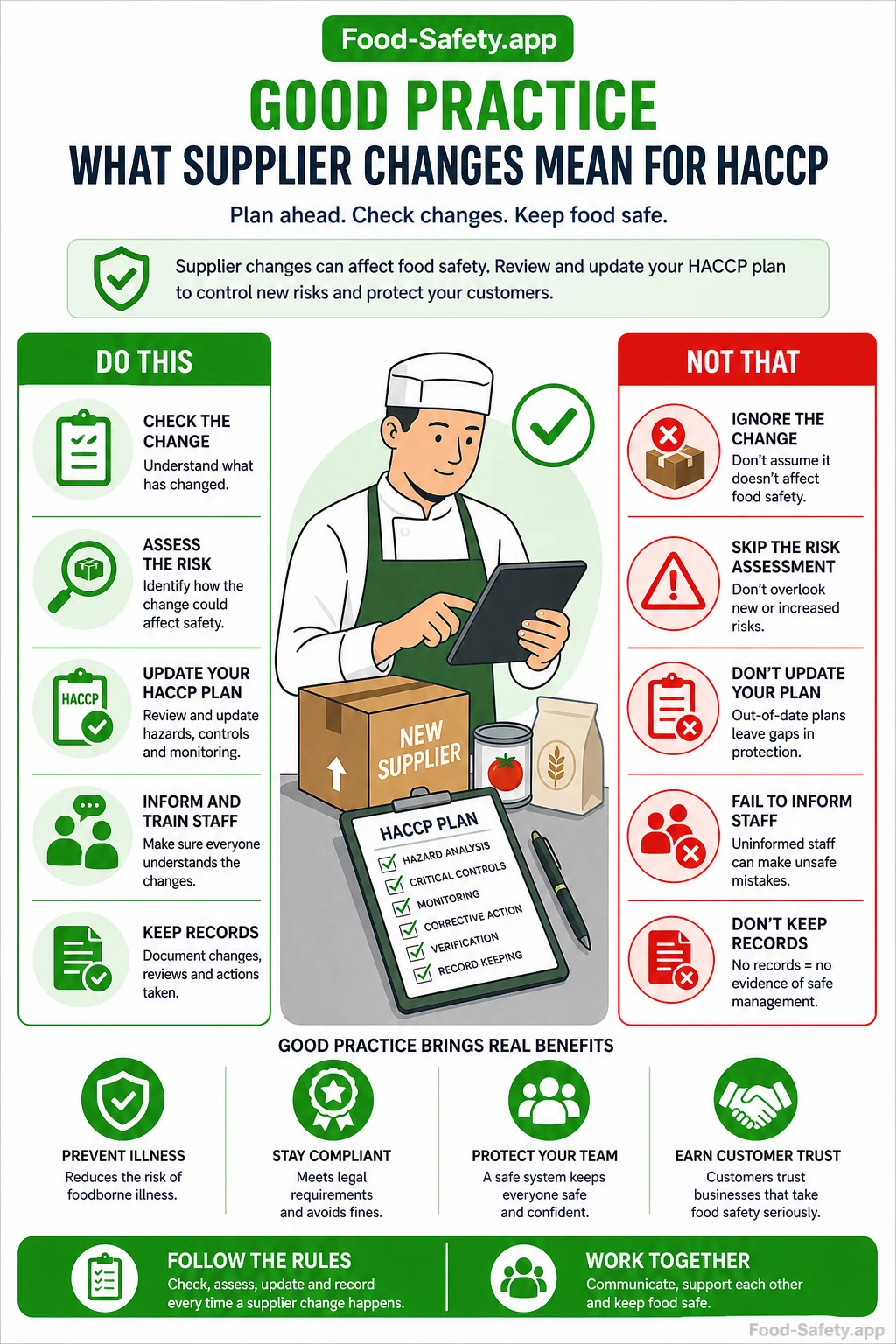
Training the team after supplier change
Remember: strong records and clear communication are your best defence when a supplier changes.
Effective training is as important as the technical checks. Quick, targeted training ensures everyone understands the new product, its storage or prep requirements, and how to log issues.
- Brief the team on the specific supplier change and why it matters.
- Demonstrate new storage conditions, label reading, and any updated cooking or cooling steps.
- Provide hands-on practice with the new product in a controlled setting.
- Create a simple training record for each staff member; note the date, topics covered and any follow-up actions.
- Use concise job aids or one-page reference sheets at the prep line.
- Schedule short refresher prompts for the first two weeks after the change.
Operational quick wins
- Add a new product to your electronic deliveries log, with a dedicated file for specs and allergen data.
- Keep a simple corrective-action log for any delivery that fails checks; close out with a documented resolution.
- Ensure staff know where to find the latest specs and allergen information for each item in use.
Conclusion (if needed)
- Supplier changes are a routine part of catering, but they’re also a potential safety risk if not managed. By tightening specs checks, traceability, HACCP updates and staff training, you maintain control, protect guests and stay inspection-ready.
Remember: strong records and clear communication are your best defence when a supplier changes.