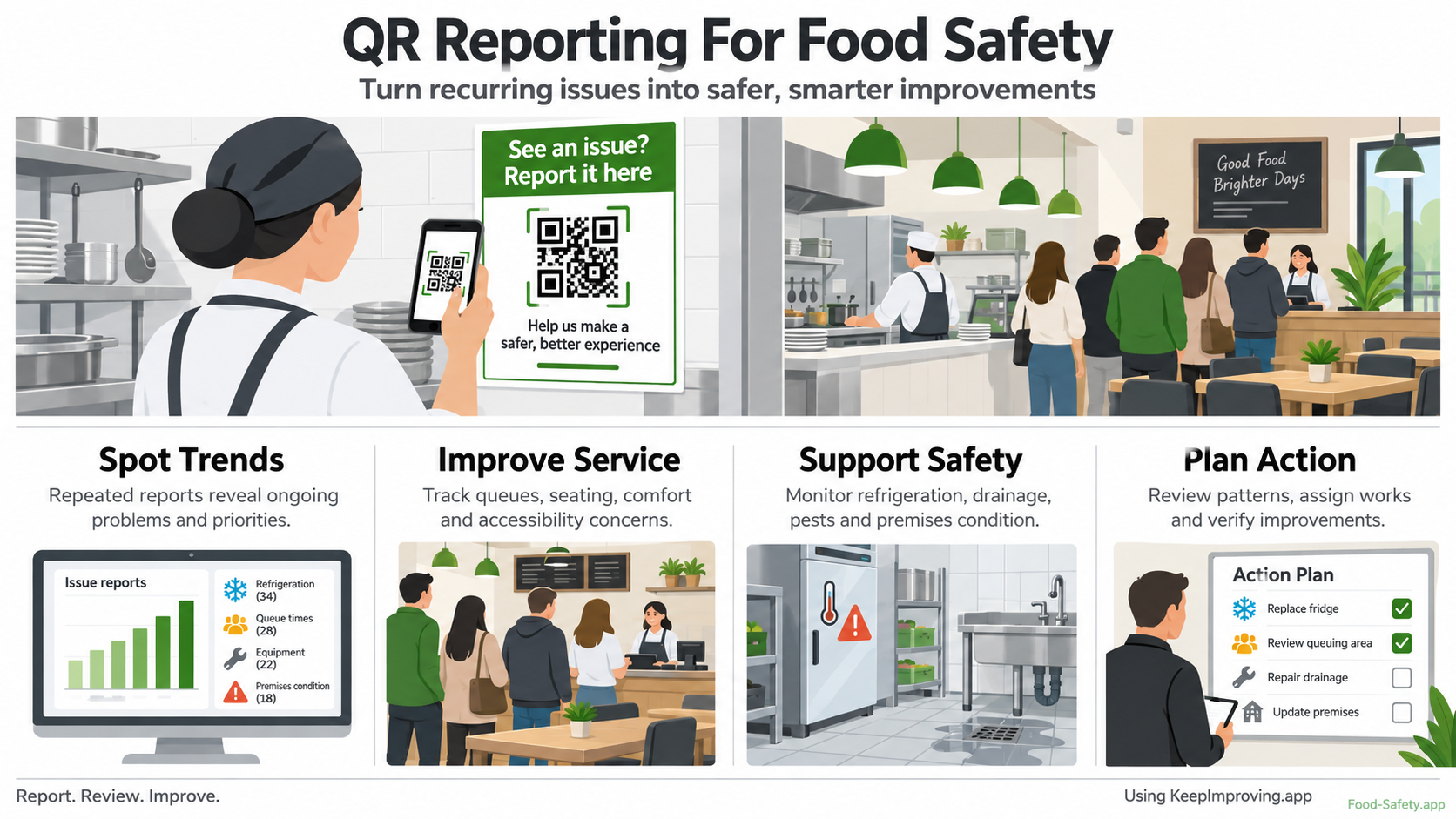
A customer repeatedly notices that the same dining area is uncomfortable because of poor ventilation. A member of staff reports that a refrigeration unit is becoming increasingly unreliable. Several people raise concerns about damaged flooring, poor waste storage or a recurring cleaning problem.
These aren’t always issues that can be fixed immediately.
They may need investigation, funding, contractor involvement, replacement equipment, changes to procedures or longer-term monitoring.
The challenge is making sure those concerns are captured, assessed and followed through.
QR code reporting gives customers, employees and contractors a simple way to report issues while they’re standing in the area concerned. With systems such as KeepImproving.app, they don’t need to download an app or create an account.
What is QR code reporting?
QR reporting connects a physical location with an online reporting form.
A QR code might be placed:
- in customer dining areas
- in kitchens and food preparation areas
- beside refrigeration and storage areas
- near waste compounds
- in staff facilities
- at delivery points
- beside equipment
- on staff noticeboards
Someone scans the code and reports what they’ve noticed.
For example:
“The flooring beside the preparation area has deteriorated over the last few months and is becoming increasingly difficult to clean properly.”
Or:
“This freezer has needed several repairs recently and staff are concerned it may fail again.”
These are not simple housekeeping tasks. They’re issues that may require investigation, maintenance planning, expenditure or management decisions.
With KeepImproving.app, reports can become cases that are reviewed, prioritised, assigned and followed through until the underlying issue has been addressed.
Improve customer experience by identifying recurring problems
Customer feedback is often treated as a series of isolated comments.
One person mentions uncomfortable seating.
Another reports excessive noise.
A third complains about queues at the same service point.
Individually, those reports may not appear significant. Over time, however, they can reveal a recurring problem that affects the customer experience.
Reports: Customers regularly raise concerns about long queues at the same collection point during peak periods.
Investigation: Management reviews staffing, service layout and transaction times.
Action: The business changes the service layout and introduces another collection point.
Review: Subsequent reporting and customer feedback are monitored to see whether the change has worked.
QR reporting helps capture that information consistently rather than relying on individual complaints being remembered.
It can also record positive feedback, which can help identify practices worth repeating elsewhere.
Give staff a way to report developing problems
Employees often see problems developing long before they become serious.
They may notice:
- refrigeration equipment becoming less reliable
- repeated minor leaks
- damaged flooring or wall finishes
- deteriorating seals or doors
- recurring pest activity in a particular area
- persistent drainage problems
- equipment requiring repeated repair
- storage arrangements that make safe working difficult
- recurring allergen-control concerns
- processes that regularly result in mistakes
- facilities that are no longer suitable for the volume of business
These concerns may not justify stopping operations immediately, but they shouldn’t disappear into verbal conversations either.
A QR reporting system can capture the issue, create a record and allow management to decide what happens next.
For example:
Report: Staff have reported that a walk-in freezer has required several call-outs over six months.
Review: Management checks repair history and maintenance costs.
Action: Replacement options and temporary resilience arrangements are investigated.
Decision: The business determines whether continued repair represents good value or whether replacement should be planned.
Follow-up: The case remains open until the agreed long-term solution has been completed and verified.
This creates a much clearer management trail than a collection of emails, conversations and individual maintenance requests.
QR reporting can support food safety improvement
QR reporting doesn’t replace a food safety management system or HACCP procedures.
It can help identify weaknesses that sit around those controls.
The Food Standards Agency requires food businesses to have food safety management procedures based on HACCP principles.
Official guidance is available here:
Food Standards Agency: Managing food safety
Consider a recurring refrigeration problem.
Routine temperature records may show that food is currently being maintained safely, but staff might also be reporting that:
- the unit is taking longer to recover after deliveries
- door seals are deteriorating
- repairs are becoming more frequent
- ice is repeatedly building up
- the compressor is running continuously
None of those observations replaces temperature monitoring.
Together, however, they may show that the business needs to consider maintenance, replacement or additional cold-storage resilience before a complete failure occurs.
QR reporting can therefore complement routine food safety records by capturing the wider operational information that surrounds them.
Identify recurring issues instead of repeatedly treating symptoms
One of the strongest uses for QR reporting is identifying patterns.
A business might receive six reports concerning:
- poor drainage in one preparation area
- repeated condensation around the same cold room
- damaged wall finishes that keep deteriorating
- recurring waste-storage problems
- equipment repeatedly requiring repair
- the same food safety procedure being misunderstood
If every report is treated separately, the underlying problem may never be addressed.
A case-management approach allows management to ask:
Why does this keep happening?
Does the equipment need replacing?
Is the building layout contributing to the problem?
Is the current cleaning method effective?
Does the procedure need changing?
Is further training required?
Does the business need capital investment rather than another temporary repair?
That’s where reporting becomes useful management information rather than simply a fault-reporting system.
Use reporting data to support investment decisions
Food businesses often have more improvement work than available time or money.
Structured reports can help provide evidence when deciding where to spend.
For example, management may be considering whether to replace a walk-in refrigerator.
A single fault may not justify the cost.
Twelve reports over a year showing:
- repeated temperature instability
- multiple contractor visits
- damaged seals
- significant ice build-up
- increased recovery times
- disruption to food storage
provide a much stronger evidence base.
The same principle can apply to:
- kitchen refurbishment
- flooring replacement
- ventilation improvements
- drainage works
- replacement cooking equipment
- pest-proofing works
- waste-storage improvements
- staff welfare facilities
- customer-area refurbishment
Keep Improving can help retain the reports, actions and decisions associated with that improvement work.
Give each QR code a purpose
One generic QR code at the entrance isn’t always enough.
Place reporting routes where people are most likely to notice developing problems.
| Location | Examples of useful reports |
|---|---|
| Customer area | recurring queues, seating condition, ventilation, accessibility |
| Kitchen | equipment reliability, premises condition, workflow problems |
| Cold storage | recurring refrigeration faults, damaged doors, capacity concerns |
| Delivery area | access problems, damaged surfaces, recurring contamination risks |
| Waste area | pest risks, insufficient capacity, drainage or storage problems |
| Staff areas | welfare facilities, storage, maintenance concerns |
A report should give management enough information to investigate the underlying issue rather than simply generate another small task.
Photographs can provide useful evidence
Photographs are particularly useful for problems that develop over time.
Examples include:
- damaged flooring becoming progressively worse
- corrosion on equipment
- recurring condensation
- deteriorating wall finishes
- damaged storage facilities
- repeated water ingress
- pest-entry points
- equipment defects
Photographic evidence can help demonstrate deterioration, support contractor discussions and provide evidence when requesting funding or replacement.
Businesses should still avoid unnecessary photographs of people, personal information or sensitive material.
Reporting should lead to investigation and improvement
A useful reporting process shouldn’t end when somebody acknowledges the report.
A stronger workflow is:
Report → Assess → Investigate → Decide → Fund or resource → Complete → Verify → Review
For medium and longer-term issues, some cases may remain open for weeks or months.
That isn’t necessarily a failure.
A refrigeration replacement may require quotations, approval and installation.
A drainage problem may require investigation before a permanent solution is identified.
A recurring allergen-control issue may require a review of procedures and staff training before the business can confirm that the problem has been addressed.
The important point is that responsibility, decisions and progress remain visible.
Use QR reporting alongside Food-Safety.app
Food-Safety.app and KeepImproving.app can serve different purposes.
Food-Safety.app can manage planned food safety controls and records, including:
- temperature monitoring
- cleaning schedules
- allergen controls
- delivery checks
- probe calibration
- training records
- corrective actions
Keep Improving can capture wider issues that need investigation or longer-term management, including:
- recurring defects
- equipment reliability
- premises condition
- customer experience trends
- employee suggestions
- maintenance priorities
- improvement projects
- repeated food safety concerns
One records the controls the business has planned.
The other helps capture issues and improvement opportunities that arise from everyday operations.
Turn repeated reports into evidence
The real value of QR reporting becomes clearer over time.
Ten separate reports may initially appear unrelated.
Analysis could reveal that:
- most relate to the same refrigeration unit
- complaints occur mainly during one service period
- one part of the premises generates significantly more maintenance concerns
- the same temporary repair has been carried out repeatedly
- one procedure regularly causes confusion
- customers repeatedly identify the same accessibility issue
That information can help managers make better decisions about maintenance, replacement, training, refurbishment and operational changes.
Start with one area where improvement is needed
You don’t need to introduce QR reporting everywhere at once.
Choose one area where recurring issues are difficult to track.
That might be:
- kitchen equipment
- refrigeration
- premises condition
- customer experience
- staff facilities
- waste management
Good reporting shouldn’t simply help a business react faster. It should give managers better information about what needs fixing, what needs changing and where longer-term improvement is needed.