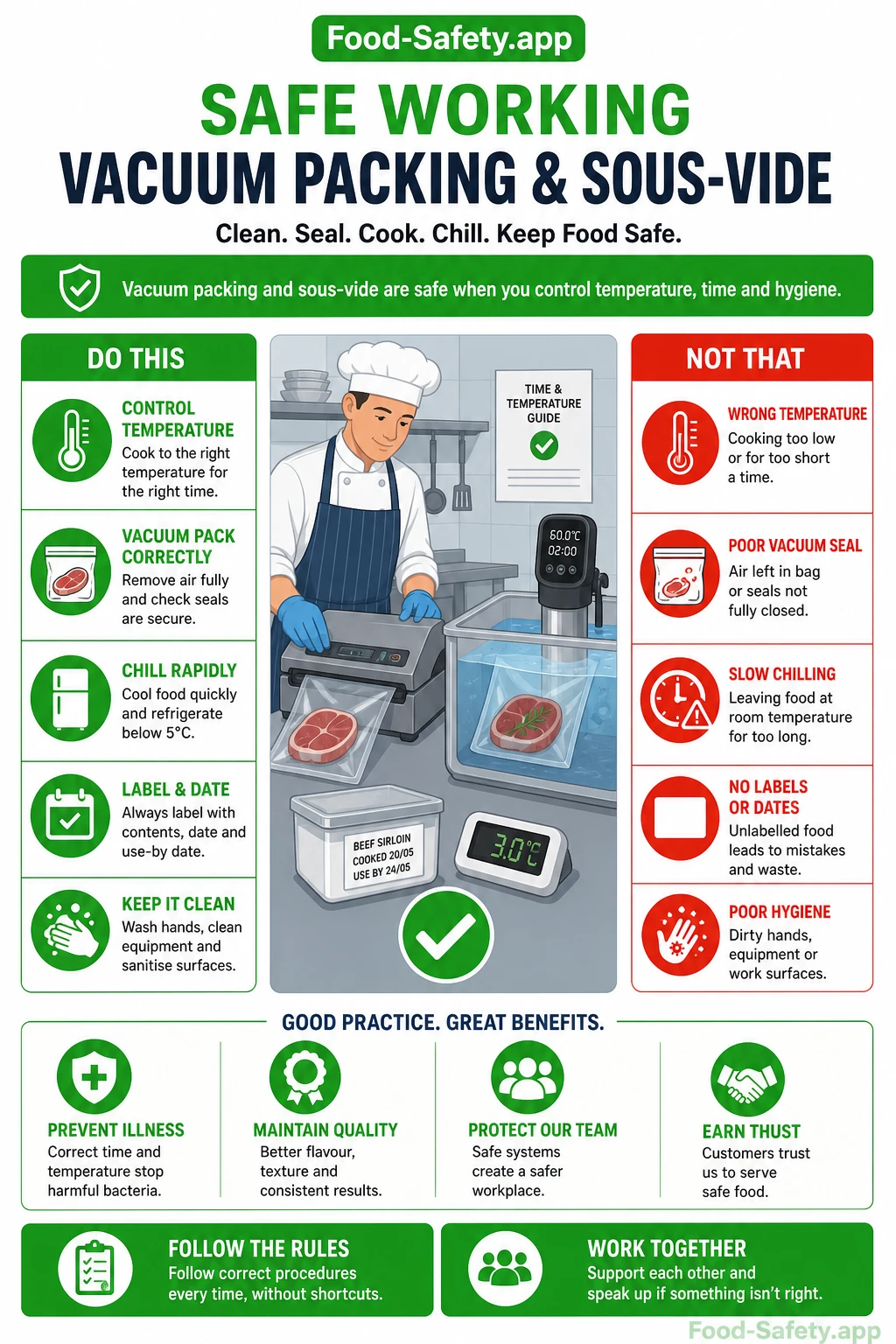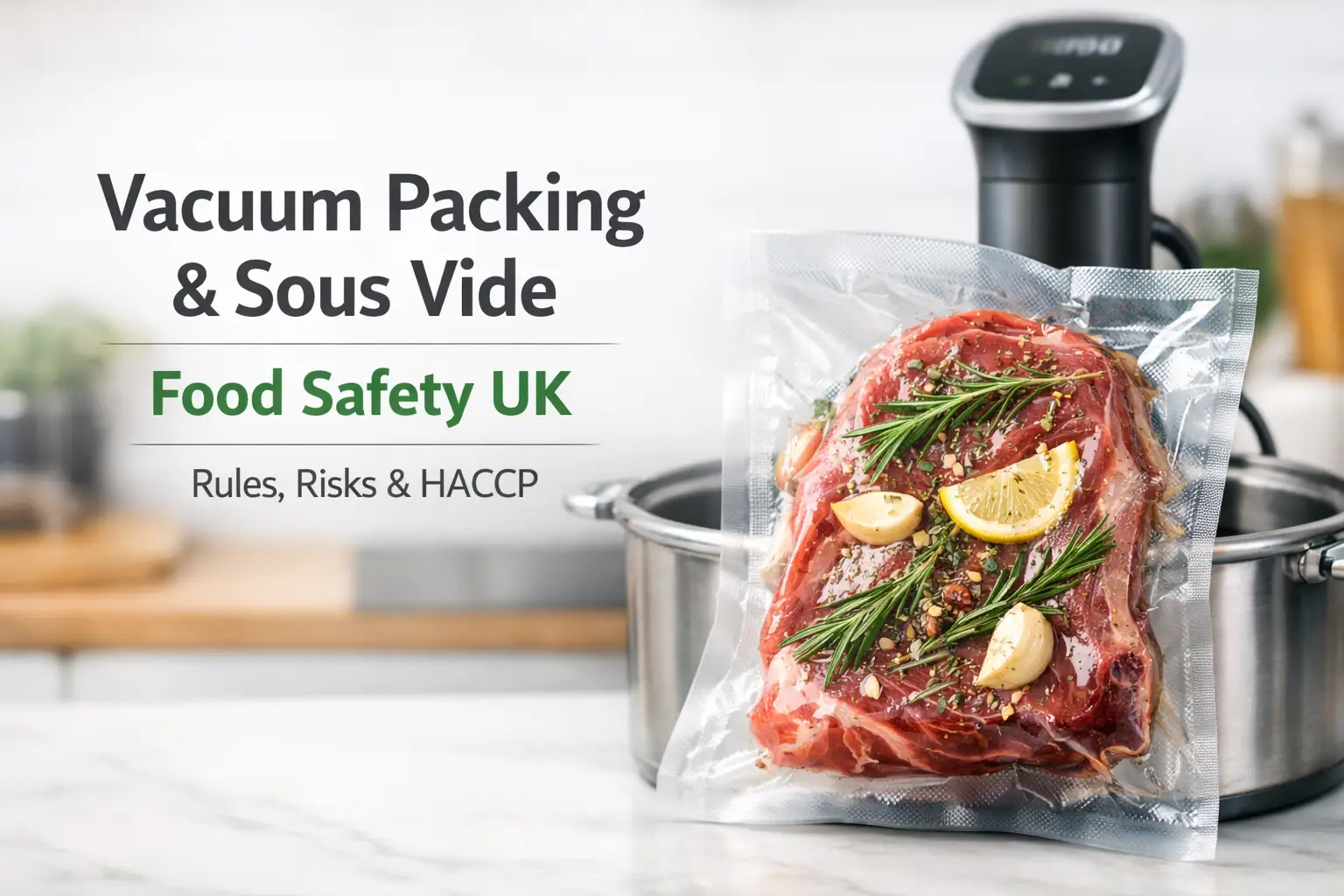
Vacuum packing and sous vide cooking can transform a busy kitchen, offering consistency and waste reduction.
In UK catering, these methods introduce specific safety considerations around botulism risk, shelf life, and temperature control.
This article explains what vacuum packing and sous vide mean in practice, where the risks come from, and how to apply HACCP controls to keep foods safe. It includes practical checks, record-keeping guidance, and when to adjust or avoid these methods.
Vacuum packing and sous vide in catering what they are and where risks come from
Important: In reduced-oxygen packs, the main safety risk is time–temperature mismanagement; it is not a guesswork area—your HACCP plan must address cooking, cooling, storage and reheating steps.
Vacuum packing removes most air from the packaging, and sous vide cooks food sealed in bags at controlled temperatures for long times. In catering, these methods enable precise portioning, extended shelf life in theory, and smoother service. The upside is real, but so are risks that aren’t always obvious in a bustling kitchen: anaerobic environments can favour certain microbes, and a lapse in time or temperature can allow hazards to develop even when the food looks, smells or tastes normal.
How to monitor in practice
- Ensure seals are intact and packaging is appropriate for the product.
- Separate raw and ready-to-eat foods at every stage of storage and preparation.
- Validate that cooling methods are fast enough to move foods quickly from hot to cold zones.
- Use clear, batch-level records for cooking, cooling, and reheating.
Remember that packaging integrity alone does not guarantee safety. The environment inside the bag is where hazards can grow if care isn’t taken.
Oxygen free packaging and botulism risk
Keep raw and ready-to-eat foods separate throughout storage and preparation to prevent cross-contamination and keep anything exposed to air or moisture from creating risky conditions.
Oxygen-reducing packaging creates a favourable environment for anaerobic bacteria such as Clostridium botulinum if time and temperature controls slip. Botulism is rare but extremely serious, and it does not rely on spoilage cues like off smells. In practice, this means that a product’s safety depends as much on how it is handled after packaging as on the initial cooking.
Practical safeguards
- Treat every vacuum-packed sous vide item as a potential hazard if cooling, storage or reheating steps are rushed or inconsistent.
- Use validated cooling methods to drive temperatures down quickly; do not rely on the bag to tell you when it’s safe.
- Record core temperatures during cooking and verify that the bag remains intact and sealed during storage.
The safest procedure is the one you can follow consistently in a busy kitchen.
The FSA ten day rule
The ten day rule is guidance to help you structure shelf-life decisions; you should not rely on it alone. Use hazard analysis and validated evidence to set your own limits.
The FSA guidance around reduced-oxygen foods in refrigeration is often framed as a ten-day horizon for some cooked-and-chilled products, including vacuum-packed and sous vide items. It is guidance, not a universal legal deadline, and it must be applied in the context of your specific product, process, and risk assessment. In practice, the ten-day window prompts brands to review shelf life based on microbiological risk, packaging, and cold chain reliability, and to justify shorter periods when risk indicators suggest so.
How to use it responsibly
Tie the rule to a documented risk assessment for each product category.
- Validate shelf life with testing, historical data, or supplier information where appropriate.
- Ensure records show the basis for any shelf-life decisions and that staff understand the rationale.
Staff training and written controls beat intuition every time when it comes to shelf life and safety.
Cook chill and reheat controls for vacuum packed and sous vide foods
A well-run cook-chill-reheat cycle hinges on validated cooling methods and thermometer accuracy.
Cook-chill-reheat controls are central to safe operation of vacuum packed and sous vide foods. The core idea is to inactivate hazards during cooking, rapidly bring the product into a safe cold state, store under controlled conditions, and reheat to service temperature with adequate time for heat penetration throughout the product.
Key points:
- Cooking: Aim for a proper kill step for the product, with a clear, measured core temperature target.
- Cooling: Move from hot to cold promptly using validated methods (e.g., blast chillers) and document cooling times.
- Storage: Keep the product refrigerated within validated temperature ranges and in correct packaging.
- Reheating: Reheat to service temperature throughout, then hold at safe temperatures if needed.
- Defect handling: If seals fail or chillers malfunction, apply defect reporting and adjust plans accordingly.
Practical example: sous vide chicken breast
- Vacuum seal with any marinade or seasoning.
- Cook sous vide to a defined target core temperature for the product.
- Cool quickly using a validated method and transfer to refrigerated storage.
- Reheat thoroughly before service, ensuring the entire piece reaches service temperature.
- If any step deviates (e.g., cooling delay or seal issue), document the incident and re-evaluate shelf life.
Cooling and cold storage limits for reduced oxygen foods
Rapid cooling and strict cold storage practices reduce the chance that dangerous organisms reach dangerous levels.
Reduced-oxygen foods require strict cooling and cold storage discipline. The aim is to keep the product out of the temperature ranges where hazards grow and to maintain the cold chain from production through service. Practical controls include:
- Using appropriate containers and shallow-depth packaging to maximise cooling efficiency.
- Implementing time and temperature logs for every batch.
- Keeping refrigerated equipment functional and monitored, with routine maintenance and calibration.
The temperature logs you maintain are often the single most persuasive element during inspections.
Delivery and storage checks
- On arrival, verify that vacuum-packed items are within the approved cold chain and check for any signs of compromised seals.
- If a package arrives warmer than expected, isolate it, perform a temperature check, and record the incident with corrective action.
The temperature logs you maintain are often the single most persuasive element during inspections.
HACCP records shelf life and traceability for vacuum packed sous vide
Keep validated shelf-life evidence and exportable records ready for inspection.
The final pillar is documentation. Shelf-life validation, probe calibration, temperature logs, batch codes, and traceability documentation should all be kept ready for inspection. Practical steps include:
- Define product-specific shelf life based on cooking, cooling, storage, and reheat controls. Validate where possible with testing or credible supplier data.
- Use calibrated thermometers and record probe accuracy regularly. Keep calibration records accessible.
- Record all cooking, cooling, chilling, and reheating temperatures and times in each batch log.
- Label storage with batch details, production date, and use-by or sell-by guidance within your HACCP plan.
- Keep defect reports for equipment or seals and have a clear corrective action path.
- Ensure staff follow written controls, not assumptions; train regularly.
The most important safeguard is a robust record-keeping culture: never assume; always document.
If you’re implementing vacuum packing or sous vide in a UK catering operation, set clear limits for time, temperature, and shelf life in your HACCP system. Record cooking, cooling, storage, reheating, and hot holding temperatures. Keep probe calibration and corrective action records up to date, and use defect reporting for any equipment or chill failures. Train staff to follow written controls, not assumptions, and keep validated shelf-life evidence and exportable records ready for inspection.