This guide helps café and coffee shop teams keep daily service safe and compliant in the UK. It covers simple, practical controls for temperature, allergens, cleaning and staff routines, designed for busy sites that need workable systems rather than paperwork-heavy theory.
Getting started: registering and legal duties
Important: In the UK, your local authority will expect evidence that you’re actively managing safety risks from day one. A straightforward plan with daily checks often suffices to demonstrate control.
Key practical steps to be inspection-ready from day one:
- Establish a simple food safety plan (a light touch HACCP approach) and write down the critical controls you’ll monitor daily.
- Create a clear opening and closing routine that includes cleaning, storage checks and handover notes.
- Keep basic documentation available for the Environmental Health Officer (EHO) if needed, such as temperature logs and cleaning checklists.
A simple opening checklist helps staff know what to do and when. Consistency beats long, theoretical procedures.
The regulator wants to see clear records showing how you handle deliveries, temperatures and cleaning. Make it easy to review.
Staff supervision and handover checks are essential during busy periods to maintain discipline and safety.
If in doubt, ask your local authority for a quick, practical briefing on what they’ll expect during an inspection.
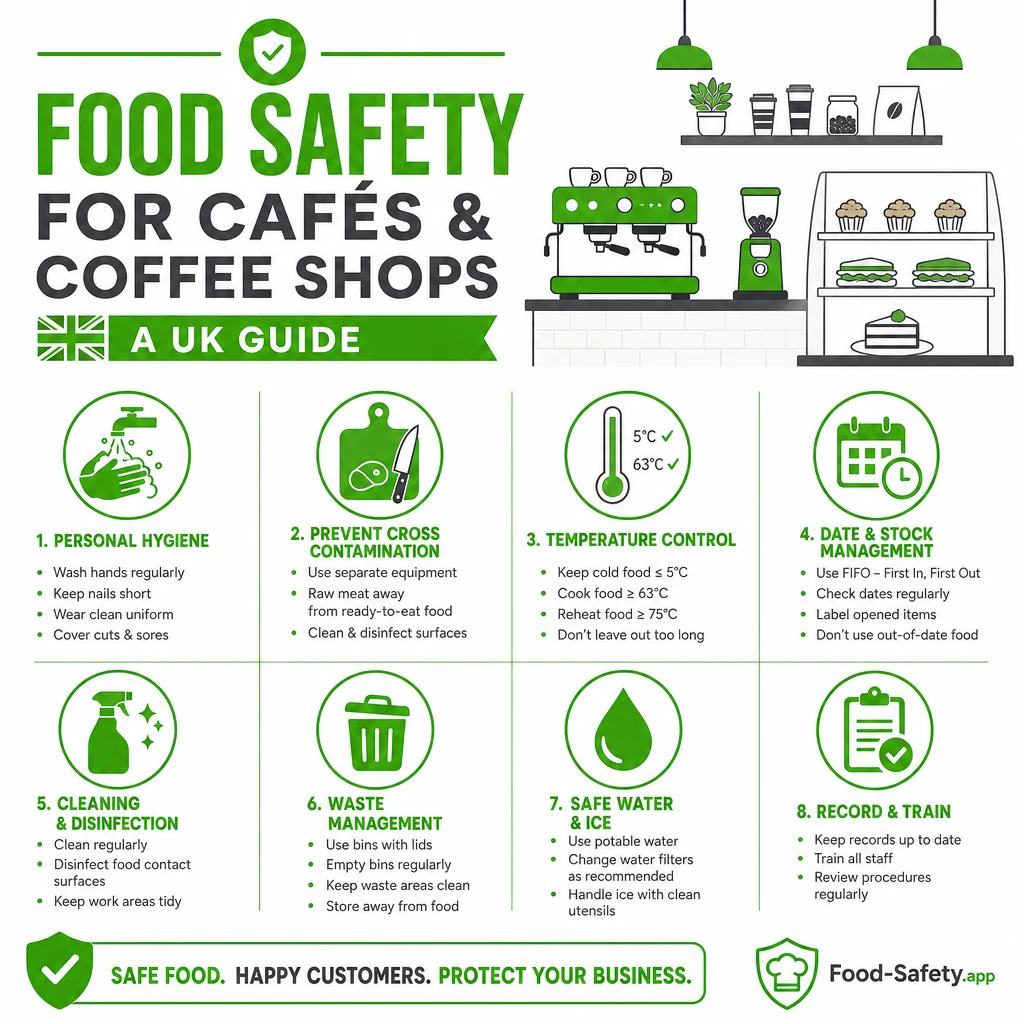
Basic HACCP principles for a cafe or coffee shop
The simplest HACCP approach is to map your day: when you store, cook, chill, hold and serve. Every step has a clear control and a quick record.
What to include in a simple HACCP plan
- Hazards: biological (bacteria), chemical (cleaning agents), physical (foreign bodies). Identify which could affect your menu items.
- Critical control points (CCPs): where you must control a risk, such as receiving, storage, cooking, cooling, hot holding, and cross-contact prevention.
- Critical limits: the safe boundaries for each CCP (for example, temperature targets for cold storage and hot holding).
- Monitoring: who checks the control, how often, and how records are kept.
- Corrective actions: what to do when a limit is not met.
- Verification and review: periodic checks of the plan and updates when recipes or suppliers change.
- Records: short logs that show what was checked and what action was taken.
In practice, a café can treat daily temperature readings as a CCP log. If a reading is out of range, you follow a short, pre-agreed corrective action and sign off the incident.
Regularly reviewing your plan—at least quarterly or when you change suppliers or menus—keeps the system practical and current.
Even small cafés benefit from a basic ingredient-check and allergen-awareness review as part of HACCP. Clear records support both safety and customer confidence.
Use simple, readable templates. You don’t need hundred-page manuals; you need reliable, repeatable routines.
Temperature control for fridge, freezer and holding temperatures
A reliable routine is the best defense: keep a running log of fridge temperatures, quick checks at opening, and a supervisor sign-off at the end of service.
Temperature control is at the core of day-to-day food safety. Practical targets and clear actions help staff manage busy service.
Typical targets (use as practical guidelines, aligned with UK guidance)
- Fridge storage: keep stored, perishable foods at or below 5°C.
- Freezer storage: keep frozen items at or below -18°C.
- Hot holding: hot foods should be kept at or above 63°C (often framed as “hot hold above the 60°C+ range” in some sites; aim for 63°C to be safe).
- Cooling: cool hot foods from 60°C down to 20°C as quickly as you can, then into the fridge to complete the cooling to storage temperature.
What to do if readings are out of range
- Do not rely on timing as a substitute for temperature. If a reading is out of range, act quickly to isolate affected items and prevent service with those items.
- Move perishable items to an appropriate cold storage if a fridge is out of range, or place into a working backup cooler if available.
- Record the incident with the time, items affected, and corrective actions taken.
- Check equipment and settings, and arrange a service or recalibration if a fault is suspected.
Common morning rush scenario
- A fridge reads 9°C during peak service. Move dairy and ready-to-eat items to a working cooler, assess what can be used today, and discard items that are past their safe-use window. Document the incident and follow up with calibration checks and a review of the cooling cycle.
A reliable routine is the best defense: keep a running log of fridge temperatures, quick checks at opening, and a supervisor sign-off at the end of service.
Staff should see clearly what to do if a fridge fails: switch to a spare unit, isolate items, and record what happened.
Regular maintenance windows, even for a small shop, prevent unexpected breakdowns and save more money than emergency repairs.
When in doubt, err on the side of safety and reduce what you hold or serve until you can verify temperatures meet targets.
If you use a data-logger, ensure it’s checked and its readings are legible to the person reviewing the log.
Allergen management under Natasha’s Law
Natasha’s Law requires clear ingredient and allergen information for prepacked foods, enabling customers to make safer choices.
Natasha’s Law changes how prepacked foods containing allergens are labelled. For cafés and coffee shops, the focus is on clear information for customers who take away or order prepacked items.
Key practices
- Ingredient checks: verify every ingredient for all items, especially prepacked or take-away foods.
- Allergen labelling for prepacked foods: ensure the packaging clearly lists allergens present in the product.
- Recipe control: maintain a current allergen matrix (which ingredients contain which allergens) tied to each menu item.
- Cross-contact controls: separate utensils and surfaces for allergen-containing items; clean and sanitise between tasks; consider dedicated equipment for common allergens.
- Customer-facing clarity: if items are sold prepacked for takeaway, provide clear allergen information on the packaging or display it where customers prepare a choice.
Example: a prepacked sandwich made on site must have an allergen label that lists all potential allergens in the ingredients. Update labels promptly if a recipe changes.
Natasha’s Law requires clear ingredient and allergen information for prepacked foods, enabling customers to make safer choices.
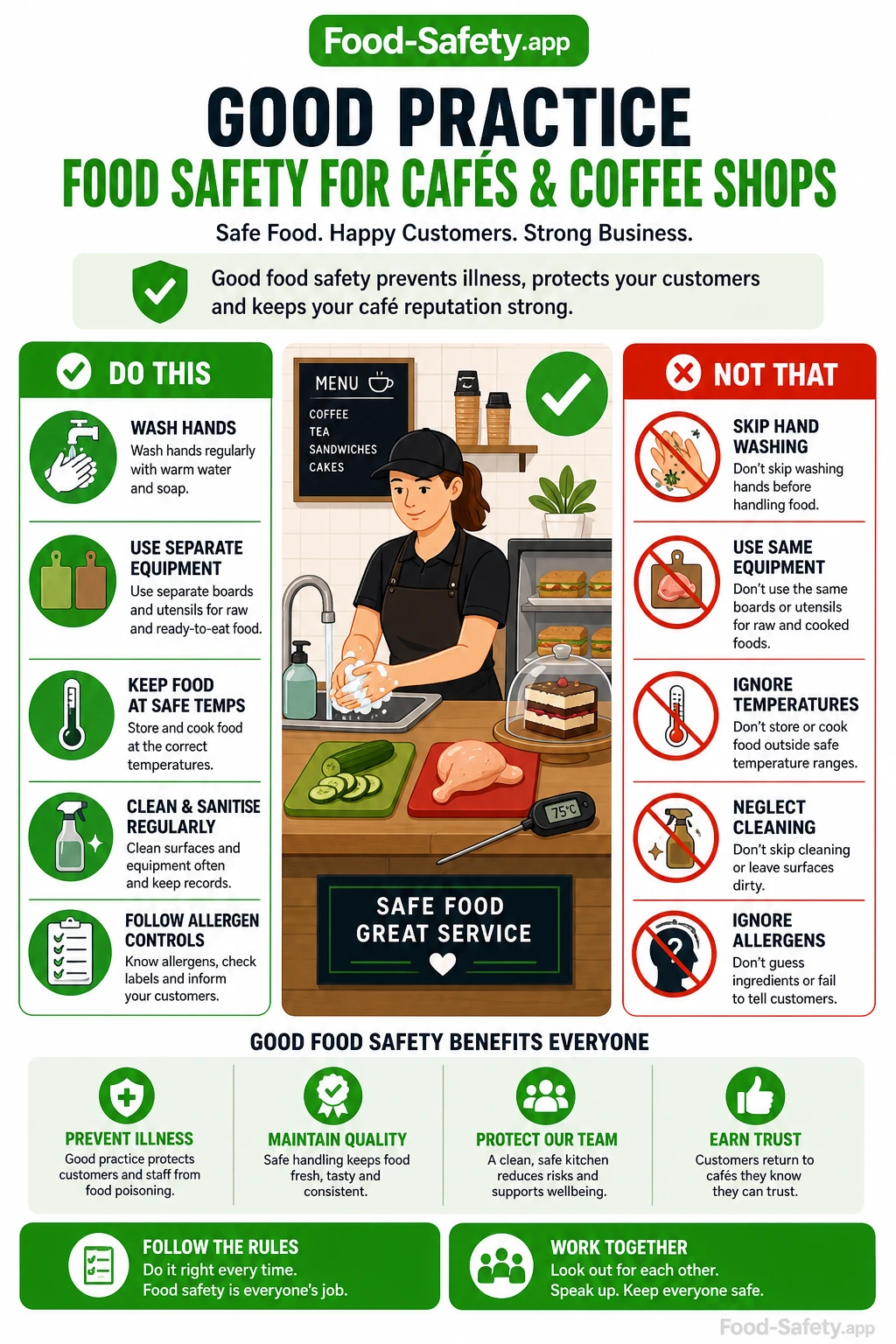
Cleaning schedules, opening and closing checks and staff routines
A practical cleaning programme is a line of defence staff can follow without needing to consult a manual every time.
What to include in schedules
- Opening checks: fridge doors sealed, cleaning cloths stocked, surfaces sanitised, coffee station ready.
- During service cleaning: wipe surfaces after allergen use, clean coffee grinders and milk frothers between customers handling dairy, and rinse prep surfaces between tasks.
- Closing checks: store items properly, clean all equipment, log temperatures, and secure the premises.
- Written schedules: assign responsibilities, specify frequency, and include space for sign-off.
Suggested structure
- Daily quick checks (opening and service)
- End-of-day deep-clean tasks
- Weekly or monthly tasks (equipment calibration, deep clean of sound-dampening areas, etc.)
Example opening/closing checklist (concise)
- Are fridge and display cases at safe temperatures? (record)
- Have all surfaces and equipment been cleaned and sanitised? (sign-off)
- Are allergen-contact surfaces separated and clean? (sign-off)
- Are deliveries checked on arrival and logged? (sign-off)
A practical cleaning programme is a line of defence staff can follow without needing to consult a manual every time.
Opening checks should be fast and focused: a few critical items that set up a safe shift.
Closing checks matter because a rushed close can miss equipment hygiene and storage issues.
Documenting the checks makes it easy to review during an inspection or internal audit.
If you operate a multi-shift service, handover notes are essential to maintain continuity and safety.
Record-keeping and inspection readiness
Good record-keeping is the simplest way to show safety in action. It’s not about endless forms, it’s about reliable evidence.
Clear, concise records support safe operation and provide evidence during inspections. Keep these in a simple, accessible format.
Essential records
- Temperature logs: fridge, freezer, hot-holding temperatures with time stamps.
- Delivery checks: supplier, item, batch, temperatures on arrival, and any immediate corrective actions.
- Corrective actions: what was wrong, what was done, by whom, and when.
- Cleaning and sanitation logs: tasks completed and sign-offs.
- Allergen checks: ingredient lists updated in the allergen matrix and any changes to recipes.
Practical examples
- A chilled cream delivery: note supplier, item, batch, arrival temperature, condition, and who checked it.
- A soup served hot: record initial serving temperature and the holding temperature during service.
- A re-labelled prepacked sandwich: record allergen declaration and the date the label was prepared.
What Environmental Health Officers look for
- Consistent evidence that hazards are identified and controlled
- Records showing temperatures within safe ranges and that corrective actions are taken when not
- Clear allergen information and robust cross-contact controls
- Regular staff training, supervision, and handover checks
- Regular cleaning schedules and proof that routines are completed
Good record-keeping is the simplest way to show safety in action. It’s not about endless forms, it’s about reliable evidence.
Keep records readable and summarise any incidents with dates, actions, and follow-up.
When items are out of spec, demonstrate that you’ve taken immediate, appropriate corrective action and kept a log.
Environmental Health Officers value routine, practical systems that staff can follow, day after day.
Regular review of records helps identify trends and keeps your safety approach fit for purpose.
Quick recap for practical compliance
- Register your business with the local authority before you open (often 28 days prior).
- Apply a simple HACCP approach: identify hazards, control points, monitoring, and records.
- Keep cold storage and hot holding within practical target ranges; act swiftly when readings fall out of range.
- Manage Natasha’s Law requirements with a current allergen matrix and clear prepacked labelling where applicable; prevent cross-contact.
- Implement straightforward cleaning schedules and opening/closing checks; use staff handover routines to maintain consistency.
- Maintain clear, time-stamped records for temperatures, deliveries, cleaning and allergens to support inspection readiness.
If you’d like, I can tailor a one-page, café-specific HACCP template or a printable weekly cleaning checklist to fit your kitchen layout and peak service times.