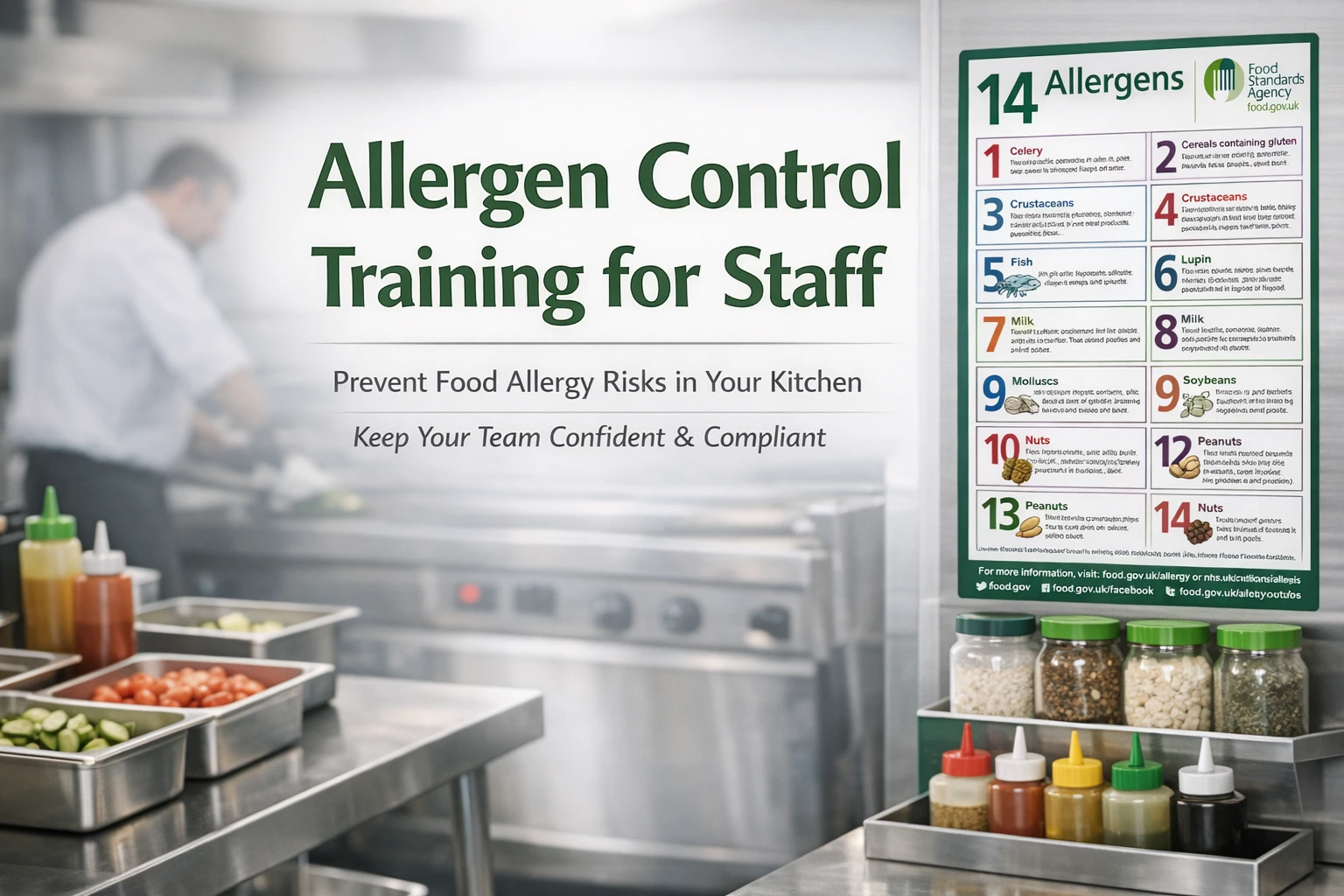
Allergen control training for staff gives busy food business owners confidence that their teams understand how to prevent food allergy risks and stay compliant using practical tools like a food safety app.
Table of Contents
- Why allergen control training matters
- What every food handler needs to know
- Practical steps to train your team
- Onboarding and induction
- In-kitchen demonstrations
- Handling customer queries
- Common training challenges and how to fix them
- Refreshers, supervision and checks
- Conclusion: make training easier with the right tools
Why allergen control training matters
Allergen control training is essential for any catering or hospitality business. In the UK, food businesses must provide accurate allergen information to customers and make sure staff understand how to prevent allergen cross-contact under food law.(Food Standards Agency)
Failing to train staff properly can lead to serious allergic reactions, unhappy customers – and potential enforcement action from your local authority. Good training protects people and protects your reputation.
What every food handler needs to know
The 14 regulated allergens
In the UK, there are 14 recognised allergens that must be declared whenever they’re used in food you serve or sell. These include things like milk, peanuts, gluten-containing cereals, nuts and sesame.(Food Standards Agency)
It’s useful to have a simple poster in your kitchen and front of house that lists these, so everyone can memorise and refer back easily.
Why cross-contact is a big deal
Allergen cross-contact happens when a tiny amount of an allergen gets into a dish that’s meant to be free of that allergen. This can be from shared knives, boards, fryers or even hands. Teaching staff to be aware of how cross-contact occurs is a cornerstone of allergen control training.
For practical examples of how contamination spreads in real kitchens and how to stop it, check out our guide on [how cross-contamination happens and how to stop it].
Food safety law responsibilities
Your team should understand that customers can ask about ingredients, and staff must answer based on accurate information – not guesswork. Knowing the basics of food safety responsibilities helps front-of-house and kitchen staff feel confident when questions arise.
Practical steps to train your team
The best allergen control training is simple, relevant and tied to everyday tasks your staff already do.
Onboarding and induction
All new starters should have allergen awareness as part of their induction. Keep sessions short, practical and directly linked to your menu and processes. Use real items from your kitchen — not abstract examples — so trainees can relate the theory to the job.
Make sure new staff know where to find allergen information, including any digital records you keep in your food safety app.
In-kitchen demonstrations
Theory only goes so far — showing staff how to control allergens in the real work environment helps training stick.
Walk through stations with your team and point out:
- Where allergenic ingredients are stored
- Colour-coded utensils or zones for allergen-free prep
- How to clean and sanitise tools and surfaces correctly
- How to change gloves between tasks
Tie this back to your everyday cleaning and hygiene routines. A strong foundation in general food safety — like [personal hygiene in food business practice] — supports allergen control too.
Handling customer queries
Role-playing customer questions is a simple but effective way to train staff. For example:
“Is this dish free from nuts?”
Staff should practise checking your allergen information in your system before answering.
This reinforces two key habits:
- Always check, don’t guess.
- Use up-to-date records, not memory.
Common training challenges and how to fix them
Even with good training materials, real kitchens throw up challenges. Here are common issues and practical fixes:
1. Cutting corners under pressure
When service gets busy, staff might skip allergy steps. Reiterate that allergen control isn’t optional — it’s part of every dish served.
2. Assuming labels or menus never change
Ingredients can change without chefs telling the team. Make sure allergen information is updated in whatever system you use and that staff know where to find the latest version.
3. Paper records that go missing
Paper sheets can be lost or outdated. Moving to a digital food safety app means allergen info, training records and updates are always accessible and current.
Refreshers, supervision and checks
Training shouldn’t be a one-off tick-box exercise. Embed refresher steps into your routines so that allergen control stays front of mind.
Regular brief refreshers
A short monthly toolbox talk about allergens can make a big difference. Use real menu items and recent examples from your service to keep it relevant.
Supervisors as role models
Supervisors should watch for risky practices and offer immediate corrective feedback — not waiting for the next formal session.
Record keeping
Document every training session, including dates, topics and attendees. If you find it tricky to track this on paper, a food safety app centralises training logs, checklists and SOPs in one place and reminds you when refreshers are due.
If you feel paperwork is slowing you down, our article on [why food safety paperwork fails in busy kitchens and what to do instead] gives practical alternatives.
Conclusion: make training easier with the right tools
Allergen control training and staff allergen awareness are vital parts of running a safe kitchen. Busy food business owners don’t need complex systems — they need straightforward guidance that fits around their daily flow.
Practical training, regular refreshers and clear processes help your team stay confident and compliant. And when you pair that with a food safety app that organises your allergen information, training records and daily checks, you take a lot of guesswork and paperwork out of the equation.
A good app doesn’t replace your team’s judgement, but it does make reliable information easy to find and keeps everyone working from the same up-to-date playbook. Consider tools designed for everyday use in hospitality — they can take some of the administrative pressure off your shoulders while helping you keep allergen control where it should be: consistent and clear.