Worried about Campylobacter in your kitchen? Here’s what UK caterers need to know about food safety management, legal duties and simple controls using digital food safety records.
Table of Contents
- What is Campylobacter?
- Why is it a serious risk for caterers?
- Your legal duties under UK food safety law
- Practical controls that prevent Campylobacter
- Keeping effective HACCP records
- How good systems help improve food hygiene rating
What is Campylobacter?
Campylobacter is the most common cause of bacterial gastroenteritis in the UK. It’s usually linked to raw and undercooked poultry, particularly chicken.
For most people, infection causes diarrhoea, stomach cramps and fever for a few days. For some customers — especially older people, young children or those with weakened immune systems — it can lead to more serious complications.
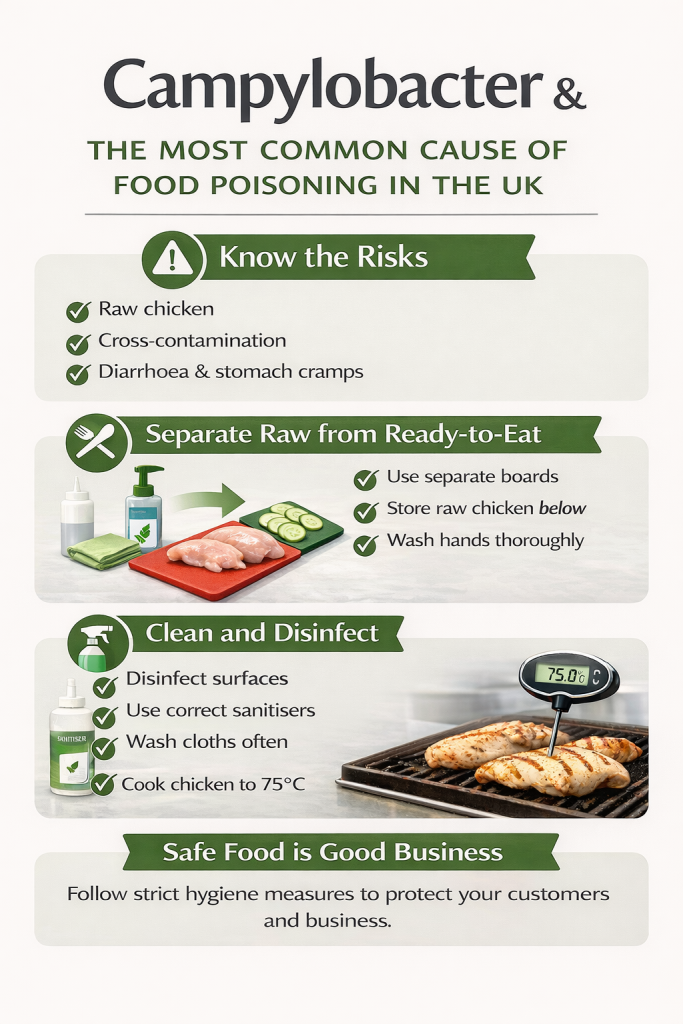
In catering settings, the main issue isn’t just undercooked chicken. It’s cross-contamination. A small amount of raw poultry juice on a chopping board, cloth or hand can transfer bacteria onto ready-to-eat food.
That’s why strong food safety management matters. Campylobacter is easily killed by heat and disinfectant, but only if controls are followed consistently.
Why is it a serious risk for caterers?
Chicken is one of the most commonly served meats in UK hospitality. Think of:
- Pub grills cooking chicken breasts to order
- Café sandwiches with cooked chicken prepared in advance
- Takeaways handling raw chicken portions all day
- Care homes serving vulnerable residents
In many food poisoning investigations, Environmental Health Officers find that the root cause wasn’t a lack of knowledge — it was gaps in day-to-day control.
Common scenarios include:
- Raw chicken stored above salad items in the fridge
- The same probe thermometer used without proper disinfection
- Inadequate handwashing between tasks
- Cloths spreading contamination around prep areas
Even a well-run kitchen can slip during busy service if systems aren’t clear and easy to follow.
Your legal duties under UK food safety law
Under the Food Safety Act 1990 and retained Regulation (EC) 852/2004, food businesses must ensure food is safe and not injurious to health.
This means you must:
- Identify hazards such as Campylobacter
- Put controls in place based on HACCP principles
- Monitor and record those controls
- Train and supervise staff properly
The Food Standards Agency provides national guidance, and local authorities enforce the law.
There isn’t a specific “Campylobacter regulation”, but the expectation is clear: you must control cross-contamination and cook poultry thoroughly. In practice, this usually means achieving a core temperature of 75°C for at least 30 seconds, or an equivalent time and temperature combination.
A documented system — not just verbal instructions — is essential.
Practical controls that prevent Campylobacter
Separate raw and ready-to-eat food
Keep raw poultry physically separate from ready-to-eat foods at all times.
- Store raw chicken at the bottom of the fridge in sealed containers.
- Use colour-coded boards and knives.
- Prepare raw poultry in a designated area where possible.
Even in small kitchens, simple zoning makes a big difference.
Clean and disinfect properly
Campylobacter doesn’t survive proper cleaning and disinfection.
Always:
- Remove visible debris with detergent.
- Apply an approved disinfectant at the correct dilution.
- Allow the correct contact time.
Cloths are a common weak point. If they’re not changed or sanitised frequently, they can spread bacteria quickly.
Cook thoroughly and check
Don’t rely on guesswork.
- Use a calibrated probe thermometer.
- Disinfect the probe before and after use.
- Check thicker parts of the meat.
Recording these checks supports both safety and compliance.
Train staff in real-life risks
Staff should understand why washing raw chicken is unsafe (it spreads bacteria through splashing), and why handwashing between tasks is critical.
Training should link directly to your documented HACCP records, so procedures aren’t just theory — they reflect what actually happens in your kitchen.
Keeping effective HACCP records
Many businesses know what to do but struggle to prove it.
Paper records can be:
- Incomplete
- Filled in retrospectively
- Misplaced
- Difficult to review
Accurate digital food safety records make it easier to:
- Log cooking temperatures
- Record cleaning checks
- Document fridge temperatures
- Track corrective actions
This isn’t about bureaucracy. It’s about showing due diligence if something goes wrong.
If a customer complaint or inspection happens, clear records demonstrate that you had reasonable precautions in place.
How good systems help improve food hygiene rating
During inspections, officers look at:
- Hygienic food handling
- Cleanliness and condition of the premises
- Confidence in management
Campylobacter control affects all three areas.
Clear procedures, consistent monitoring and accurate documentation show that management understands risk and keeps it under control. That directly supports efforts to improve food hygiene rating outcomes.
A well-organised system also helps you spot patterns — such as recurring temperature issues — before they become enforcement problems.
Bringing it all together
Campylobacter is common in UK poultry, but it’s preventable in professional kitchens. The essentials are simple: separation, cleaning, thorough cooking and proper monitoring.
Where businesses often struggle isn’t knowledge — it’s consistency.
Food-Safety.app is a food safety management system for UK catering businesses. It supports structured procedures, organised HACCP records and straightforward digital food safety records that reflect real kitchen practice.
If you want compliance to feel manageable rather than stressful, it’s worth considering a system that keeps everything in one place and makes daily food safety management easier to maintain.