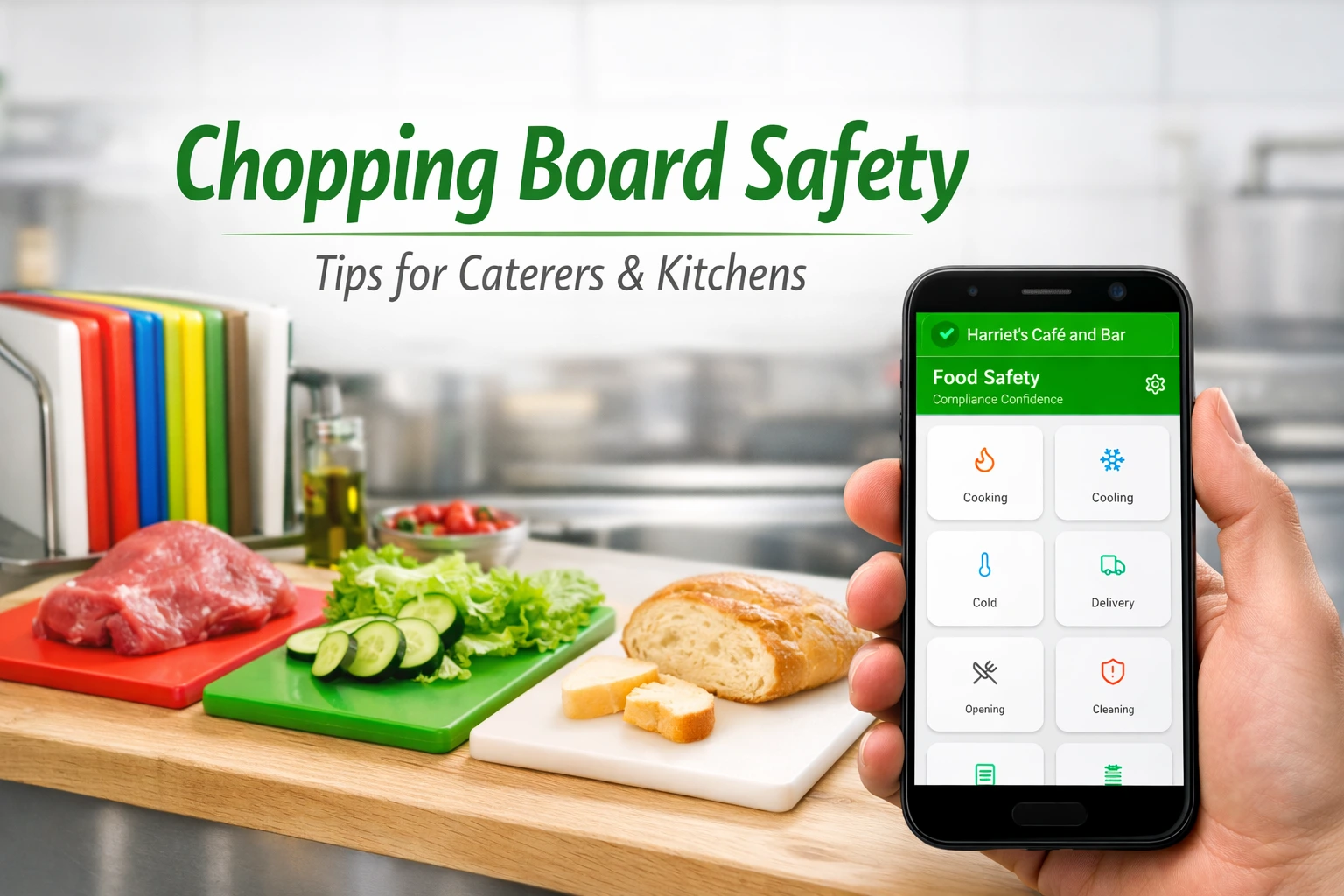
Struggling to manage chopping board hygiene in your kitchen? Here’s a clear guide to colour coding, cleaning, and storage using a food safety management system.
Table of Contents
- What is chopping board colour coding?
- How should chopping boards be cleaned?
- When should chopping boards be replaced?
- How should chopping boards be stored?
- How does this fit into food safety management?
What is chopping board colour coding?
Colour-coded chopping boards are a simple way to prevent cross-contamination in busy kitchens. Instead of relying on memory, staff can quickly identify which board is safe for each task.
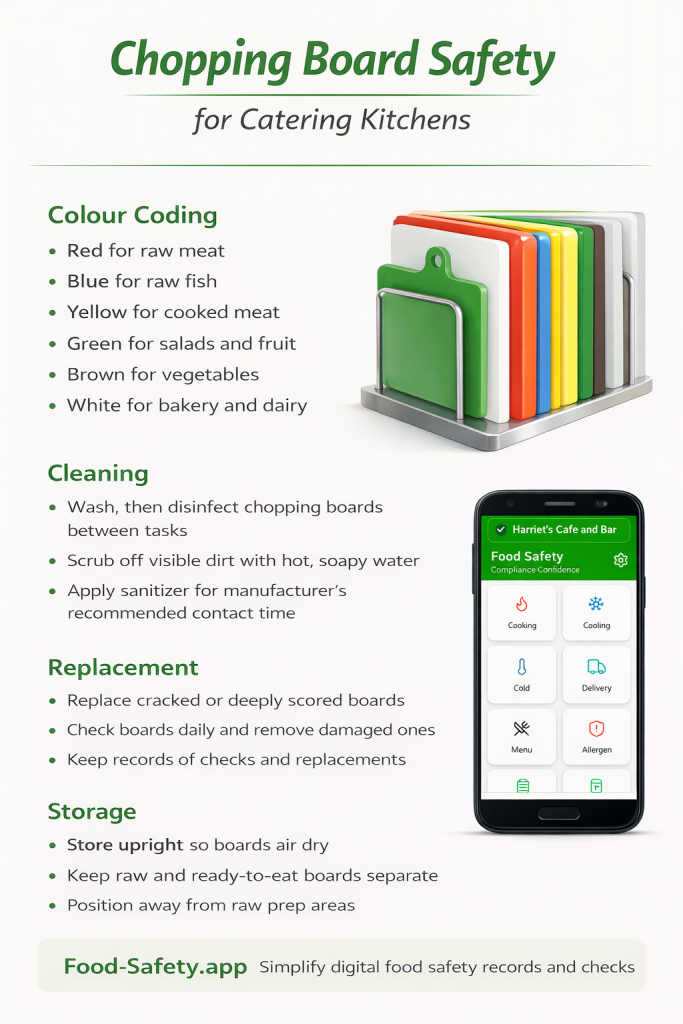
A typical system used in UK catering includes:
- Red for raw meat
- Blue for raw fish
- Yellow for cooked meat
- Green for salads and fruit
- Brown for vegetables
- White for bakery and dairy
Some kitchens also introduce a separate colour for allergen-free preparation, supporting effective allergen management.
This system isn’t a legal requirement on its own, but it supports compliance with food hygiene law by helping staff keep raw and ready-to-eat foods separate. It’s especially useful during busy service when mistakes are more likely.
For best results, keep the system consistent across your whole kitchen and train staff to follow it every shift.
How should chopping boards be cleaned?
Cleaning is where many kitchens fall short. A quick rinse or wipe isn’t enough to remove harmful bacteria.
The correct method is a two-stage clean:
- Wash with hot water and detergent to remove visible dirt
- Apply a disinfectant or sanitiser and leave it for the required contact time
This process is essential for maintaining safe surfaces, especially after preparing raw meat or fish.
You can find detailed guidance from the Food Standards Agency cleaning advice .
Boards should be cleaned:
- After every task
- Between raw and ready-to-eat food preparation
- At the end of each shift
This is a key part of maintaining accurate HACCP records and ensuring your cleaning controls are working in practice.
If you use a dishwasher, make sure it reaches the correct temperature and completes a full cycle. Otherwise, you’ll need separate boards for different food types.
When should chopping boards be replaced?
There’s no fixed replacement schedule in UK law, but condition is critical.
Boards should be replaced when they show:
- Deep knife grooves
- Cracks or splits
- Warping
- Staining that doesn’t clean off
Damaged boards can trap bacteria and make effective cleaning difficult. Even if they look usable, they may no longer be safe.
A practical approach is to include chopping board checks in your daily or weekly kitchen routine. This supports both SFBB (Safer Food Better Business) procedures and wider compliance.
Keeping a simple record of checks and replacements can also help during inspections and contribute to a stronger food hygiene rating.
How should chopping boards be stored?
Storage is often overlooked, but it plays a big role in preventing re-contamination.
Clean boards should be:
- Stored upright or in racks to allow air drying
- Kept separate for raw and ready-to-eat use
- Positioned away from raw prep areas
- Clearly labelled or colour-matched to storage slots
Avoid stacking boards flat when wet, as this can trap moisture and bacteria.
In smaller kitchens, space-saving solutions like vertical racks or wall-mounted holders can help maintain separation without taking up valuable prep space.
Good storage habits support cross-contamination prevention and make it easier for staff to follow the correct process.
How does this fit into food safety management?
Chopping boards are just one part of a wider system. On their own, they won’t keep food safe — they need to work alongside cleaning routines, staff training, and supervision.
In practice, this means:
- Using colour coding consistently
- Cleaning and disinfecting properly between tasks
- Replacing worn equipment promptly
- Storing boards safely after cleaning
All of these actions form part of your documented procedures, whether you use paper-based SFBB packs or digital food safety records.
This is where a structured system becomes valuable. Food-Safety.app is a food safety management system for UK catering businesses that helps you track cleaning, checks, and compliance in one place.
Instead of relying on memory or scattered paperwork, you can keep clear records of:
- Cleaning schedules
- Equipment checks
- Staff responsibilities
This makes it easier to stay consistent and demonstrate compliance during inspections.
Conclusion
Chopping board safety might seem like a small detail, but it has a big impact on preventing cross-contamination in your kitchen. Getting the basics right — colour coding, cleaning, replacement, and storage — helps protect your customers and your business.
By building these habits into your daily routine and recording them properly, you create a more reliable and manageable system.
If you’re looking to make that process simpler and more consistent, a digital approach like Food-Safety.app can support your food safety management without adding extra complexity.