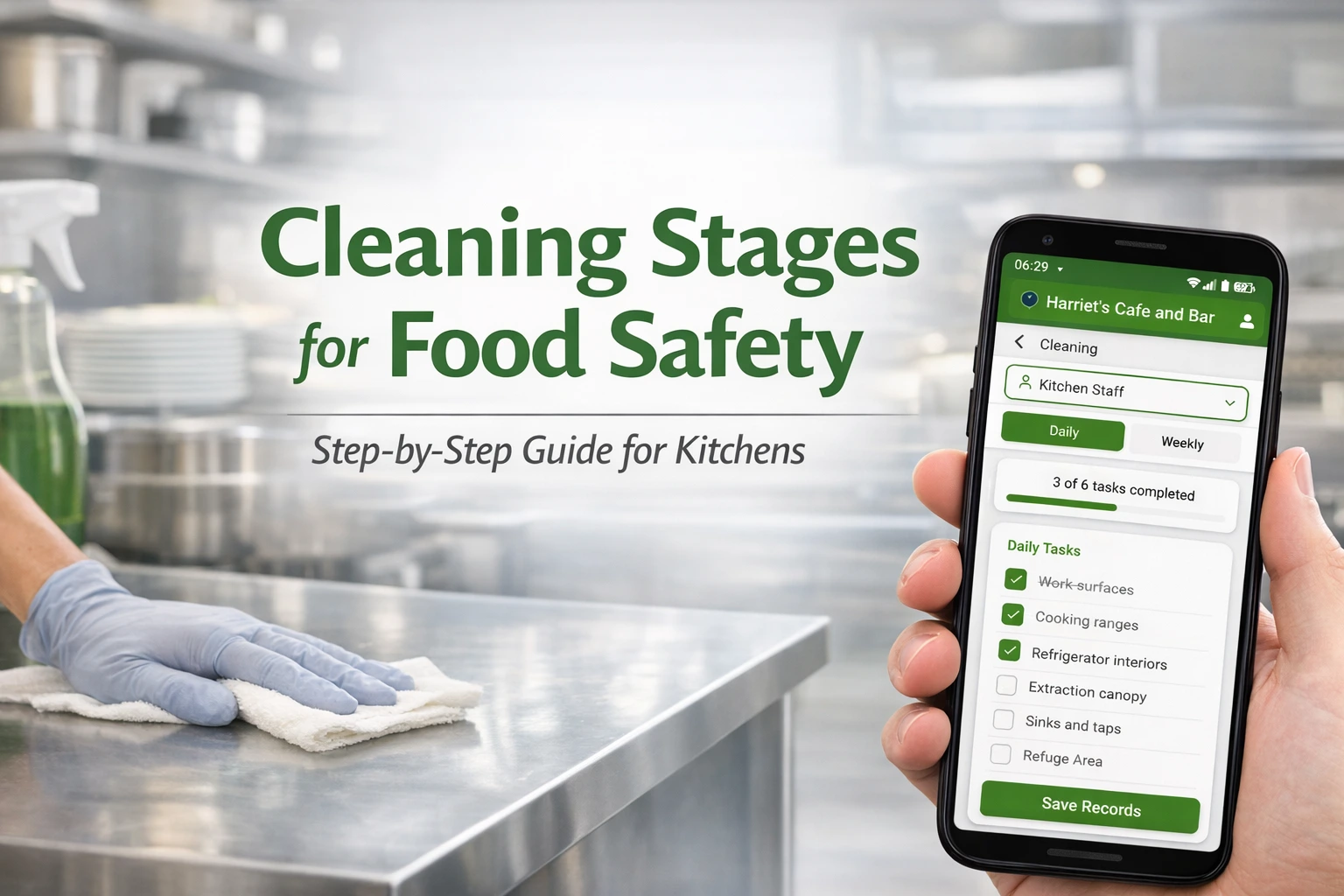
Struggling to keep cleaning consistent? This guide explains simple cleaning stages for food safety management and how a food safety app can help.
Table of Contents
- Why cleaning matters in food safety management
- The 6 cleaning stages explained
- How this fits the UK two-stage clean
- Common cleaning mistakes to avoid
- Making cleaning work in busy kitchens
- Using digital food safety records
Why cleaning matters in food safety management
Good cleaning isn’t just about appearances. It’s a core part of food safety management and plays a major role in preventing contamination.
In a busy kitchen, food residue, grease and bacteria can quickly build up on surfaces, equipment and utensils. If these aren’t removed properly, they can spread harmful bacteria to ready-to-eat food.
UK guidance from the Food Standards Agency makes it clear: cleaning must remove visible dirt first, then disinfect to make surfaces safe.
That’s where a structured approach helps. Breaking cleaning into stages makes it easier for staff to follow and repeat correctly, even during busy service.
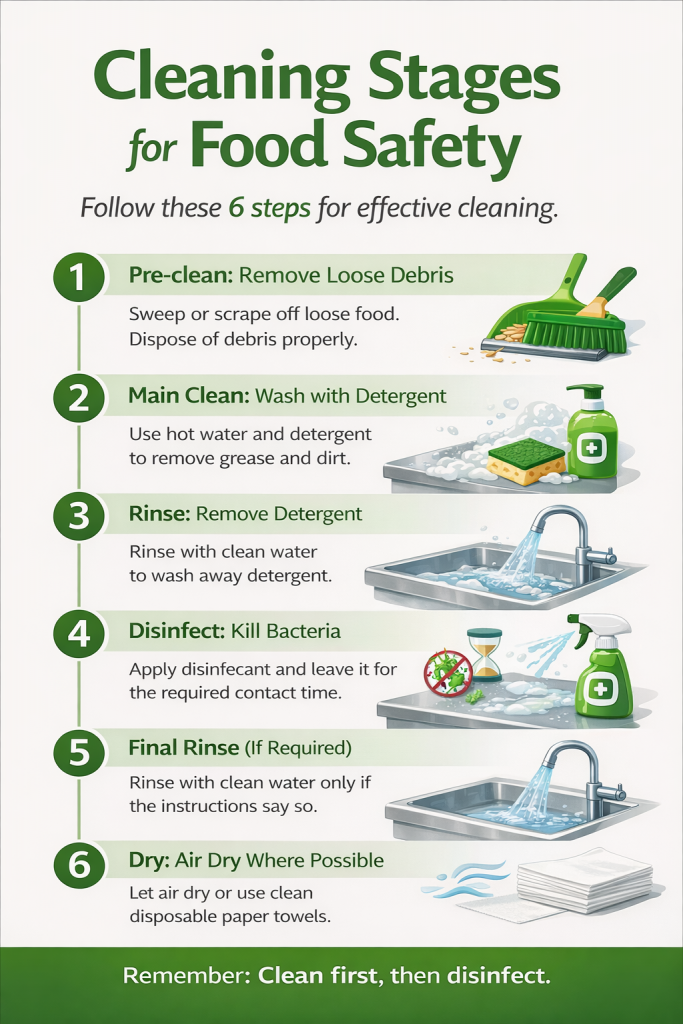
The 6 cleaning stages explained
Many kitchens use a simple six-stage process to make cleaning more consistent. It’s not a legal requirement, but it’s a practical way to apply good hygiene standards.
1. Pre-clean: remove loose debris
Start by scraping, wiping or sweeping away food scraps and debris.
For example, clearing a chopping board of onion skins or meat trimmings before washing stops you spreading dirt around during the next step.
2. Main clean: wash with detergent
Use hot water and a suitable detergent to remove grease and visible dirt.
This is the stage where most of the contamination is physically removed. Without it, disinfectant won’t work properly later.
3. Rinse: remove detergent and loosened dirt
Rinse with clean water if needed to remove any remaining detergent and debris.
This step is especially important if the cleaning chemical could interfere with disinfectant.
4. Disinfect: kill bacteria
Apply a disinfectant or sanitiser and leave it for the correct contact time.
This is the key safety step. Make sure staff follow the product instructions carefully, including dilution and timing.
5. Final rinse (if required)
Some disinfectants need rinsing off after use, while others don’t.
Always check the label. Rinsing when it’s not required can reintroduce contamination, while skipping it when needed could leave chemical residue.
6. Dry: air dry where possible
Allow surfaces and equipment to air dry, or use clean disposable paper towels.
Reusable cloths can spread bacteria if they’re not managed properly, so they should be changed and cleaned frequently.
How this fits the UK two-stage clean
In the UK, official guidance focuses on a “two-stage clean”:
- Clean with detergent
- Disinfect properly
The six stages simply break that process down into practical steps.
For example, in a café kitchen:
- Pre-clean and main clean remove milk residue from a worktop
- Rinse clears detergent
- Disinfect makes it safe for preparing sandwiches
Understanding this link helps staff follow procedures correctly without overcomplicating things.
Common cleaning mistakes to avoid
Even with a clear process, some issues come up again and again in food businesses.
Skipping the cleaning stage
Applying disinfectant to a dirty surface doesn’t work. Grease and food residue block it from killing bacteria.
Incorrect chemical use
Using too much or too little disinfectant, or not leaving it on long enough, reduces effectiveness.
This can also affect your efforts to improve food hygiene rating during inspections.
Poor cloth control
Dirty or damp cloths can spread bacteria around the kitchen.
It’s better to use disposable paper or have a strict system for cleaning and replacing reusable cloths.
Missing high-touch areas
Handles, switches, fridge doors and taps are often overlooked.
These areas can carry just as much risk as food prep surfaces.
Lack of documentation
If cleaning isn’t recorded, it’s harder to prove it’s being done properly.
This is where HACCP records become important.
Making cleaning work in busy kitchens
The biggest challenge isn’t knowing what to do — it’s doing it consistently.
In real kitchens:
- Staff change shifts
- Service gets busy
- Tasks are rushed or forgotten
That’s why cleaning schedules need to be simple, visible and easy to follow.
Link cleaning to key moments:
- After handling raw food
- Between different tasks
- At the end of service
Clear responsibilities also help. Everyone should know what they’re responsible for cleaning and when.
Using digital food safety records
Paper checklists can work, but they’re easy to lose, forget or fill in after the fact.
Digital systems make it easier to stay consistent and organised.
Using digital food safety records allows you to:
- Track cleaning in real time
- Set reminders for staff
- Keep everything in one place
- Show clear evidence during inspections
This also supports wider controls like allergen management, where cleaning plays a key role in preventing cross-contact.
Food-Safety.app is a food safety management system for UK catering businesses. It helps teams manage cleaning schedules, complete records digitally, and stay aligned with UK guidance without adding extra admin.
Conclusion
Breaking cleaning into clear stages makes it easier for teams to follow, especially during busy shifts. The six-stage approach supports the UK two-stage clean by turning it into practical, repeatable actions.
When cleaning is done properly, it reduces risk, supports compliance, and helps maintain high hygiene standards.
Using a digital system like Food-Safety.app can make this process more consistent and easier to manage, giving you a clearer view of what’s been done and what still needs attention.