
Cross-contamination is one of the most common causes of food poisoning. It affects every type of food business and every food handler, from large factories to small kitchens. It doesn’t matter what food you prepare or where you work. If food isn’t handled safely, contamination can happen.
This guide explains contamination vectors in a clear and simple way. It’s written for all food handlers and food businesses and follows best practice and guidance from the Food Standards Agency. The aim is to help you understand the risks and stop problems before they start.
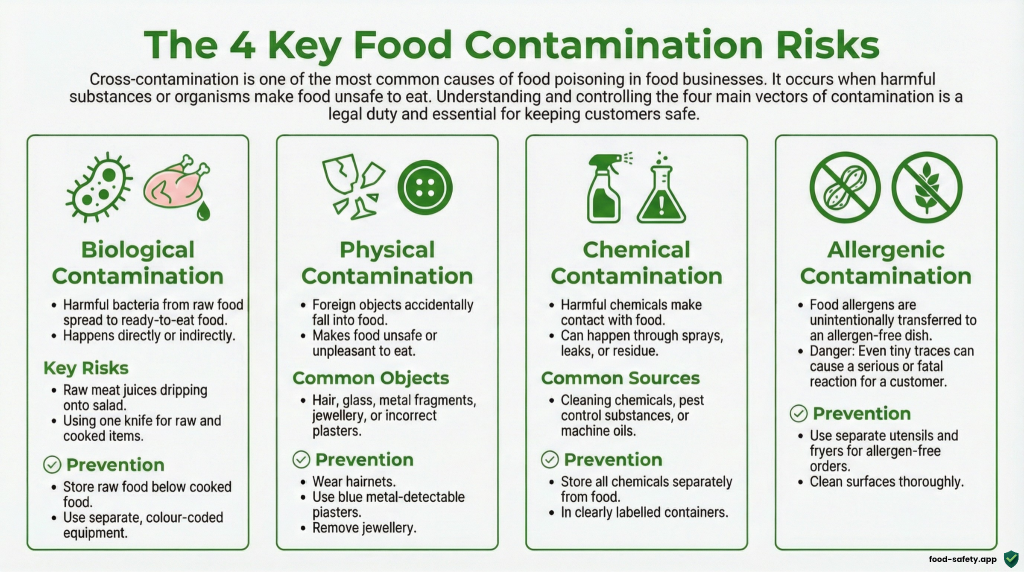
What is food contamination?
Food contamination happens when something harmful gets into food and makes it unsafe to eat. This could be bacteria, chemicals, allergens or physical objects.
Cross-contamination is when contamination spreads from one place to another. You often can’t see it happening. Food may look and smell fine but still be unsafe.
Contamination can happen at any stage of food handling, including:
- Delivery
- Storage
- Preparation
- Cooking
- Cooling
- Service
That’s why everyone who handles food has a responsibility to work safely at all times.
What are contamination vectors?
A contamination vector is the way contamination moves. Think of it as the route the problem takes.
There are five main contamination vectors you need to understand:
- Direct cross-contamination
- Indirect cross-contamination
- Physical contamination
- Chemical contamination
- Allergenic contamination
Each one causes food safety incidents in different ways.
Direct cross-contamination
What it means
Direct cross-contamination happens when raw food comes into direct contact with ready-to-eat or cooked food.
Raw meat, poultry, fish and eggs can contain harmful bacteria. If these foods touch cooked food, the bacteria transfer straight away.
How it happens
- Raw food is stored incorrectly
- Raw juices drip or leak
- Cooked and raw food touch each other
There are no warning signs. Once contact happens, the food is unsafe.
Common examples
- Raw meat stored above cooked food in a fridge
- Raw food touching ready-to-eat food on a shelf
- Raw and cooked food sharing the same container
- Raw food placed on surfaces used for cooked food
How to prevent it
Store raw food below ready-to-eat food.
Keep raw food sealed and leak-proof.
Use separate storage areas where possible.
Never let raw and cooked food touch.
Indirect cross-contamination
What it means
Indirect cross-contamination happens when contamination spreads through something else. These are often called vehicles.
Common vehicles include hands, knives, chopping boards, cloths, equipment and work surfaces.
How it happens
- Raw food contaminates hands or tools
- Items are not cleaned properly
- The same items are then used on ready-to-eat food
Bacteria spread without being noticed.
Common examples
- Using the same knife on raw and cooked food
- Not washing hands after handling raw food
- Using the same cloth across different tasks
- Sharing equipment without cleaning and sanitising
How to prevent it
Wash hands properly between tasks.
Clean and sanitise equipment between uses.
Use colour-coded tools where provided.
Change gloves between tasks and remember gloves don’t replace handwashing.
Physical contamination
What it means
Physical contamination happens when foreign objects get into food. This can make food unsafe or unpleasant to eat.
Common physical contaminants
Hair, plasters, glass, metal, screws, packaging, jewellery and false nails.
Common examples
- Hair falling into food
- Broken glass near food areas
- Jewellery dropping into food
- Parts from damaged equipment
How to prevent it
Wear suitable protective clothing.
Cover cuts with blue detectable plasters.
Remove jewellery where required.
Keep equipment in good condition.
Protect food immediately if breakages occur.
Chemical contamination
What it means
Chemical contamination happens when harmful chemicals get into food.
This can be just as dangerous as bacteria.
Common sources
Cleaning chemicals, sanitisers, pest control products, oils and lubricants.
Common examples
- Spraying chemicals near exposed food
- Using sanitiser at the wrong strength
- Storing chemicals close to food
- Equipment leaks contaminating food
How to prevent it
Store chemicals away from food.
Label all chemicals clearly.
Follow instructions for use and dilution.
Never clean near uncovered food.
Only use food-safe products on equipment.
Allergenic contamination
What it means
Allergenic contamination happens when allergens are transferred to food that should not contain them.
For some people, even tiny amounts can cause serious or fatal reactions.
Common allergens
In the UK, there are 14 recognised allergens. These include nuts, peanuts, milk, eggs, cereals containing gluten, sesame and soya.
Common examples
- Shared utensils between allergen and non-allergen food
- Poor cleaning between tasks
- Shared fryers or oils
- Incorrect or unclear food information
How to prevent it
Follow allergen controls carefully.
Clean thoroughly between tasks.
Use separate equipment where possible.
Never guess ingredients or allergen content.
Why contamination problems keep happening
Most food safety incidents don’t happen because people don’t care. They happen because of rushed work, poor habits or unclear procedures.
When things get busy, it’s easy to take shortcuts. That’s when mistakes happen.
Safe food handling needs to be consistent, not perfect.
Key points to remember
- Cross-contamination is a major food safety risk
- It can be direct or indirect
- Contamination can be biological, physical, chemical or allergenic
- Small actions make a big difference
- Everyone handling food has a legal duty to keep it safe
Keeping food safety simple
Food safety works best when it’s clear and easy to follow. Simple routines, good habits and regular checks help reduce risk in all food businesses, no matter their size or type.
If you want a simpler way to manage food safety tasks, training and records, it’s worth exploring how the Food Safety App can help. It’s designed to support food handlers and food businesses by saving time, reducing paperwork and making food safety easier to manage every day.