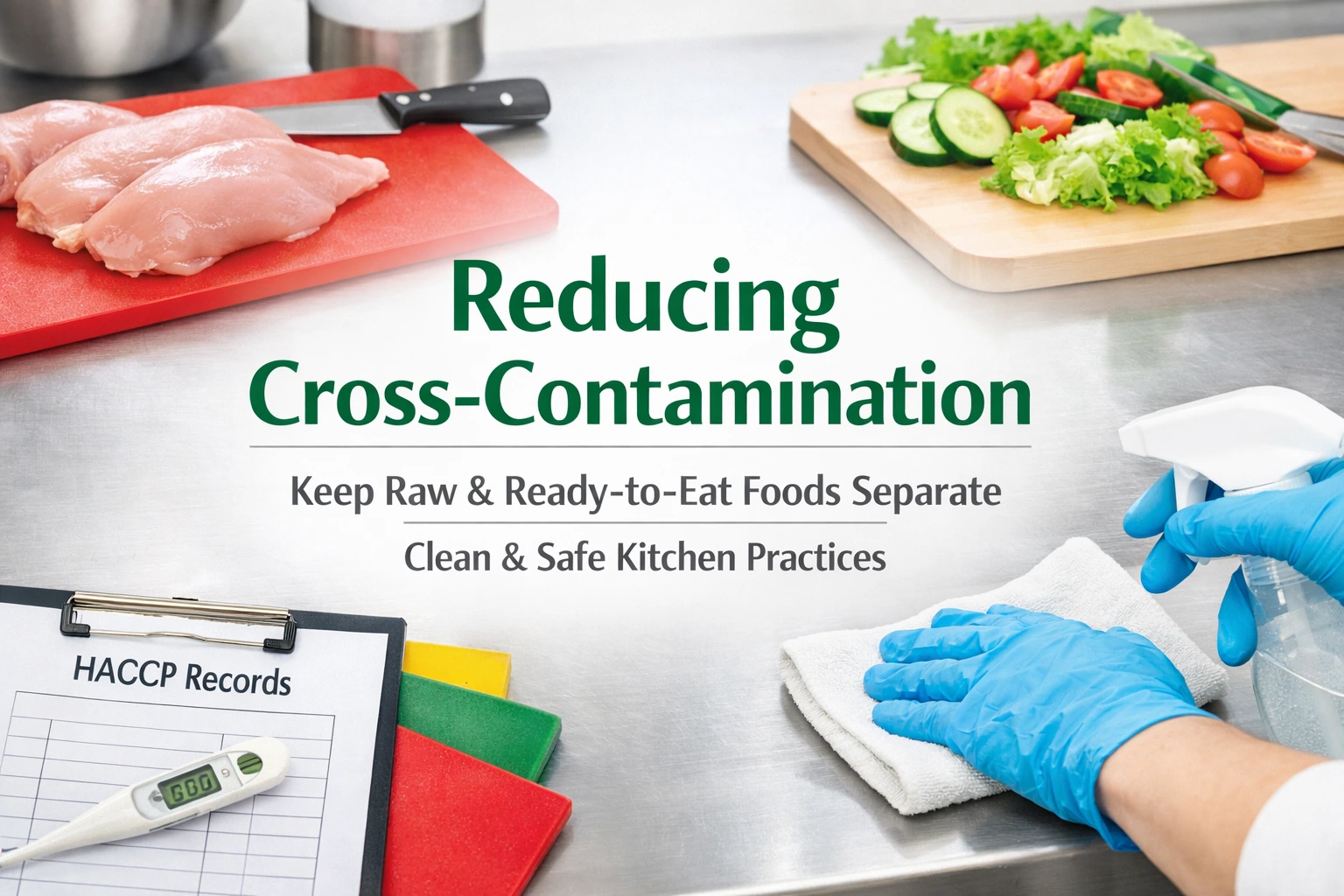
If you run a catering business, reducing cross-contamination is central to effective food safety management. This guide explains what it means in practice, what UK law expects, and how digital food safety records can help you stay organised and inspection-ready.
Table of Contents
- What is cross-contamination?
- Why it matters for UK food businesses
- Your legal duties under UK food safety law
- Practical steps to prevent cross-contamination
- Managing allergen cross-contact
- Using digital records to improve food hygiene rating
- Final thoughts
Cross-contamination happens when harmful bacteria, viruses or allergens are transferred from one surface, food or person to another.
In a busy kitchen, it often looks like:
- Raw chicken stored above ready-to-eat desserts in a fridge
- The same knife used for raw meat and salad without proper cleaning
- A cloth wiping down multiple surfaces throughout service
- Peanut residue left on a prep bench before making a “nut-free” dish
These situations are common, but they create real risks. Ready-to-eat foods won’t be cooked again, so any contamination stays there.
For most catering businesses, controlling cross-contamination is a core part of food safety management and should be built into daily routines.
Cross-contamination is one of the most frequent causes of foodborne illness in the UK. Raw poultry is commonly linked to Campylobacter. Poor separation between raw and ready-to-eat foods has also been linked to E. coli outbreaks.
Environmental Health Officers (EHOs) pay close attention to this during inspections. They’ll look at:
- Fridge layout
- Kitchen workflow
- Cleaning standards
- Staff practices
- Documented HACCP records
If controls aren’t clear or consistently followed, it can affect your inspection outcome and your ability to improve food hygiene rating.
The reputational and financial impact of a food safety incident can be significant, especially for independent businesses.
Under Regulation (EC) No 852/2004 on the hygiene of foodstuffs (retained in UK law), food businesses must prevent contamination at all stages of production and service.
You’re legally required to:
- Keep premises clean and maintained
- Protect food from contamination
- Train and supervise staff
- Implement procedures based on HACCP principles
The Food Standards Agency provides guidance for businesses, including Safer Food, Better Business (SFBB) packs.
In practical terms, EHOs expect to see clear separation between raw and ready-to-eat foods, effective cleaning and disinfection, and records that show you’re managing risks consistently.
Store raw meat and poultry on the bottom shelf of fridges, below ready-to-eat foods.
If space allows, use separate fridges or clearly designated areas. In smaller kitchens, careful shelving and strict labelling become even more important.
Where both raw and ready-to-eat foods are prepared in the same area, consider time separation. For example, prep ready-to-eat foods first, then fully clean and disinfect before handling raw meat.
Colour-coded chopping boards and knives reduce confusion. For example:
- Red for raw meat
- Green for fruit and vegetables
- Blue for raw fish
- Yellow for cooked meat
Make sure staff understand the system and follow it during busy periods.
Slicers are a common problem area. If used for both raw and ready-to-eat products, they must be fully dismantled, cleaned and disinfected between uses.
Effective cleaning is usually a two-stage process:
- Clean with detergent to remove visible dirt.
- Disinfect with a food-safe disinfectant at the correct dilution and contact time.
Rushing this stage is a frequent mistake. If the chemical doesn’t stay on the surface for long enough, it may not kill bacteria effectively.
Reusable cloths can spread contamination if not managed properly. Many businesses switch to disposable paper towels or strict laundering controls.
Handwashing remains one of the simplest and most effective controls.
Staff should wash hands:
- Before handling ready-to-eat food
- After handling raw food
- After using the toilet
- After handling waste
Gloves don’t replace handwashing. They must be changed regularly and never used to switch between raw and ready-to-eat tasks.
Cross-contamination doesn’t just apply to bacteria. Allergen cross-contact can be life-threatening.
Since October 2021, PPDS foods must include full ingredient labelling with allergens emphasised. Strong allergen management procedures are essential.
This includes:
- Storing allergenic ingredients separately
- Cleaning down between allergen and non-allergen production
- Clear recipe control
- Good communication between kitchen and front of house
Even small traces can cause serious harm, so procedures must be practical and consistently followed.
Good procedures aren’t enough on their own. You also need evidence.
Keeping accurate digital food safety records helps demonstrate that controls are in place and reviewed. This includes:
- Cleaning schedules
- Staff training logs
- Fridge temperature checks
- Documented HACCP reviews
Paper systems often get missed during busy services. A structured digital system makes it easier to see what’s complete, what’s overdue and where improvements are needed.
Food-Safety.app is a food safety management system for UK catering businesses. It supports structured record-keeping, helping you maintain consistent standards and stay organised for inspections.
When EHOs can see clear, well-maintained records alongside good practical controls, it strengthens confidence in how the business is run.
Reducing cross-contamination isn’t about complicated theory. It’s about practical habits: separating raw and ready-to-eat foods, cleaning properly, training staff and keeping clear records.
Strong food safety management protects your customers, your reputation and your food hygiene rating. Using digital tools to manage HACCP records and daily checks can make that process more consistent and less stressful.
If you’re reviewing your current system, it may be worth exploring how a structured food safety app could help you keep everything clear, organised and inspection-ready.