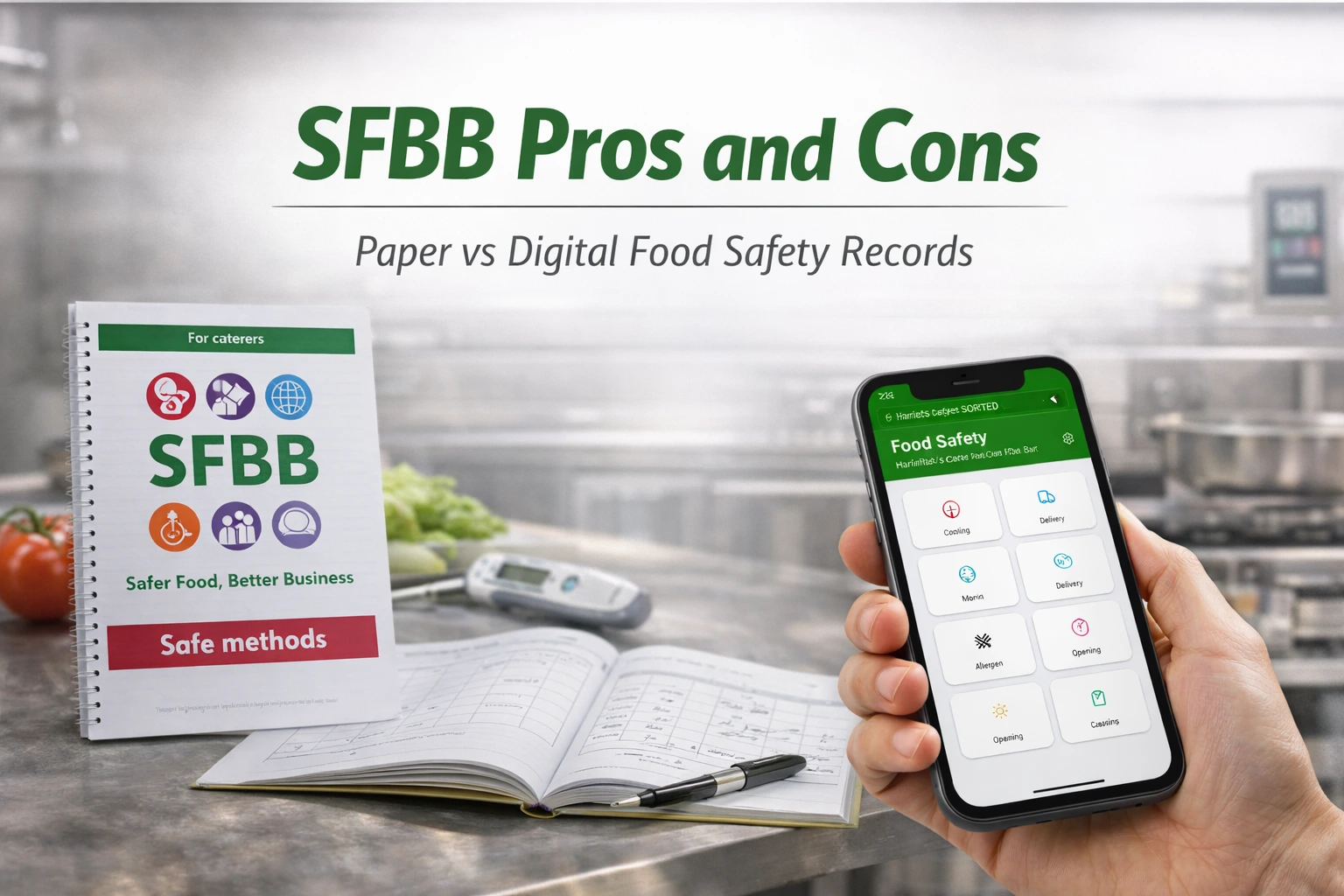
Understanding the pros and cons of SFBB can help you improve food safety management, keep reliable HACCP records, and move towards simpler digital systems like Food-Safety.app.
Table of Contents
- What is SFBB?
- Why many UK food businesses use SFBB
- Pros of using SFBB
- Common drawbacks of SFBB
- Digital alternatives to SFBB
- Should your business move to digital records?
What is SFBB?
Safer Food Better Business (SFBB) is a food safety management pack developed by the UK Food Standards Agency (FSA). It helps small food businesses follow food hygiene law using a simple system based on HACCP principles.
The pack includes safe method sheets and a daily diary where staff record checks such as fridge temperatures, cleaning tasks, and cooking controls.
For many cafés, takeaways, and small catering operations, SFBB acts as a ready-made system for documenting food safety procedures.
Food businesses in the UK are legally required to operate a system based on HACCP principles under food hygiene regulations. SFBB isn’t legally mandatory, but it’s widely accepted by Environmental Health Officers as a practical way to meet those requirements.
More information about the legal requirements can be found on the Food Standards Agency SFBB guidance.
Why many UK food businesses use SFBB
Many hospitality businesses start with SFBB because it’s free and relatively simple to understand.
A typical small kitchen might use it to:
- Record daily fridge temperatures
- Confirm food is cooked to safe temperatures
- Track cleaning tasks
- Review food safety procedures every four weeks
For example, a takeaway might record its fridge temperature each morning, confirm cooked chicken reaches 75°C, and note any problems in the diary.
These records show Environmental Health Officers that the business is actively managing food safety risks.
Pros of using SFBB
Simple starting point for food safety management
SFBB is designed for businesses without specialist food safety knowledge.
The safe method sheets already explain key hazards such as cross-contamination, cleaning, chilling, and cooking. Staff don’t need to write a full HACCP plan from scratch.
This makes it a useful introduction to structured food safety management.
Free and widely recognised
Because SFBB was created by the Food Standards Agency, most Environmental Health Officers are familiar with it.
Using the system can make inspections easier because officers know where to look for information and records.
Helps demonstrate HACCP compliance
The diary system helps create a record of checks and actions.
For example:
- temperature monitoring
- cleaning schedules
- corrective actions when something goes wrong
These become documented HACCP records that show your controls are being monitored.
Useful for staff training
SFBB also works as a simple training reference.
New staff can learn the key hazards in a kitchen, including cross-contamination risks and safe cooking temperatures.
Common drawbacks of SFBB
While SFBB can work well for small operations, many businesses struggle with the practical realities of a paper-based system.
Paper records are easy to lose or damage
Kitchen environments aren’t ideal for paperwork.
Diaries often end up with:
- missing pages
- water damage
- grease marks
- illegible handwriting
This can make it difficult to prove compliance during inspections.
Records are often filled in retrospectively
In busy kitchens, staff may forget to complete records during service.
A common issue is filling in several days of diary entries at once. While the records look complete, they don’t accurately reflect what happened.
This weakens the reliability of HACCP records.
Limited oversight for managers
If you run multiple sites or manage a busy kitchen, paper records are hard to review quickly.
You can’t easily spot patterns such as:
- repeated fridge temperature problems
- missed cleaning checks
- gaps in monitoring
Without clear oversight, it becomes harder to improve food hygiene rating outcomes.
Harder to manage allergens and changing menus
Modern catering businesses often change menus frequently or use delivery platforms.
Paper systems don’t easily adapt to things like:
- new dishes
- supplier changes
- improved allergen management
As kitchens evolve, the paperwork often stays unchanged.
Digital alternatives to SFBB
Many food businesses are now switching to digital food safety systems.
Instead of a paper diary, staff complete checks using a mobile device or tablet. Records are stored securely in the cloud.
Digital systems can support:
- temperature monitoring
- cleaning schedules
- allergen controls
- corrective action logs
- real-time reporting
These systems also create reliable digital food safety records, which can be reviewed instantly.
Food-Safety.app is a food safety management system for UK catering businesses designed to simplify these daily checks while keeping clear HACCP documentation.
Should your business move to digital records?
SFBB can still work well for small businesses with simple operations.
However, digital systems are becoming more common as kitchens look for ways to reduce paperwork and improve consistency.
For example, a busy café could complete opening checks on a tablet, automatically log temperature records, and ensure tasks aren’t missed during peak service.
This creates clearer oversight and reduces the risk of incomplete paperwork.
Food-Safety.app is a food safety management system for UK catering businesses that helps replace paper diaries with structured digital checks, making compliance easier to manage across teams and locations.
If you’re finding SFBB paperwork difficult to maintain, exploring a food safety app could be a practical step towards more consistent records, better visibility, and smoother inspections.