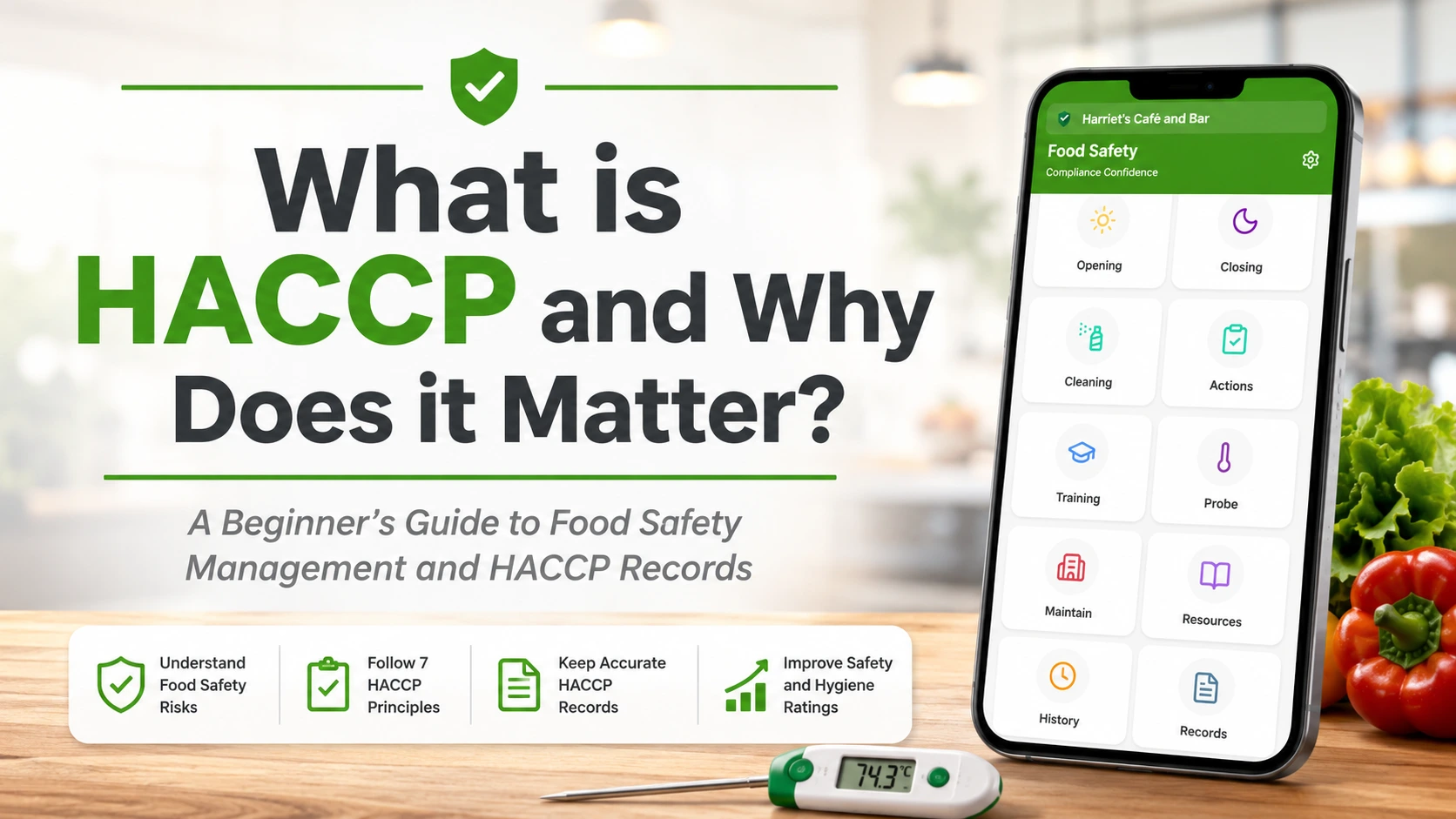
HACCP stands for Hazard Analysis and Critical Control Points. It is a practical way for cafés, restaurants, takeaways, caterers and other food businesses to identify what could make food unsafe, control those risks and keep evidence that checks have been completed.
This guide explains HACCP in plain English, shows how the seven principles work in a real kitchen and outlines the records an Environmental Health Officer may expect to see.
What is HACCP?
HACCP stands for Hazard Analysis and Critical Control Points. The name sounds technical, but the basic idea is straightforward:
- Identify what could make food unsafe.
- Decide where those risks must be controlled.
- Set clear limits and checks.
- Take action when a check shows something has gone wrong.
- Keep records that show the system is working.
Most food businesses already carry out HACCP activities every day, even when staff do not use the word HACCP. Checking a delivery, separating raw meat from ready-to-eat food, measuring a cooking temperature and rejecting damaged stock are all examples of HACCP in practice.
A HACCP system should reflect what actually happens in your business. A small coffee shop serving pre-packed cakes will not need the same controls as a care-home kitchen, a mobile caterer or a restaurant that cools and reheats large batches of food.
For a more detailed explanation of the framework, read our guide to the seven HACCP principles.
Which food businesses need HACCP?
UK food businesses must operate suitable food safety procedures based on HACCP principles. The system should be proportionate to the size, type and complexity of the operation.
This applies to businesses such as:
- Cafés and coffee shops.
- Restaurants, pubs and hotel kitchens.
- Takeaways and delivery kitchens.
- Bakeries and sandwich shops.
- Food trucks, market stalls and mobile caterers.
- Schools, nurseries and care homes.
- Contract caterers and event kitchens.
- Businesses producing, storing or distributing food.
The amount of documentation required will vary. A small café may be able to use a recognised food safety management pack, while a complex production kitchen may need detailed flow charts, product-specific controls and formal verification procedures.
Official guidance is available from the Food Standards Agency.
Why is HACCP important?
HACCP helps a business prevent food safety problems instead of relying on staff to notice them after food has already been served. It turns general instructions such as “keep food safe” into defined controls that can be checked, recorded and reviewed.
An effective HACCP-based food safety management system can help you:
- Reduce the risk of foodborne illness.
- Protect customers, employees and the reputation of the business.
- Meet food safety responsibilities.
- Give staff clear instructions during busy shifts.
- Spot failing equipment or unsafe processes earlier.
- Show that corrective action was taken when something went wrong.
- Provide useful evidence during a food hygiene inspection.
A realistic kitchen example
A café manager checks a display fridge at 10:30am and finds that it is warmer than the business’s safe limit. Simply writing down the temperature is not enough. A functioning HACCP system should tell the manager what to do next.
The manager might:
- Check the food with a clean, calibrated probe.
- Move affected food to a working refrigerator.
- Assess how long the food may have been outside safe control.
- Discard anything that cannot be shown to be safe.
- Report the faulty unit and arrange repair.
- Record the problem and the corrective action taken.
The value comes from the complete response, not the temperature entry alone. Learn more in our guide to commercial fridge temperature monitoring.
A simple HACCP example: preparing chicken curry
Imagine a restaurant prepares chicken curry in batches for evening service. The process may include receiving raw chicken, chilled storage, preparation, cooking, hot holding, cooling leftovers and reheating.
Each stage creates different risks.
| Stage | What could go wrong? | Practical control | Evidence to keep |
|---|---|---|---|
| Delivery | Chicken arrives too warm, damaged or out of date. | Inspect packaging, dates, condition and delivery temperature against the business’s acceptance rules. | Delivery check and details of rejected stock. |
| Storage | Raw chicken contaminates ready-to-eat food. | Store covered raw chicken below ready-to-eat food in suitable chilled storage. | Fridge checks and opening checks. |
| Preparation | Bacteria spread through hands, boards, knives or work surfaces. | Use safe separation, correct handwashing and effective cleaning and disinfection. | Cleaning records, training records and supervisor checks. |
| Cooking | Chicken is not cooked thoroughly. | Use a clean probe to confirm the business’s validated cooking limit has been achieved in the thickest part. | Cooking temperature and any corrective action. |
| Hot holding | Food remains at a temperature that allows bacteria to grow. | Monitor hot-held food at the frequency defined in the HACCP procedure. | Hot-holding checks. |
| Cooling | A large container cools too slowly. | Divide food into smaller portions, use shallow containers and follow the business’s safe cooling method. | Cooling record and time checks. |
| Reheating | Cold spots remain in the curry. | Stir thoroughly and probe more than one area before service. | Reheating temperature and corrective action. |
This example shows why a HACCP plan must follow the complete journey of the food. A cooking check alone will not control poor delivery, cross-contamination, slow cooling or unsafe reheating.
Businesses receiving chilled ingredients can also use our practical guide on how to check delivery temperatures.
What are the seven HACCP principles?
1. Identify food safety hazards
Consider what could make food unsafe at every stage of the process. Hazards are usually grouped into biological, chemical, physical and allergen hazards.
Real-world example: Raw chicken may contain harmful bacteria. Cleaning chemicals stored beside ingredients create a chemical risk. A broken container could introduce pieces of plastic. An undeclared ingredient could expose a customer to an allergen.
Common mistake: Writing “bacteria” for every process without identifying where contamination, survival or growth could actually happen.
2. Identify critical control points
A critical control point is a stage where control is essential to prevent, eliminate or reduce a significant hazard to an acceptable level.
Real-world example: Thorough cooking may be a critical control point because it controls harmful bacteria in raw poultry.
Common mistake: Treating every routine check as a critical control point. Important cleaning, delivery and storage controls may be managed through prerequisite procedures rather than being labelled as CCPs.
3. Set critical limits
A critical limit is the measurable boundary between acceptable and unacceptable control. It could relate to temperature, time, acidity or another validated measure.
Real-world example: A business may use a validated cooking standard of 75°C for 30 seconds, or another equivalent time-and-temperature combination suitable for its process.
Common mistake: Copying a temperature from another business without checking whether it is appropriate for the food, equipment and method being used.
4. Monitor the controls
Monitoring confirms whether a control is operating as intended. The procedure should state what is checked, how it is checked, how often it is checked and who is responsible.
Real-world example: The chef probes the centre of the thickest chicken portion from each batch and records the result before service.
Common mistake: Filling in an entire day’s record from memory at closing time. A completed sheet is not reliable evidence when the checks were not performed at the stated times.
5. Take corrective action
The HACCP plan should explain what staff must do when a critical limit or other control is not met.
Real-world example: Chicken below the cooking limit stays in the oven, is checked again with a clean probe and is not served until the required limit has been achieved.
Common mistake: Recording the failed result but leaving the corrective-action box blank. Read our guide to recording corrective actions that matter.
6. Verify that the system works
Verification means checking that the HACCP system is suitable and is being followed. This may involve reviewing records, observing staff, checking complaints, calibrating probes and reassessing procedures after a menu or equipment change.
Real-world example: A manager reviews the week’s cooking records and notices that one shift repeatedly records checks late. The manager observes the process, retrains the team and checks subsequent records.
Common mistake: Collecting months of forms without anyone reviewing them for repeated failures or suspicious entries.
7. Keep suitable records
Records provide evidence that controls were monitored and that problems were handled. They should be clear, accurate, completed at the time of the check and proportionate to the business.
Real-world example: A refrigerator record shows the result, time, staff member, affected food and action taken after a door was found open.
Common mistake: Recording only a corrected temperature and removing evidence that the original failure happened.
What HACCP records should you keep?
The records required will depend on the processes and hazards in your business. Do not create paperwork simply to make a folder look complete. Each record should support a genuine control, decision or review.
Records that may be completed during each shift
- Opening and closing checks.
- Cooking, reheating and hot-holding checks.
- Fridge and freezer checks.
- Cooling records where applicable.
- Delivery acceptance or rejection checks.
- Cleaning sign-offs.
- Corrective actions and equipment defects.
Records that may be reviewed weekly or periodically
- Deep-cleaning schedules.
- Probe accuracy or calibration checks.
- Pest-control observations.
- Stock rotation and date-labelling reviews.
- Manager reviews of missing or failed checks.
Records to update when something changes
- HACCP flow charts and hazard analyses.
- Recipes and allergen information.
- Approved suppliers and ingredient specifications.
- Staff induction and refresher training.
- Cleaning procedures and chemical instructions.
- Equipment maintenance records.
There is no value in recording a fridge as “4°C” every morning when nobody checked it. Honest records that show occasional problems and sensible corrective actions are more credible than pages of identical entries.
Allergen controls should also connect with the wider food safety system. See our guides to practical allergen management and creating an allergen matrix.
Common HACCP mistakes and how to correct them
Records are completed after the event
A closing manager fills every gap with temperatures that look reasonable. This creates paperwork but does not prove the food was controlled during service.
Better approach: Assign each check to a named role, set realistic monitoring times and investigate repeated gaps rather than inventing entries.
Every reading is identical
A record showing every refrigerator at exactly 4°C for several weeks may suggest staff are copying the expected result instead of checking the equipment.
Better approach: Train staff to record the actual reading and explain that an honest failure, followed by corrective action, is useful management information.
Corrective action is vague
Entries such as “sorted,” “chef told” or “temperature fixed” do not explain whether the food remained safe.
Better approach: Record what failed, what happened to the food, how control was restored and whether further action was required.
The probe cannot be trusted
Staff may take temperatures correctly but use a dirty, damaged or inaccurate probe.
Better approach: Clean and disinfect the probe appropriately, check its accuracy regularly and store it safely. Our guide explains how to use a food probe safely.
The HACCP plan no longer matches the menu
A takeaway introduces sous-vide chicken, vacuum packing or batch cooling but continues using a plan written when everything was cooked to order.
Better approach: Review the HACCP system whenever ingredients, suppliers, equipment, recipes, packaging or processes change.
Staff know the rule but not the reason
A new employee is told to “write down the fridge temperature” but does not know what to do when the result is unacceptable.
Better approach: Use task-based training. Show the employee how to take the check, recognise a failure, protect affected food and record the action.
Cleaning records prove a box was ticked, not that cleaning worked
A signed cleaning sheet does not prove the correct product, dilution, contact time or method was used.
Better approach: Connect cleaning schedules to clear instructions, staff training and supervisor verification.
Is HACCP the same as SFBB?
No. HACCP is the underlying food safety approach. Safer Food Better Business (SFBB) is a practical food safety management pack produced by the Food Standards Agency to help many small food businesses apply HACCP principles.
For example, an SFBB pack can help a small café document safe methods, opening and closing checks and diary entries without requiring the owner to produce a highly technical HACCP manual from scratch.
However, a pack only works when it accurately reflects the business and is used consistently. Keeping an unopened folder on a shelf does not demonstrate effective food safety management.
A business with more complex production methods may need a different or more detailed HACCP-based system. The important question is not which template is used, but whether the system identifies the real hazards and controls them effectively.
How does HACCP affect a food hygiene inspection?
An Environmental Health Officer is unlikely to assess paperwork in isolation. They may compare what the HACCP system says should happen with what staff are actually doing in the kitchen.
An officer may consider:
- Whether the documented controls reflect the menu and processes.
- Whether staff understand the controls relevant to their jobs.
- Whether temperature and cleaning checks are completed consistently.
- Whether unsafe results lead to appropriate corrective action.
- Whether managers review records and follow up recurring problems.
- Whether allergen information is accurate and accessible.
- Whether the business updates its system after changes or incidents.
What credible evidence looks like
Suppose an inspector asks what happened when a freezer failed two weeks earlier. A strong answer might include:
- The time the fault was discovered.
- The temperatures or condition of the affected food.
- Which products were moved or discarded.
- Who authorised the decision.
- The repair report.
- The follow-up check confirming the freezer was working correctly.
That evidence shows the business can recognise a problem, protect food and prevent the issue from being ignored.
Read more about what happens during a food safety inspection and what EHOs look for when reviewing kitchen records.
Official information about the rating process is available from the Food Standards Agency Food Hygiene Rating Scheme.
Paper vs digital HACCP records
Paper and digital systems can both support food safety when they are suitable, accurate and used properly. The right choice depends on the size of the team, the complexity of the business and how records are reviewed.
Paper HACCP records
Paper can be familiar and simple to introduce. However, busy kitchens often experience missing sheets, illegible handwriting, damaged folders, backfilled entries and difficulty finding evidence during an inspection.
Digital HACCP records
A well-designed digital system can make checks easier to complete and records easier to review. Useful features may include timestamps, corrective-action histories, custom checklists, record searches and PDF exports.
Moving from paper to digital does not fix a weak HACCP system automatically. Staff still need suitable procedures, training, supervision and clear responses to failed checks.
Where Food-Safety.app fits
Food-Safety.app is designed for cafés, restaurants, takeaways, pubs and catering businesses that want to replace separate paper records with one practical food safety management system.
It can be used to organise:
- Cooking, cooling and storage temperatures.
- Opening and closing checks.
- Cleaning schedules.
- Delivery checks.
- Corrective actions and defects.
- Allergen information.
- Staff training records.
- Probe checks and HACCP documentation.
The product is most useful after the business has identified what needs to be controlled. It provides a simpler way to complete, organise and review the evidence created by those controls.
Frequently asked questions
Is HACCP a legal requirement in the UK?
Food businesses must put in place, implement and maintain permanent procedures based on HACCP principles. The exact format should be proportionate to the nature and size of the business. Small businesses may use recognised food safety management packs rather than producing an unnecessarily complex manual.
Does a café need a HACCP system?
Yes. The system may be straightforward, but it should still cover the café’s real activities. This could include receiving milk and chilled food, storing fillings, preventing allergen mistakes, cleaning equipment and controlling any cooked or reheated products.
Does a food truck need HACCP?
Yes. Mobile businesses face additional practical issues such as limited refrigeration, water supplies, waste storage, restricted preparation space and changing service locations. Those conditions should be considered in the food safety system.
Is SFBB enough for a small food business?
It may be suitable when it reflects the processes in the business, is completed properly and is kept up to date. A business carrying out specialised or complex processes may need additional controls or a more detailed HACCP plan.
How often should HACCP records be completed?
There is no single frequency for every record. The frequency should be based on the risk, the process and the monitoring procedure. A cooking check may be required for each batch, while a manager’s review or probe accuracy check may be carried out at a different planned interval.
Do I need to record every food temperature?
Not necessarily. Your HACCP assessment should determine which checks provide meaningful evidence of control. Recording hundreds of low-value readings can distract staff from the checks that genuinely matter.
What should happen when a temperature check fails?
Follow the corrective action in the food safety procedure. This may involve continuing cooking, moving food to working equipment, assessing how long it has been outside control, discarding it, reporting an equipment defect and recording what happened.
Can HACCP records be kept digitally?
Yes. Digital records can be used when they are accurate, accessible, protected from inappropriate alteration and suitable for the operation. The business should also consider how records will remain available during device, power or connectivity problems.
How often should a HACCP plan be reviewed?
Review it at planned intervals and whenever a significant change occurs. Changes might include a new menu item, supplier, ingredient, piece of equipment, preparation method, packaging process or kitchen layout. Complaints, failed controls and food safety incidents should also trigger a review.
Who is responsible for HACCP?
The food business operator has overall responsibility, but successful HACCP depends on everyone understanding the controls relevant to their role. Managers should provide suitable training, supervision and verification rather than leaving responsibility with one employee or an external consultant.
Conclusion
HACCP is not simply a folder of temperature sheets. It is a working system for identifying food safety hazards, controlling the important stages, responding to failures and checking that the controls remain effective.
A useful HACCP system should:
- Match the food and processes in the business.
- Give staff clear and realistic instructions.
- Define what must be monitored.
- Explain what to do when a check fails.
- Create honest evidence of both routine checks and problems.
- Be reviewed when the business changes.
Start by mapping what happens to food from delivery to service. Identify the stages where things could go wrong, decide how those risks will be controlled and make sure staff understand the actions they must take.
Once the procedures are clear, a digital system can make the daily records easier to complete, organise and review.