If you run a catering business, knowing when staff must report illness is vital for food safety management and protecting your food hygiene rating. This guide explains the rules clearly and how a food safety app can help you stay compliant.
Table of Contents
- Why reporting illness matters
- What symptoms must be reported?
- Understanding the 48-hour rule
- Legal duties for food businesses
- Practical steps for managers
- Common mistakes to avoid
- How a digital system helps
Why reporting illness matters
In catering and hospitality, one unwell staff member can contaminate large volumes of food very quickly. Viruses such as norovirus spread easily through poor hand hygiene and ready-to-eat foods like sandwiches, salads and desserts.
Food handlers have a legal duty not to work with food if they’re suffering from an illness that could be passed on through food. Reporting symptoms early allows you to act quickly, protect customers and avoid enforcement action.
It’s also about reputation. A single outbreak linked to your business can seriously affect trade and make it harder to improve food hygiene rating scores at your next inspection.
What symptoms must be reported?
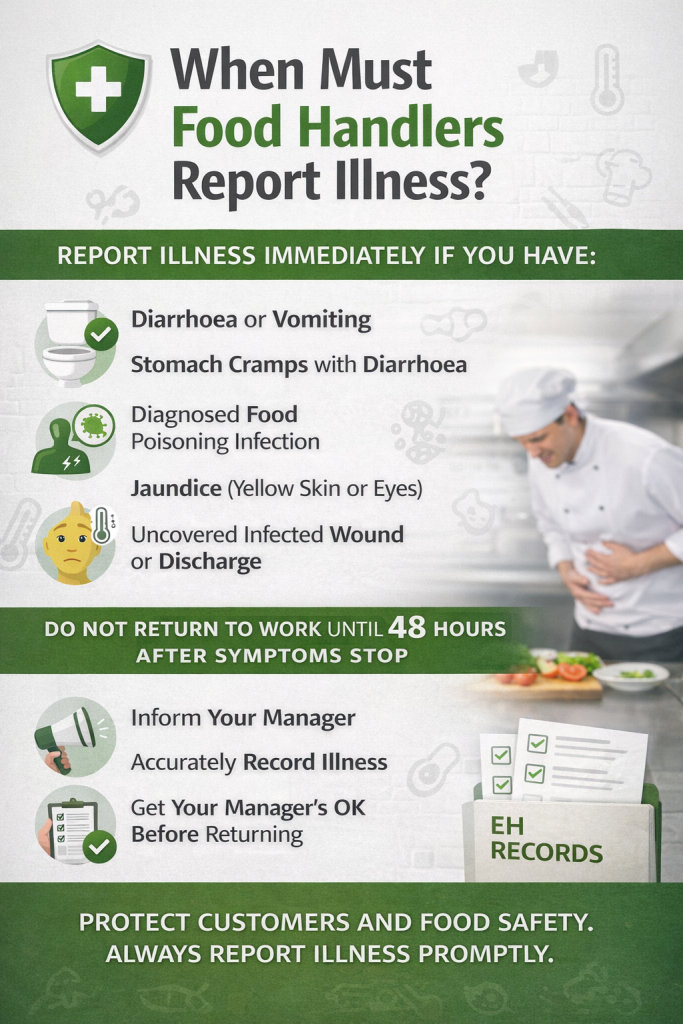
Staff must tell you immediately if they experience:
- Diarrhoea
- Vomiting
- Stomach cramps with diarrhoea or vomiting
- Fever linked to gastric symptoms
They must also report:
- Jaundice (yellowing of the skin or eyes)
- Diagnosed food poisoning infections such as Salmonella or E. coli
- Infected wounds, boils or skin infections that can’t be securely covered
- Discharge from eyes, ears or nose
These requirements come from UK food hygiene law, including Regulation (EC) 852/2004 (retained in UK law). You can read more in the official guidance from the Food Standards Agency .
Even if symptoms seem mild, staff should report them. It’s far safer to assess and exclude someone early than deal with the consequences of contamination later.
Understanding the 48-hour rule
The “48-hour rule” is one of the most important practical controls in catering.
If a food handler has diarrhoea or vomiting, they must:
- Stop working immediately
- Stay off work
- Not return until 48 hours after symptoms have completely stopped
This applies even if they feel better sooner.
For example, if a chef in a pub kitchen is sick on Monday evening but feels fine by Tuesday afternoon, they still cannot return to food handling until Thursday afternoon.
In some confirmed infections, such as certain strains of E. coli or Typhoid, public health officials may require clearance samples before return. Always follow advice from your local authority or UK Health Security Agency.
Legal duties for food businesses
As a food business operator, you must have procedures in place to manage staff illness as part of your wider food safety management system.
This includes:
- A clear sickness reporting policy
- Staff training on when and how to report symptoms
- Records of illness and return-to-work dates
- Exclusion controls built into your HACCP records
Environmental Health Officers (EHOs) will often ask to see evidence that you manage staff illness properly. If you can’t show documented procedures or records, it may affect your inspection outcome.
Illness reporting also links closely with allergen management, as unwell staff are more likely to make mistakes if they’re not fit to work.
Practical steps for managers
For busy kitchens, clarity and consistency are key.
Have a simple reporting process
Staff should know exactly who to call and when. Encourage them to report symptoms before their shift starts.
Carry out return-to-work checks
A short discussion when they come back confirms they’ve been symptom-free for 48 hours.
Keep written records
Whether paper-based or digital, you need proof of exclusion periods and return dates.
Create a culture of honesty
Staff may worry about losing pay or letting the team down. Make it clear that staying off when ill protects everyone, including the business.
In high-risk settings such as care homes, nurseries or hospitals, illness controls should be even tighter due to vulnerable customers.
Common mistakes to avoid
- Staff returning before the 48-hour period ends
- No written sickness policy
- Agency or temporary staff not briefed on reporting rules
- Managers ignoring “mild” symptoms
- No documented link between illness controls and HACCP
Another common issue is relying on memory instead of keeping proper records. During an inspection, “we usually tell them to stay off” isn’t enough. You need evidence.
How a digital system helps
Managing illness alongside cleaning schedules, temperature checks and supplier controls can feel overwhelming.
That’s where digital tools make a difference. Using digital food safety records allows you to:
- Log staff illness in real time
- Record exclusion dates automatically
- Link sickness reporting directly to your HACCP system
- Keep everything ready for inspection
Food-Safety.app is a food safety management system for UK catering businesses. It brings illness reporting, monitoring checks and compliance records into one place, helping you stay organised without adding paperwork.
When processes are simple and consistent, staff are more likely to follow them correctly.
Conclusion
Knowing when a food handler must report illness isn’t just a legal technicality. It’s a practical safeguard that protects customers, your team and your reputation.
Clear rules, proper exclusion periods and accurate records are essential parts of good food safety management. With the right systems in place, managing staff illness becomes routine rather than stressful.
If you’re reviewing your procedures, it may be worth exploring how a dedicated food safety app can support consistent reporting, structured HACCP records and stronger inspection outcomes across your business.