Learn what food safety you need when starting a business. This food safety startup guide will help you get set up with confidence and avoid common mistakes.
Requirements for a food safety startup
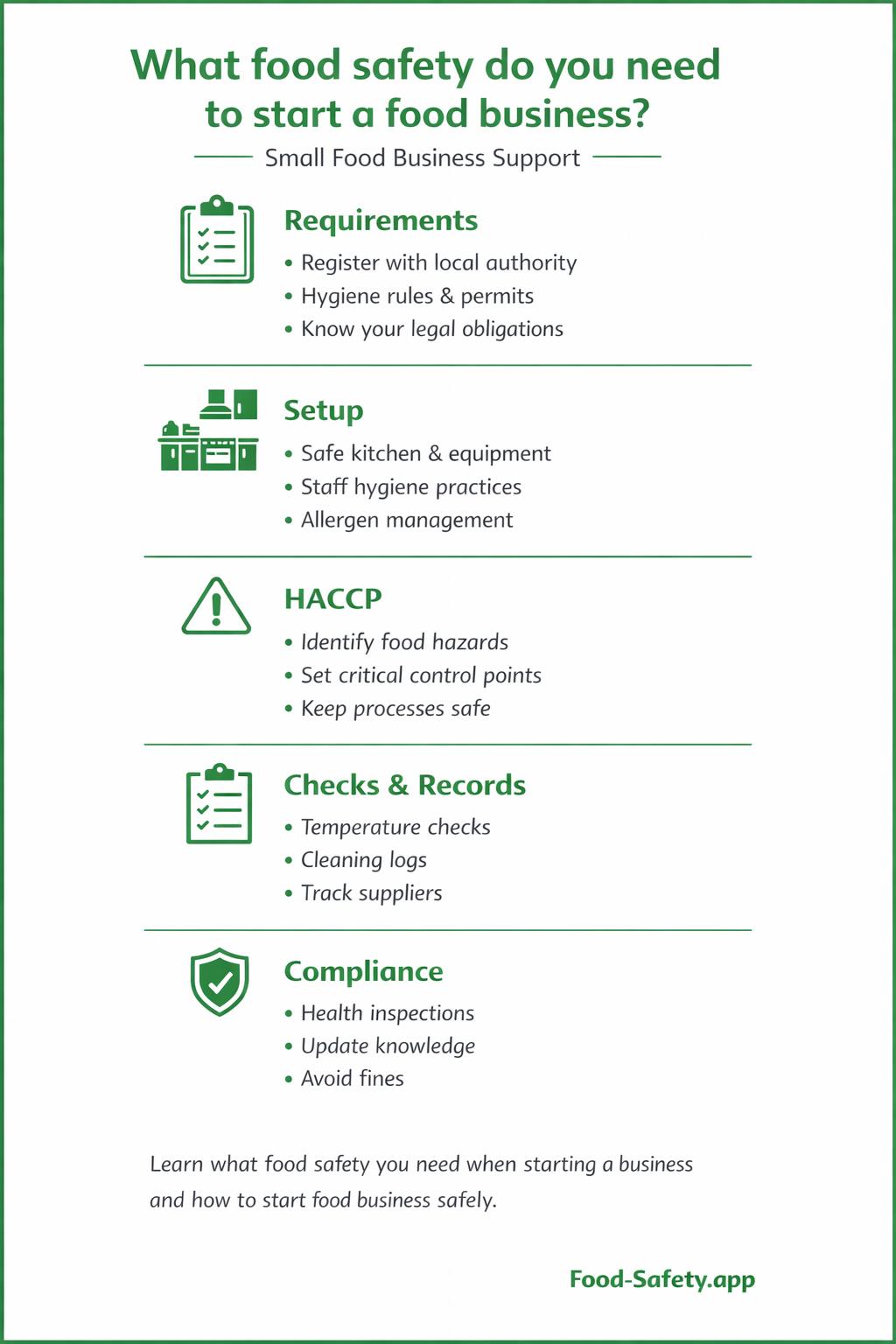
If you’re launching a café, takeaway, food truck, or home-based catering service, the first step is understanding your legal duties. A food safety startup usually needs safe premises, trained staff, pest control, cleaning systems, allergen control, and procedures that prevent contamination. In most places, you’ll also need to register your food business with the local authority or relevant regulator before trading. The exact rules vary by country, but the core expectation is the same: food must be safe, traceable, and handled hygienically at every stage.
That means thinking beyond the menu. You’ll need suitable equipment, reliable suppliers, temperature controls, and a simple system for managing hazards. For example, a sandwich shop needs clear separation between raw and ready-to-eat food, while a catering business may need chilled transport and hot-holding controls. If you want a practical structure from day one, food safety systems can help turn legal duties into everyday routines.
Setting up your kitchen safely
Your setup should make safe food handling the easiest option. Start with cleanable surfaces, enough handwashing facilities, suitable refrigeration, and separate storage for raw ingredients, allergens, and ready-to-eat foods. Good layout reduces risk, especially in small kitchens where space is tight. A bakery, for instance, may need a clear flow from ingredients to mixing, baking, cooling, packing, and dispatch so that dirty and clean activities don’t overlap. The safer your layout, the less you’ll rely on memory and the fewer mistakes you’ll make under pressure.
It also helps to set safe limits for equipment and processes early on. Thermometers, fridges, freezers, and hot-holding units should all be checked against your chosen standards. That’s where a structured approach to temperature control becomes useful, because keeping food out of the danger zone is one of the simplest ways to reduce the risk of food poisoning. For a food safety startup, these basics matter just as much as the recipes themselves.
How to build a HACCP plan for a new food business
HACCP stands for Hazard Analysis and Critical Control Points, and it’s the backbone of most modern food safety systems. For a food safety startup, the aim isn’t to produce a thick folder that sits on a shelf. It’s to identify where things could go wrong, decide which steps are critical, and write down what you’ll do to prevent problems. Common hazards include bacteria growth, allergen cross-contact, cleaning chemical contamination, and foreign bodies such as broken glass or packaging fragments.
Start with your menu and map the process for each product. For example, if you serve chicken curry, you’d look at receiving the chicken, chilled storage, cooking, cooling if needed, reheating, and hot holding. Then decide what controls matter most, such as minimum cooking temperatures, fridge limits, and time controls. If you need help turning those steps into a workable system, food safety fundamentals is a useful place to build your understanding before you formalise your plan.
Food-Safety.app can also support this stage as a food safety management system for catering businesses, especially if you want a simple way to organise tasks and records without relying on paper files that get lost or forgotten. Keep your HACCP plan proportionate, practical, and based on the food you actually make.
Focus on the risks that matter most
In a new business, it’s easy to overcomplicate HACCP by trying to cover every possible issue in equal detail. Instead, prioritise the risks most likely to affect your operation. For a sandwich bar, allergen cross-contact and chilled storage may be the biggest concerns. For a mobile burger unit, cooking and hot holding may be more important. For a bakery, contamination from utensils, surfaces, and handling may be the main issue. The best food safety startup plans are simple enough for staff to follow during a busy shift.
Daily checks and controls
Once your business opens, day-to-day checks become the real test of your food safety startup. You should confirm that fridges are cold enough, freezers are working, cooked food is held safely, and cleaning is done to schedule. Delivery checks are also important, because you should never accept damaged packaging, warm chilled goods, or products past their use-by date. Small failures can become serious quickly, especially in catering where food may be prepared in advance and served to large groups.
It’s also important to build in checks for allergen safety, opening and closing routines, and equipment condition. If a fridge is running warm or a probe gives inconsistent readings, you need to know straight away, not after service. A good cleaning and hygiene routine helps control bacteria and reduce cross-contamination, while regular staff awareness keeps standards consistent even when the team is busy or changing frequently.
Use simple prompts that staff can complete quickly, such as opening checks, temperature readings, cleaning sign-offs, and defect reporting. This makes it easier to spot trends before they turn into food safety failures. For example, repeated fridge issues may show that maintenance is overdue, or recurring cleaning gaps may mean a shift pattern needs adjusting. The goal is not paperwork for its own sake, but control that actually works in real service conditions.
What records should a new food business keep?
Records show that your food safety startup is being managed properly. They also help you learn from problems and demonstrate due diligence during inspections. At a minimum, you should keep evidence of training, cleaning, temperatures, allergen controls, corrective actions, maintenance, and supplier checks. These records don’t need to be complicated, but they should be accurate, easy to find, and completed when the work is done, not filled in later from memory.
Digital systems can make this much easier, especially if you’re running a small team or working across multiple sites. Automatic timestamps, full history, and instant PDF exports can save time and make inspections less stressful. They also help with consistency when staff change. If you’d like to see how digital record-keeping can support daily operations, paperwork and digital food safety explains the practical benefits without adding extra admin burden.
Training records matter from the start
Even in a small business, staff training is a legal and practical necessity. New employees should understand handwashing, contamination risks, temperature checks, allergen handling, and what to do if something goes wrong. Keep a record of what training was given, when it happened, and who completed it. That way, you can show that your team has been properly briefed and can identify any gaps before they affect food safety. Training is especially important in fast-paced catering environments where shortcuts can happen easily.
How to stay compliant as your business grows
Compliance isn’t a one-off task. Once your business is open, you need to review your controls, update your HACCP plan when menus change, and act quickly when something goes wrong. If you introduce new dishes, delivery services, outside events, or late-night trading, your risks may change too. A food safety startup that works for a small launch menu may not be enough once you scale up, so regular review is part of staying legal and protecting your customers.
That’s why it helps to build food safety into routine management rather than treating it as a separate job. Keep your checks current, fix problems promptly, and make sure records are available if an inspector asks to see them. For broader guidance on daily operation and long-term control, running a food business safely is a helpful next step. If you need a simple starting point, Food-Safety.app can support a food safety startup with practical tools for checks, HACCP, and inspection-ready records.
Starting a food business can feel overwhelming, but food safety doesn’t have to be. If you focus on the essentials — safe setup, a workable HACCP plan, regular checks, and clear records — you’ll create a stronger business from day one. A solid food safety startup protects your customers, supports your team, and makes compliance much easier as you grow.