If you manage a busy commercial kitchen, knowing when staff must stay off after sickness can stop a small illness turning into a food poisoning incident, an outbreak, or a costly staffing mess. The key is to make quick, sensible decisions, keep exclusion periods clear, and return staff only when they are well enough and safe to work with food again. In the UK, the exact rules and best practice can differ from other countries, so always follow local guidance as well as your own company procedures.
For a broader safety framework, see our guide on HACCP.
Contents
When staff must stay off after sickness
The rule in food businesses is simple in principle: if a member of staff has symptoms that could spread infection, they should not handle food, clean food-contact surfaces, or work in areas where they could contaminate ready-to-eat food. This is especially important in restaurants, school canteens, hotel kitchens, cafés and takeaways where one ill person can affect a full service.
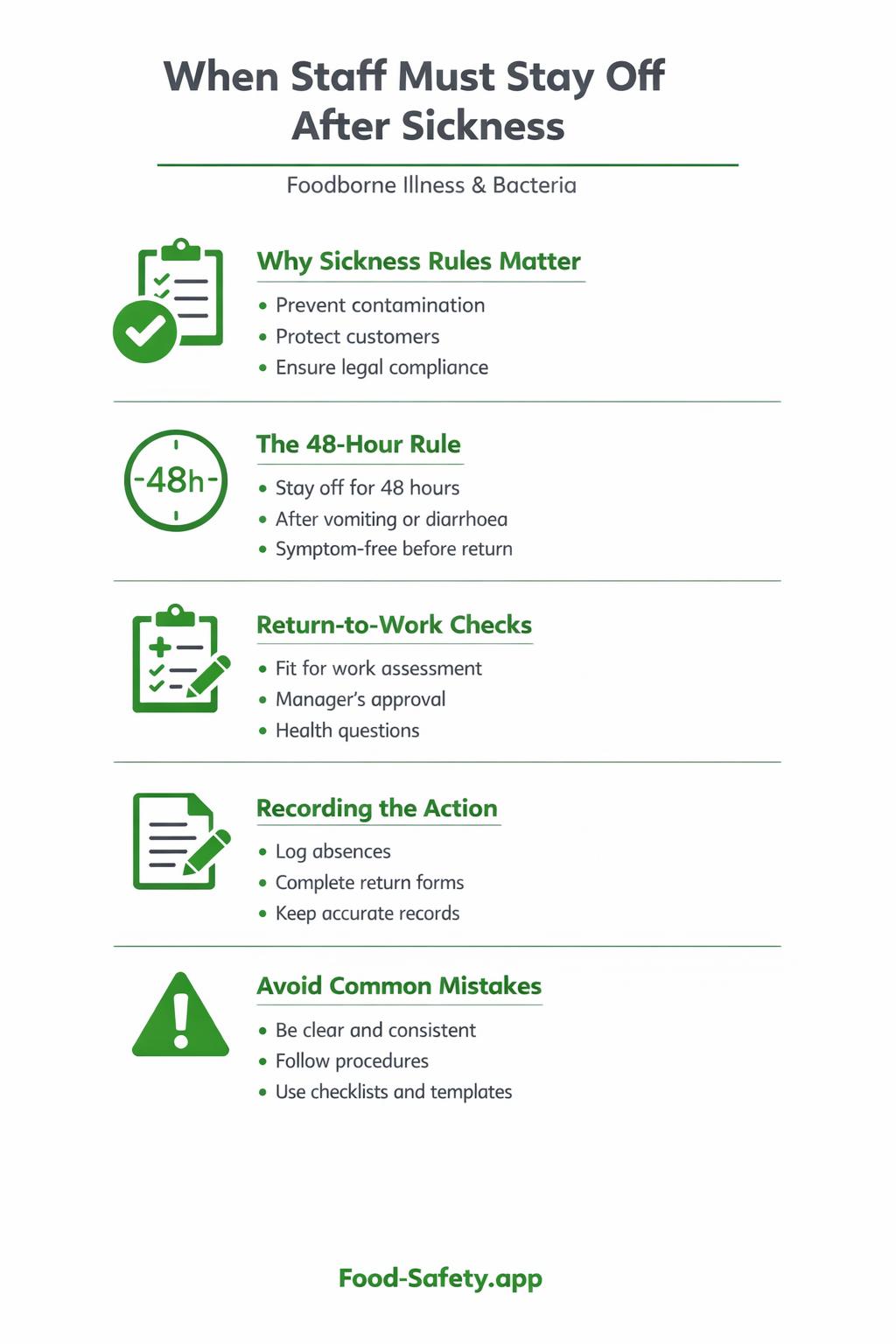
The most common reason for exclusion is stomach and bowel illness, particularly vomiting and diarrhoea. Staff should stay off during the illness and should not return until they are fully well and have been symptom-free for the appropriate period set by your local guidance and your company policy. Other illnesses, such as fever with a flu-like condition, can also make staff unfit for food work if they are coughing, sneezing, weak, or unable to maintain good hygiene.
For food businesses, the practical question is not just “Can they work?” but “Can they work safely around food, equipment, and colleagues?” If the answer is no, they must stay off food duties. That may mean staying away from prep, plating, wash-up support, or anything else that could spread contamination.
Symptoms that usually mean immediate exclusion
Any of the following should trigger a manager review straight away:
- Vomiting
- Diarrhoea
- Fever with stomach upset
- Unexplained sickness and feeling unwell enough to struggle with work
- Visible signs of infection such as infected cuts that cannot be fully covered and protected
- Symptoms that make good hand hygiene difficult to maintain
In a professional kitchen, the safest approach is to treat sudden sickness seriously rather than try to “see how they go”. A chef who feels better after a few hours may still be within the risky period for spreading illness. The same applies to front-of-house staff who help plate desserts, garnish drinks, or clear and reset utensils.
If there is any uncertainty, keep the person off food handling until you have checked the symptoms, timing, and whether they have been illness-free long enough. If the illness may be linked to a notifiable infection or a wider incident, escalate it quickly through your local food safety process.
Return to work checks before a food handler comes back
A return-to-work check should be part of the manager routine, not an awkward chat at the pass. Before letting someone back into food work, confirm:
- What symptoms they had
- When the symptoms started
- When they last vomited or had diarrhoea
- Whether they have been symptom-free for the required period
- Whether they still feel weak, dehydrated or unable to keep up with hygiene standards
- Whether they need temporary non-food duties first
If they are back on site but not quite ready for full kitchen duties, use low-risk tasks where appropriate, such as stock rotation, paperwork, or closed-pack cleaning duties that do not involve exposed ready-to-eat food. In a busy service, that can protect the business without rushing someone straight back onto prep or service.
Do not assume that looking better means being safe to return. Someone may be physically present but still unsafe if they are rushing to the toilet, can’t keep hydrated, or are not focused enough to maintain strict hygiene. That is a real risk in fast-moving catering environments.
Maintaining personal hygiene remains essential; see why hand-washing is so important for UK food businesses.
What this means in busy kitchens
High-pressure service can lead managers to make poor decisions, especially when rota gaps are hard to fill. But one poorly timed return can affect a whole shift. For example, if a breakfast chef comes in after a stomach bug and starts handling pastry, fruit garnish and clean crockery, the contamination risk spreads fast. In a school canteen or care setting, the consequences are even more serious.
Good practice is to have a simple sickness reporting routine:
- Staff must report symptoms before the shift, not just when they arrive
- Managers must decide on exclusion before food work starts
- Replacement cover plans should be ready for common sickness absences
- Non-food duties should only be offered where they are genuinely low risk
- Any cleaning after sickness should focus on toilets, touch points, uniforms and food areas that may have been contaminated
If a person has been sick on site, deep cleaning and safe disposal of contaminated items may be needed. Keep other staff away from the affected area until it has been cleaned properly.
Good temperature control is essential; see fridge temperature monitoring.
Records, reporting and manager actions
Keeping clear records helps you make consistent decisions and shows that your team takes food safety seriously. A simple sickness log should include the date, symptoms reported, manager decision, return-to-work check, and any temporary restrictions. This is especially useful if the same person has repeated illness or if there is a cluster of symptoms across the team.
Managers should also know when to ask further questions. If a worker has vomiting and diarrhoea after a shared meal, or if several staff members become ill at around the same time, that needs prompt investigation. Do not wait for the end of service if there is a serious pattern.
For UK businesses, a trusted starting point for public health advice is the Food Standards Agency, which explains food hygiene responsibilities and illness controls for food handlers. If you operate in another country, check your local authority or health body because the details can vary.
Regular cleaning and sanitation are essential parts of effective controls; see cleaning schedules for better food safety management.
Common mistakes to avoid
Common mistakes include letting staff return because the rota is short, assuming medication has fixed the problem when symptoms have not fully cleared, using sick staff on “light duties” that still involve open food, failing to ask about vomiting and diarrhoea specifically, not recording decisions, which makes repeat judgement harder later, and forgetting that hotels, cafés and takeaways often have shared prep spaces where contamination spreads quickly.
The safest kitchens are the ones that make exclusion routine, not dramatic. If everyone knows the process, staff are more likely to report illness early and managers are less likely to make rushed decisions during service.
Practical takeaways
When staff are sick, the safest approach is to stop food work early, check symptoms properly, and only allow a return when they are well enough and no longer a contamination risk. Keep the process simple: report, exclude, record, and check before return. In a professional kitchen, that protects customers, colleagues and the business.
Clear sickness rules, sensible cover planning and good records make everyday decisions easier. If you want to keep that process consistent across shifts and sites, a food safety management system for catering businesses such as Food-Safety.app can help teams follow the same checks every time.
Keep food safety checks consistent
Food-Safety.app helps catering teams manage daily checks, staff routines and records in one place, so sickness decisions, cleaning controls and food safety tasks are easier to follow across shifts. It’s built to support practical kitchen management without adding unnecessary admin pressure.