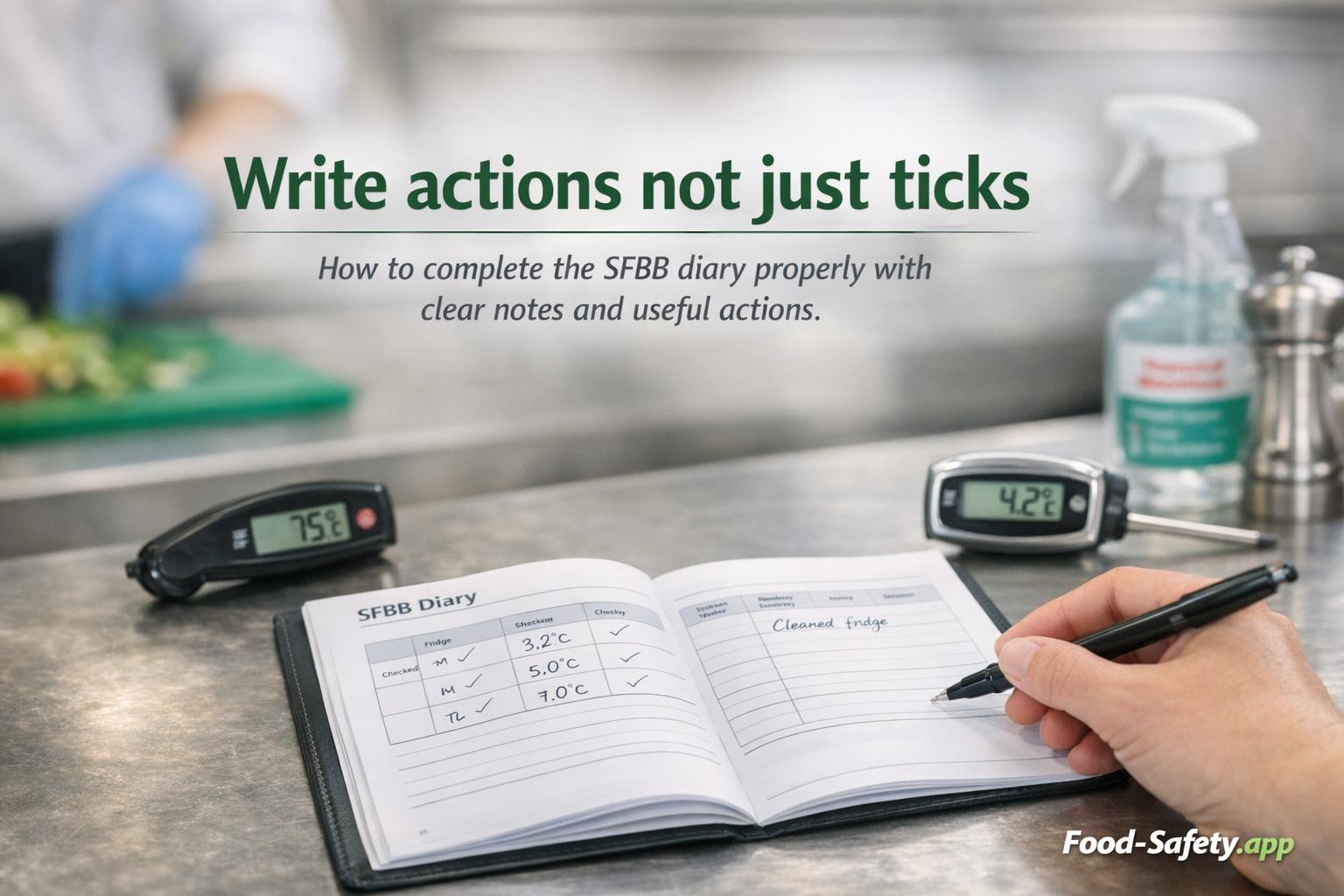
Knowing how to fill in the SFBB diary properly can save time, reduce mistakes and give your team a clear record of what was checked each day. In a busy commercial kitchen, the diary should be quick to complete, easy to understand and strong enough to show that food safety controls are being followed. Done well, it supports daily routine, helps managers spot problems early and keeps records tidy for inspections. See HACCP principles explained for context.
What the SFBB diary is for
SFBB stands for Safer Food, Better Business. The diary is the daily record that supports your food safety management system. It is not meant to create paperwork for the sake of it. Its job is to show that the key checks are being done, issues are being dealt with, and safe practice is part of the routine.
For restaurant owners, kitchen managers, chefs and catering teams, the diary should reflect what actually happens on shift. A good diary is brief, clear and honest. If the fridge had a problem at lunchtime, that needs to be written down. If a delivery arrived in poor condition and was rejected, that should also be noted. That kind of record is far more useful than a page full of ticked boxes with no detail.
What to record each day
The exact sections can vary depending on the SFBB pack you use, but most diaries focus on the same basics. In a professional kitchen, the main aim is to show that you have checked the controls that matter most to food safety.
It also aligns with cross-contamination and food safety management best practices.
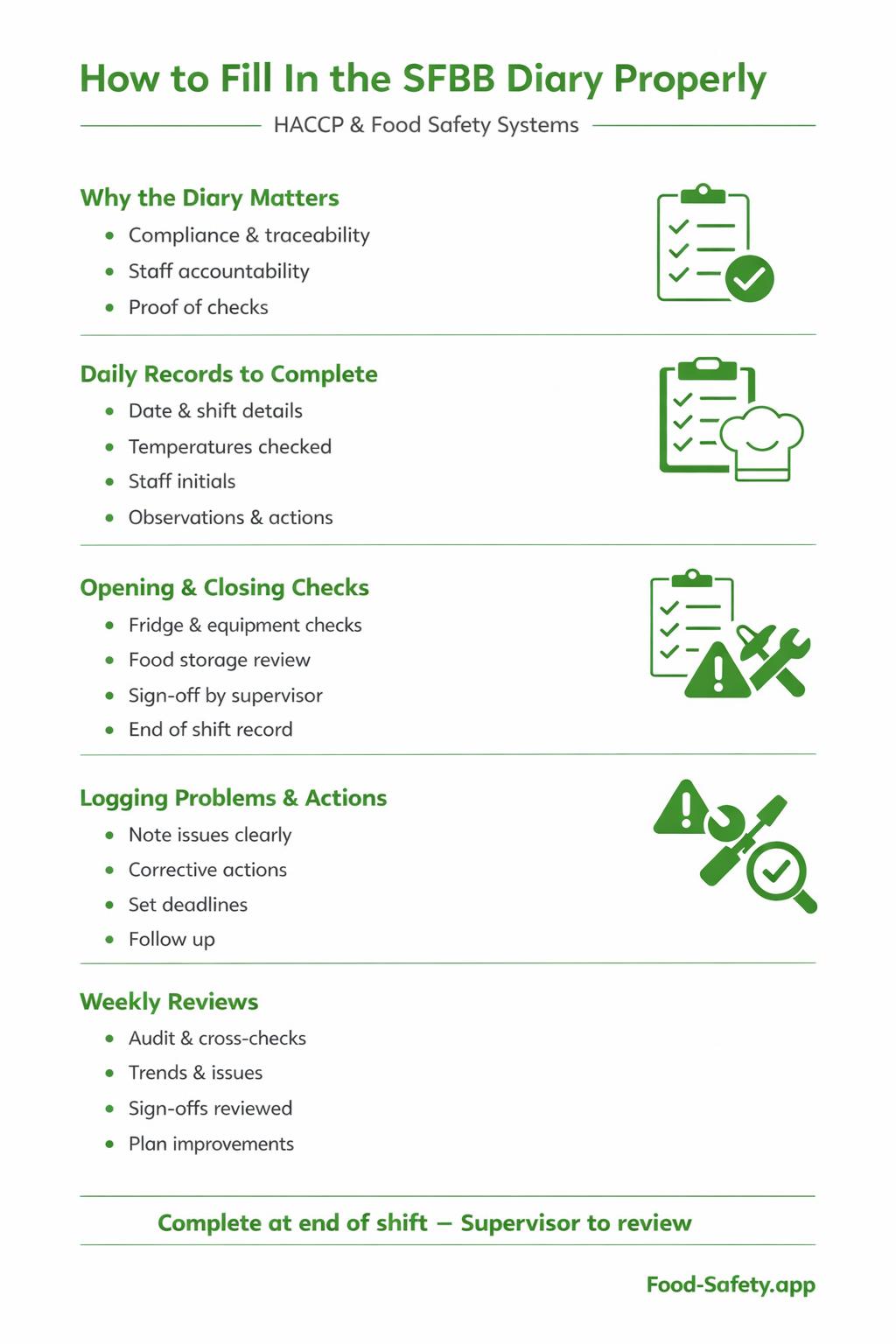
Typical daily entries include
- Opening checks, such as cleanliness and readiness for service
- Fridge and freezer checks, where your system requires them
- Cooking, cooling or reheating controls, if they are part of your process
- Cleaning checks for equipment, surfaces and food contact areas
- Pest control or signs of pest activity
- Allergen controls, where relevant to the operation
- Delivery checks and stock issues
- Any faults, breakdowns or corrective actions
If your business is a café, hotel kitchen, takeaway, school canteen or contract caterer, the same principle applies: record what you actually check, not just what looks neat on paper. A small team can keep this simple if the checklist is part of the daily close-down or opening routine.
How to fill in the SFBB diary properly
The best way to fill in the SFBB diary properly is to make the record immediate, specific and easy for the next person to understand. The diary should be completed by the person doing the check, or by someone who has been clearly briefed and can confirm what happened.
Use clear, simple wording
Write in plain English. For example, instead of saying “issue dealt with”, write “top fridge running warm at 8:10am, moved high-risk food to backup fridge and called engineer”. That tells the story, shows action and avoids confusion later.
Be consistent with times and dates
Always use the correct date and, where the diary asks for it, the time of the check. In busy service, timing matters. A fridge that was fine at opening but faulty after lunch is very different from one that failed overnight.
Record actual findings, not assumptions
If you did not check something, do not pretend you did. If a delivery was accepted by a supervisor but you were off shift, do not guess at the detail. Good records should be based on what was seen, done or measured by the person signing it.
Sign or initial as required
If your SFBB diary needs initials or a signature, complete it every time. This shows responsibility and makes it easier to follow up if there is a query. In larger kitchens, a manager may also review entries later to spot repeated issues.
Write corrective action straight away
If something is not right, do not leave the page blank or write “sorted”. Note what was wrong, what was done, and whether the problem was resolved. This is one of the most important parts of the diary.
What to write when something goes wrong
Corrective action is where many teams go wrong. It is not enough to say there was a fault. The diary should show the response. That might mean moving food to another fridge, discarding unsafe items, contacting maintenance, or increasing checks until the issue is fixed.
Useful corrective action examples
- “Fridge 2 not holding temperature, food moved to prep fridge, engineer called.”
- “Raw chicken delivery rejected due to damaged packaging and warm product.”
- “Hand wash basin blocked, cleared before service and checked again after lunch.”
- “Cleaning check failed on slicer, equipment taken out of use and re-cleaned.”
Where food safety may have been affected, write what happened to the food as well. If items were discarded, say so. If they were held pending a decision, make that clear. This is especially important in school kitchens, care settings and hotel operations where multiple teams may need to understand the issue later.
Common mistakes to avoid
Most weak diaries fail for the same reasons. They are either too vague, completed too late, or used as a tick-box exercise with no real value. Avoid these common mistakes:
- Filling in the diary at the end of the week from memory
- Writing “OK” without showing what was checked
- Leaving gaps in dates or sections
- Using the same phrase every day, even when conditions changed
- Not recording faults, breakdowns or out-of-range checks
- Failing to note what was done with affected food
- Using illegible handwriting that another team member cannot read
A diary should tell the truth about the day. If there is a temporary issue in a busy service, honest notes are better than perfect-looking records with missing detail.
How to make the diary work in a busy kitchen
In a busy commercial kitchen, the diary only works if it fits the workflow. Keep it where checks happen, not locked in an office drawer. Make sure the responsibility is clear for opening, service and closing. If several people use the diary, agree who completes each section so nothing is missed.
Practical routine that helps
- Attach the diary to the daily opening checklist or close-down folder
- Keep a pen with it so staff are not searching for one
- Use short, clear prompts for each control point
- Review entries during handover or end-of-shift checks
- Escalate repeated faults to the manager without delay
It also helps to train new staff using real examples from your own operation. A takeaway kitchen will have different pressure points from a hotel breakfast service, but the principle is the same: write down the check, note the result, and record action if needed.
See also our guidance on cleaning schedules for better food safety management.
Final checks before closing the diary
Before the diary is put away, check that every required section has been completed, any issues have a clear follow-up, and the writing can be understood by someone else. If a manager is reviewing it, they should be able to see at a glance that checks were done properly and that any problems were dealt with.
For current UK guidance, the Food Standards Agency provides useful information on Safer Food, Better Business. Rules and expectations can vary outside the UK, so always follow the system that applies to your business location.
For more on Food hygiene ratings and inspections, see Understanding food hygiene ratings.
When the diary is completed well, it becomes more than paperwork. It is a simple daily record that supports safe service, helps teams stay organised and gives managers confidence that the basics are under control. For businesses that want a straightforward way to keep records in order, Food-Safety.app is a food safety management system for catering businesses.
In summary, the key to how to fill in the SFBB diary properly is to keep it accurate, specific and up to date. Focus on the checks that matter, write clear corrective actions, and make sure the record reflects what happened in the kitchen that day. That approach is practical, professional and much more useful than a diary filled in after the event.