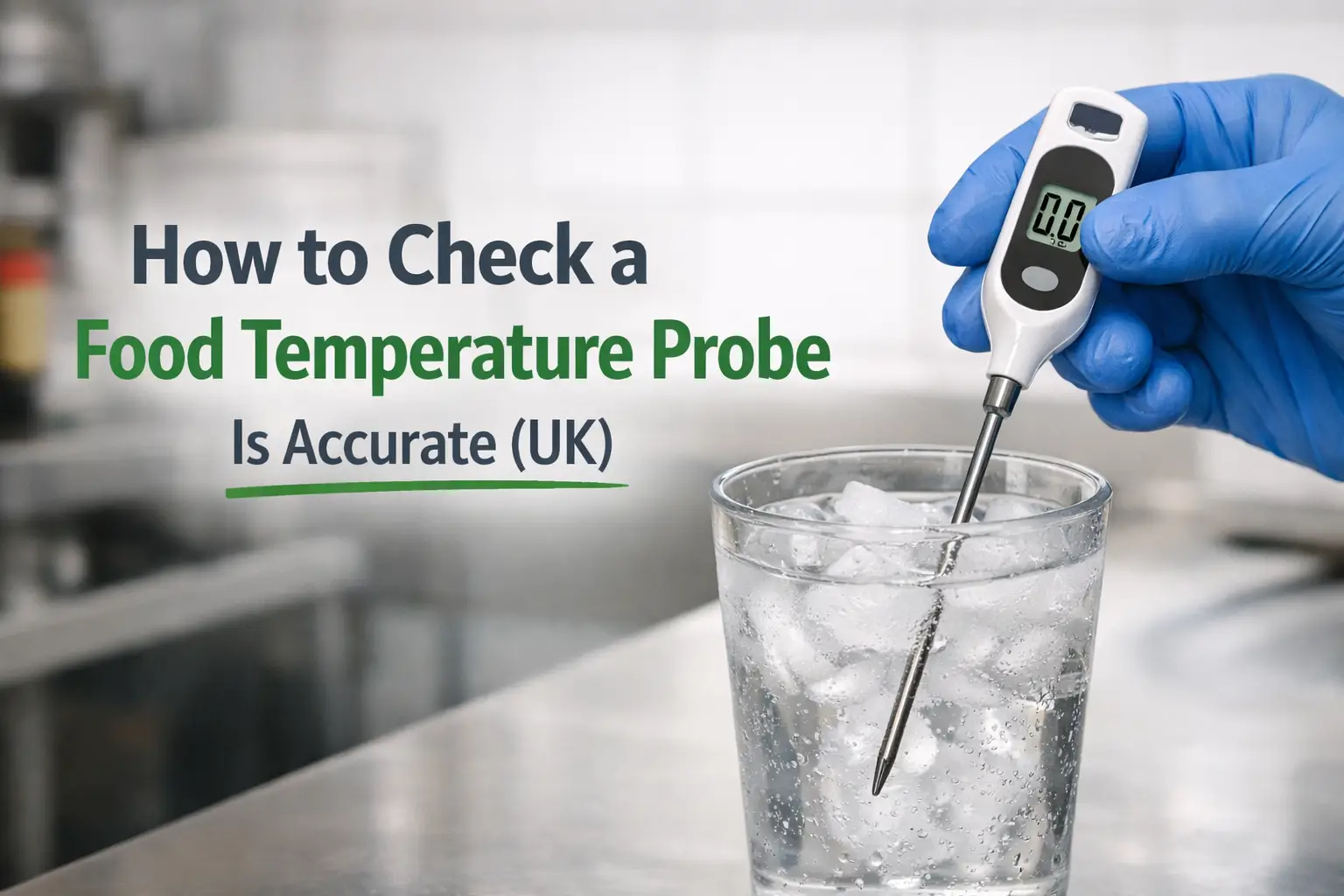
Learn how to check a food probe is accurate before it causes bad decisions. Covers simple calibration checks cleaning steps and record keeping.
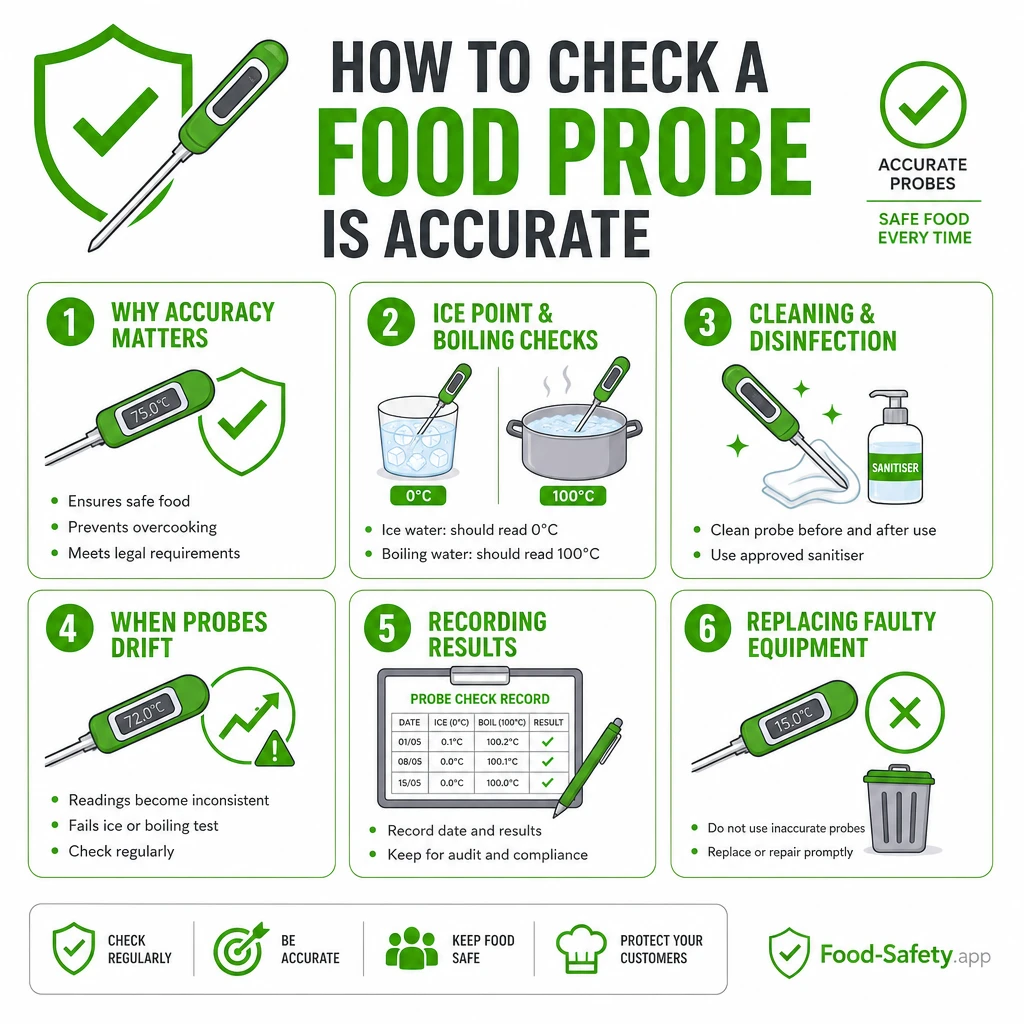
Why probe accuracy matters in a busy kitchen
Accurate temperature readings are the backbone of your HACCP controls. An undercooked dish because a probe reads low creates a direct food safety risk. Misleading readings during cooling can produce unsafe records, while incorrect hot-holding temperatures may conceal food that has fallen into the danger zone. Consistent, auditable probe results support compliant cooking, cooling, reheating and service planning, reducing the chance of a recall or an inspection finding.
Under cooking and food safety risk
A probe that drifts high or low risks delivering meals that never reach safe core temperatures. This is particularly critical for proteins and ready-to-eat items prepared in advance for service.
Impact on cooling, reheating and hot holding records
Cooling logs and hot-holding readings rely on reliable probes. If a device is inaccurate, logs may show compliant practice when the reality is unsafe, or vice versa—undermining confidence in your records and audit trails.
Signs a probe may be drifting
Early detection saves waste, protects customers and keeps staff confidence high. Look for these indicators in day-to-day use.
Slow readings
Readings that take unusually long to reach stabilisation or remain slow compared with a known reference can indicate drift or a compromised probe.
Inconsistent results
Two readings from the same food item or same temperature zone that differ by more than 1–2°C without any obvious cause should be investigated.
Damaged cable or probe head
Cracks, kinks or exposed wiring, and a probe head that feels loose can affect performance and require removal from service.
Repeated odd temperatures
Frequent unexpected jumps or readings that jump between plausible values often point to a failing sensor or poor contact.
Two practical checks you can rely on
Two simple checks—ice point and boiling point—offer quick confirmation of probe accuracy. Use them as part of your opening checks or after a bump or drop. Document results in your log and act swiftly if readings stray from expectations.
Ice point check: what it is, when to use it, and what a correct reading should look like
The ice point check uses a slurry of crushed ice and water at approximately 0°C. Insert the probe into the coolest part of the mixture, avoiding air pockets, and wait a short stabilisation period. A correct reading should be very close to 0°C (within about -0.5°C to +0.5°C at sea level). Readers in busy service should perform this check at the start of shift or after a probe has been dropped and before resuming use. If readings are consistently above 0°C by more than 1°C, the probe may be drifting and should be removed from service for calibration or replacement.
Boiling point check: when it helps, key safety cautions, and how to judge the result
The boiling water check uses freshly boiled water at sea level (about 100°C). Submerge the probe tip and wait for stabilisation. A correct reading should be close to 100°C. In kitchens operating at altitude or with spectral readings from devices, readings slightly below 100°C (for example 97–99°C) can occur, but large deviations indicate issues. Use this check with caution, and never rely on it as the sole calibration method. Always allow the probe to stabilise fully and avoid contact with steam or hot surfaces that could burn staff.
Cleaning, disinfection and handling between uses
Cleanliness is essential to prevent cross-contamination and to maintain accurate readings. Follow a routine before and after each use to protect both staff and the integrity of measurement data.
Before use
Wipe the probe with a clean disposable wipe or cloth dampened with a mild sanitiser approved for food contact surfaces. Dry thoroughly before insertion into food or a measurement slurry. Check the probe for signs of wear during cleaning. For more on preventing cross-contamination, see cross-contamination in food safety explained.
After use
Clean away any food debris with a non-abrasive cloth, then disinfect according to your approved protocol. If the probe has touched raw foods, use a separate sanitiser and ensure complete drying before storing. Do not coil or bend cables tightly after cleaning; store in a safe place where it cannot be damaged.
Frequency and decision rules: how often to check probes
In busy kitchens, daily checks are advised, with additional checks after any knock, drop or suspected impact. If readings look unusual, suspend use immediately and test again with both ice point and boiling point checks. Maintain a simple log that captures date, probe ID, reading, pass/fail decision and corrective action taken to enable quick audit reviews. Learn more about keeping essential records.
Recording results and maintaining records
Clear, auditable records support inspections and trend analysis. Use a straightforward format and keep records readily accessible for managers and auditors. The following guidance helps you build a reliable log.
What to record
- Date and time of the test
- Probe ID and location used
- Test type (ice point, boiling point, in-service check)
- Reading and whether it passed or failed
- Action taken (calibrate, replace, remove from service)
When to take a probe out of service and replace it
Remove a probe from service if: readings are consistently outside expected ranges, physical damage is evident, the device fails calibration checks repeatedly, or there is obvious drift despite cleaning. Mark the device clearly and store it separately from active probes until it is repaired or replaced.
Sample failure actions
| Scenario | Action | Record |
|---|---|---|
| Ice point reads +1°C or more above 0°C | Retest; if still out of range, remove from service and tag for calibration | Record date, reading, pass/fail, action |
| Boiling point reads well below 100°C | Retest; inspect for damage; replace if persists | Record date, reading, pass/fail, action |
| Inconsistent readings between identical probes | Compare calibration or replace faulty probe | Record comparison results |
For reference and official guidance on temperature control and safe practice, consult appropriate safety bodies as part of your ongoing training. (External guidance available from a reputable UK health and safety authority.)
Practical scenarios and lessons
Real-world examples help staff understand what to do in the field and how to keep service moving safely.
Prep cook checks a probe after it has been dropped during service
Immediately remove the probe from service, perform an ice point check and a boiling point check if feasible, and log the results. If readings fail, replace or calibrate before the next service. For cross-contamination prevention guidance, see cross-contamination in food safety explained.
Chef compares two readings from the same fridge and notices one probe is out
Tag the suspect probe as out of service, test both probes side by side, and document the discrepancy. Recalibrate or replace the faulty unit to restore reliability for stock checks and cold-chain monitoring.
Supervisor records a failed ice point check and removes the probe from use before lunch service
Split from service, perform the second validation check with a spare probe, record the outcome, and notify the maintenance team or supplier for calibration or replacement if necessary. For cross-contamination training references, see cross-contamination-training-that-staff-remember.
Compliance and operational focus
- Link probe checks to HACCP records and calibration evidence.
- Keep a simple log for audits, inspections and manager review.
- Make sure faulty equipment is clearly marked and not used until fixed or replaced.
- Consider a dedicated probe calibration routine as part of your shift-start checks.
- If you operate offline, ensure your log can export as PDFs for inspections.
Learn more about probe accuracy
Discover practical steps to calibrate food probes, maintain clear records and keep your kitchen aligned with food safety standards. Explore straightforward checklists, reliable operating practices and useful management guidance from Food-Safety.app to support safer temperature checks, stronger audit trails and more consistent daily controls.