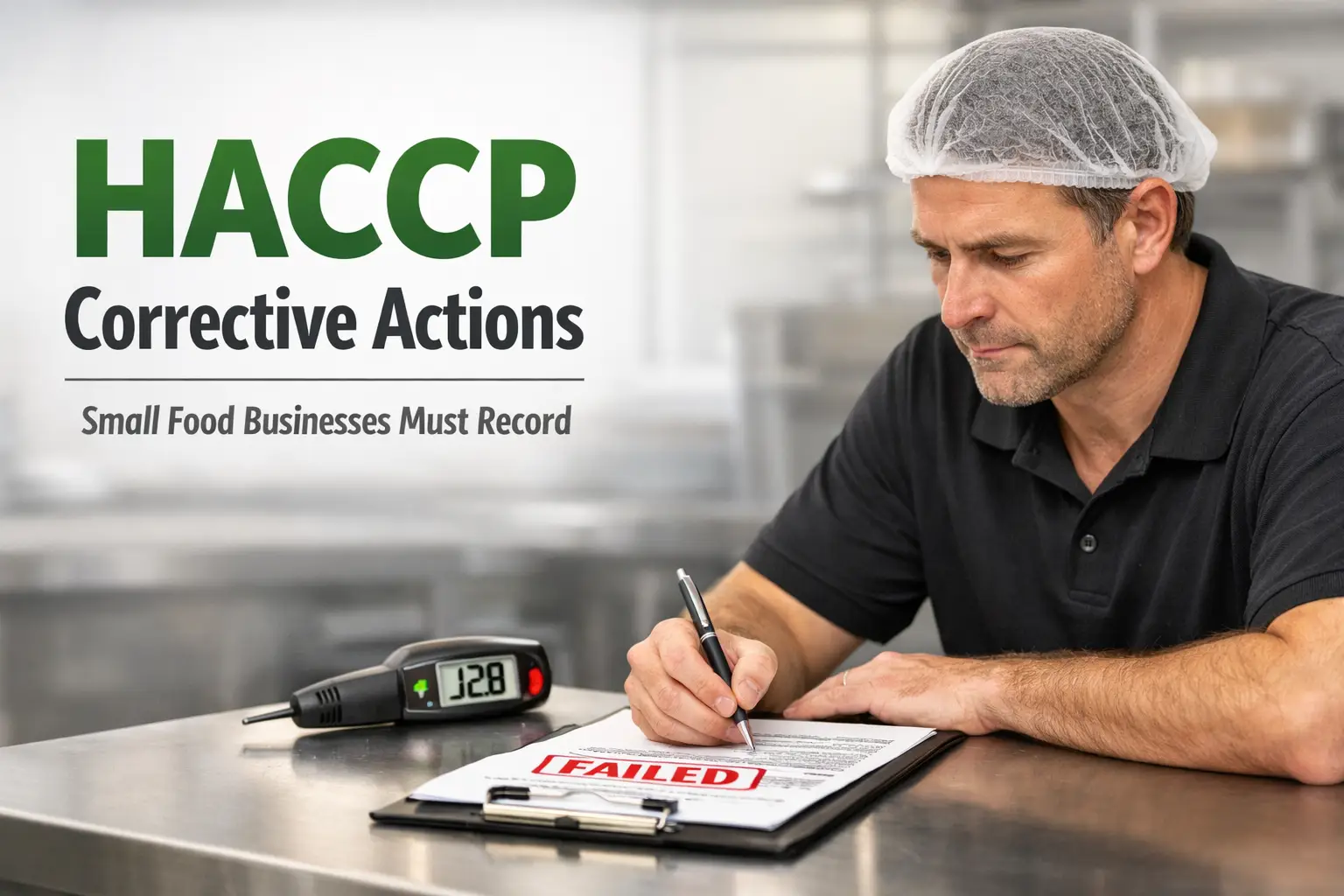
Corrective actions are the backbone of practical food safety for small catering operations. This guide helps you identify what to record, how to write it clearly, and how to link actions to daily checks for better traceability and confidence during audits.
What counts as a corrective action in catering and food service
The strongest records show both the action and the rationale, plus who checked the outcome.
A corrective action should reflect both what happened and how it’s prevented from reoccurring.
Corrective actions are the documented steps taken to bring a process back under control after a deviation. They are not the same as a routine check or a vague note that something was “fixed.” A proper corrective action records the issue, the immediate response, and the plan to prevent recurrence.
Key elements include:
- Immediate containment or risk reduction (move or isolate affected product, halt service if needed).
- Verification that controls are back in range (re-check temperatures, cleaning verification, etc.).
- Assignment of responsibility and a clear timeline for follow-up.
- Evidence that the action was reviewed and approved by someone with authority.
Clear, time-stamped actions help inspectors see you’re controlling risk rather than reacting after the fact.
Immediate actions and documentation
Immediate containment is often the first step (for example, isolating stock or stopping service in a specific area). The record should show the exact action and the time it occurred, so there’s nothing left ambiguous if an inspector asks when the issue was addressed.
Practical example
If a fridge runs warmer than the target, the entry should log the temperatures observed, the food moved to a cold storage area, any stock disposed if unsafe, and the maintenance call or review of the equipment. The record should also note when the fridge was kept out of service and what monitoring followed.
The strongest records show both the action and the rationale, plus who checked the outcome.
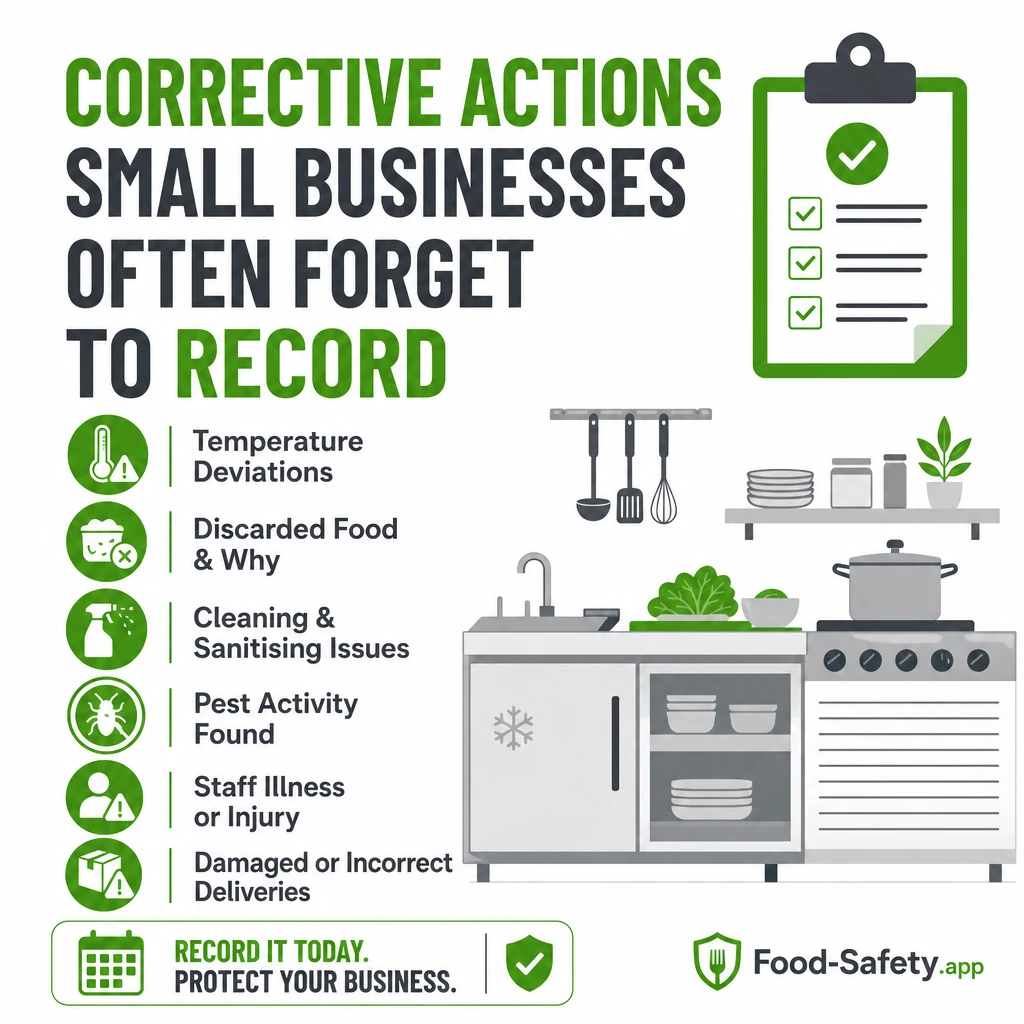
Distinguishing check deviation and corrective action
A check reveals the problem; a deviation describes it; the corrective action fixes it.
Understanding the three terms helps you build a structured record that’s easy to audit.
- Check: A scheduled or routine assessment (temperature logs, cleaning checks, delivery inspections).
- Deviation: The result of a check that falls outside the acceptable limit (e.g., a temperature outside the safe range).
- Corrective action: The concrete steps taken to bring the system back into control and prevent recurrence.
The flow usually looks like: perform a check → if the result is out of range, record the deviation → implement corrective action → verify that the issue is resolved.
If you simply note “the problem occurred” without listing the corrective action and follow-up, you haven’t completed the control loop. The aim is to close the loop with actions that reduce risk and provide a traceable history.
Practical consequences
Writing and recording corrective actions effectively
Use precise wording and avoid ambiguous terms. Time-based details help demonstrate due diligence.
Well-written corrective actions are specific, time-based, and verifiable. They answer who did what, when, and why, and they link back to the risk. Avoid vague phrases like “fixed,” “sorted,” or “checked again.”
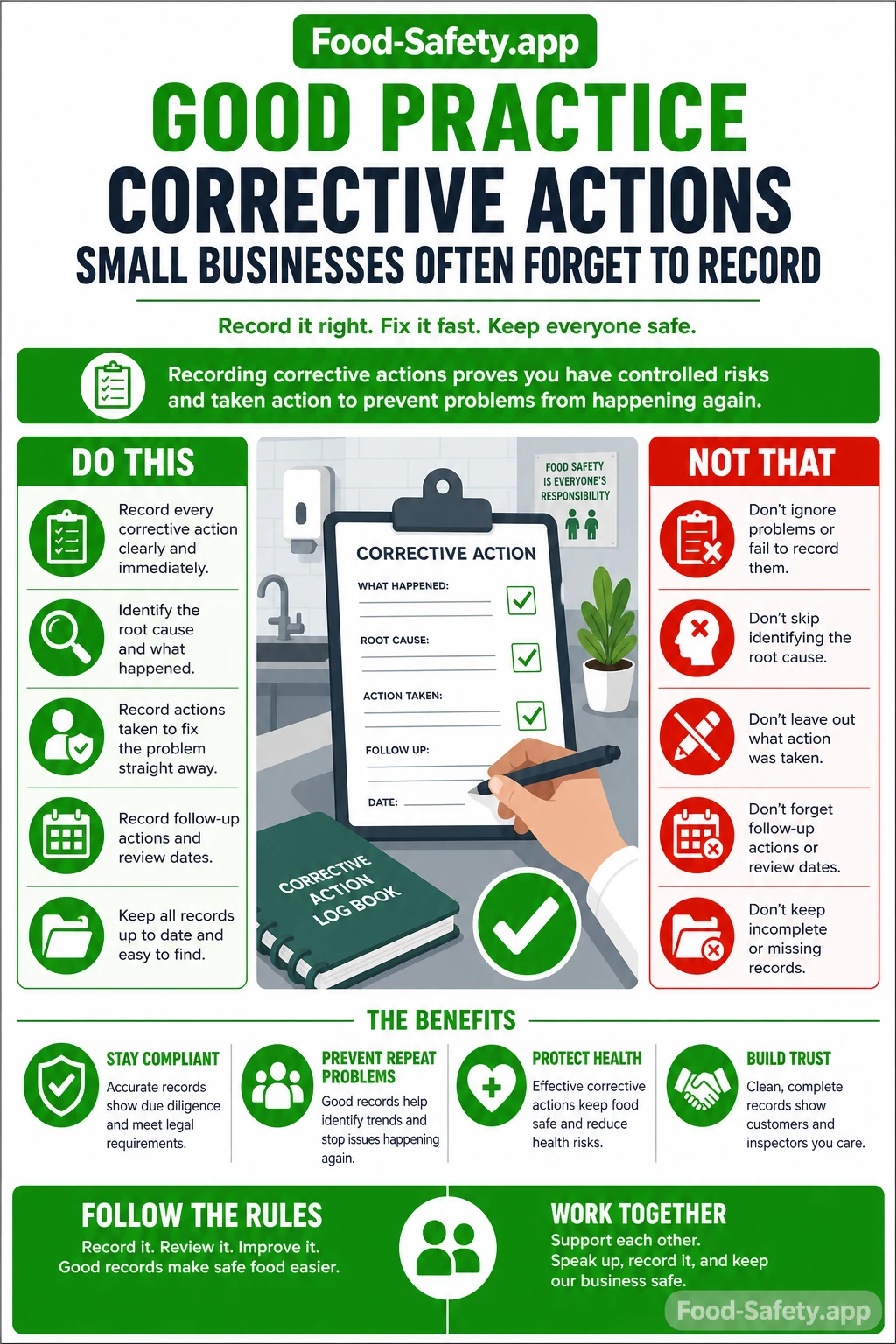
What to include in a corrective action entry:
- Date and time of the finding
- Location and equipment involved
- Who found the issue
- The hazard or risk identified
- Immediate action taken
- Person responsible for implementing the action
- Person who reviewed or approved the action
- Verification or follow-up requirement
- Current status and time to recheck or re-test
Template you can mirror on your forms:
Date/Time:
Location:
Issue found by:
Hazard:
Immediate action taken:
Responsible for action:
Action taken:
Follow-up required (date and method):
Reviewed by:
Status:
Use precise wording and avoid ambiguous terms. Time-based details help demonstrate due diligence.
Example note for a deviation
- Date/Time: 18 Sep 2026, 14:05
- Location: Main fridge, prep area
- Issue found by: Jo
- Hazard: Food temperature exceeded safe range
- Immediate action: Moved affected items to secondary cooler
- Responsible for action: Kai (assistant)
- Action taken: Adjusted thermostat, rechecked 2x, disposed any unsafe product
- Follow-up: Calibration check scheduled for 24 Sep
- Reviewed by: Chef/Manager
- Status: Closed after verification
Linking corrective actions to daily checks for traceability
A traceable link to the daily check speeds audits and demonstrates proactive risk management.
Linking corrective actions to daily checks creates a connected record that’s easier to audit and harder to dispute. Each corrective action should reference the related check or incident ID whenever possible.
Ways to link:
- Include the exact check reference (e.g., temperature log entry ID) in the corrective action.
- Cross-link equipment faults to maintenance tickets and action records.
- Tie delivery temperature discrepancies to supplier records and rejection notes.
- Capture a succinct note on how the corrective action affects the next routine checks.
A small table can help illustrate the relationship:
| Link type | Example Identifier | Benefit |
|---|---|---|
| Temperature log | TempLog-2026-09-18-01 | Shows temperature trend and action timing |
| Equipment fault | MaintTicket-2026-09-17-03 | Connects fault with calibration or repair |
| Delivery check | Delivery-DEL-2026-09-18-02 | Documents rejection rationale and supplier details |
A traceable link to the daily check speeds audits and demonstrates proactive risk management.
Why this matters for inspections
Auditors look for evidence that control measures were prompt and effective, with actions tied to specific checks. Clear links reduce ambiguity and demonstrate continuity in your HACCP records.
Roles and review manager sign off and accountability
Manager review strengthens records and accountability.
Appoint a clear flow for who creates, reviews, and signs off corrective actions. A simple, consistent process strengthens accountability and makes the history easier to review.
Recommended workflow:
- Frontline staff identify and document issue and initial action.
- Supervisor reviews for accuracy and sufficiency.
- Manager signs off once verification is complete.
- A centralized history view preserves the record of all actions and reviews.
Benefits of manager sign-off:
- Demonstrates oversight and due diligence.
- Improves consistency across shifts.
- Supports internal reviews and external audits with a clear audit trail.
Verification might involve rechecking temperatures, confirming that corrective steps didn’t impact other processes, and ensuring no further deviations occur within a defined period. The record should capture the verification result and the date.
Practical scenarios and templates
For every scenario, attach a concise corrective action entry that shows the risk, immediate control, responsibilities, and a plan for verification.
Scenario 1: Fridge running warm
What happened: Temperature rose above safe limit; some items cooled slowly.
Corrective action: Move affected items to a functioning cooler, isolate stock, call maintenance, log temperatures before and after, dispose any unsafe product if needed.
Documentation: Temperature readings, time of action, maintenance ticket number, and sign-off.
Scenario 2: Cooling is too slow
What happened: Product fails to reach safe cooling within specified times.
Corrective action: Split batches into smaller portions, use blast chiller if available, recheck times, log the revised method and outcomes.
Documentation: Revised cooling plan, time stamps, verifier.
Scenario 3: Delivery arrives above safe temperature
What happened: Delivered items at unsafe temperature.
Corrective action: Reject delivery, note supplier details, record reason, return or discard per policy, adjust receiving records.
Documentation: Delivery temp readings, supplier reference, disposal log if necessary.
Scenario 4: Cleaning task missed on a prep area
What happened: A cleaning task wasn’t completed as scheduled.
Corrective action: Complete immediately, document the hazard, re-clean, perform a follow-up check.
Documentation: Cleaning log entry, follow-up check result, responsible person.
Scenario 5: Probe fails calibration
What happened: Temperature probe calibration drift detected.
Corrective action: Stop using the probe, replace or recalibrate, log any readings taken during the period, schedule recheck.
Documentation: Calibration records, replacement details, verification readings.
Scenario 6: Pest sighting in store room
What happened: Pest sighting reported.
Corrective action: Isolate area, enhance monitoring, arrange professional pest control, update daily checks to reflect monitoring plan.
Documentation: Location log, action taken, monitoring follow-up dates.
For every scenario, attach a concise corrective action entry that shows the risk, immediate control, responsibilities, and a plan for verification.
Final notes on practice
Use corrective actions alongside open and closing checks, cleaning records, goods-in checks, temperature logs, and defect reporting.
Keep wording specific, factual, and time-based; avoid vague phrases.
Ensure every action demonstrates control of risk and states any needed follow-up.
Store records in a structured way so they can be exported for inspection.
Include manager sign-off or supervisory review where possible to show oversight.
The right corrective action system is not just about fixing today—it’s about preventing tomorrow’s problems and making audits straightforward.
If you’d like a simple starter template or a fillable digital form for your team, consider adapting the template above to your own paper or digital logs, ensuring every entry remains consistent with this guidance.