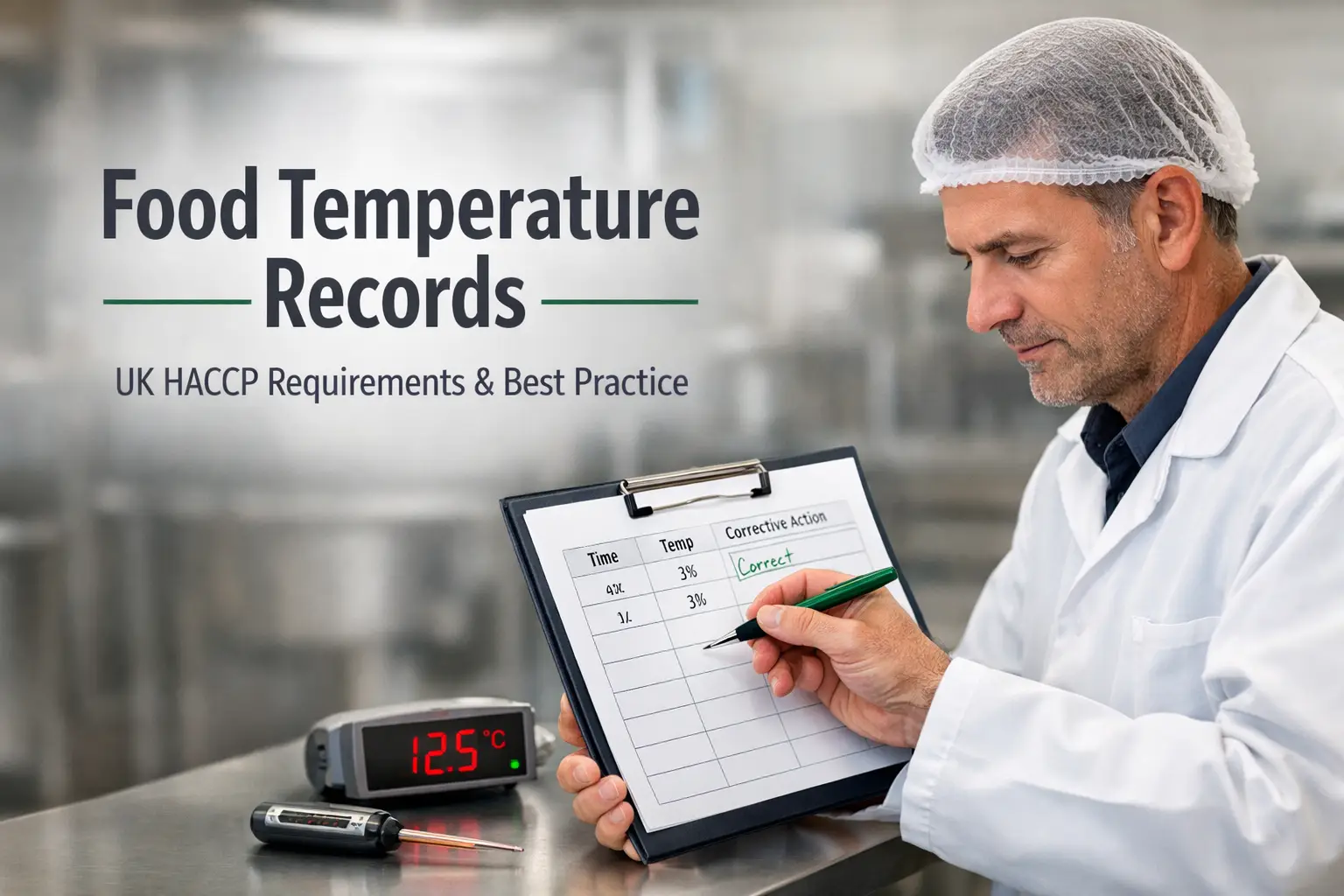
Temperature logs are a core part of HACCP records in catering. This guide helps busy kitchens assess whether their logs would stand up to an inspection, explains what good records look like in real service, and highlights common gaps and practical fixes to strengthen due diligence.
What inspectors usually expect to see in temperature logs
Inspectors expect end-to-end traceability: who checked, when, and what happened next.
A well-constructed temperature log is structured around your critical control points: cooking, cooling, cold storage, reheating and hot holding. Each entry should clearly show what was checked, when, by whom, and the measured value. There should be a record of the action taken if the result is out of spec, plus any follow-up verification. Prefer a single, consistent format across shifts and sites rather than ad hoc sheets.
| Process | Data captured | Purpose |
|---|---|---|
| Cooking | Date, time, item, core temperature, initials | Prove safe cooking and traceability |
| Cooling | Date, time, cooling start and finish temps | Verify safe cooling rates |
| Cold storage | Date, time, storage location, ambient and product temps | Ensure maintained cold chain |
| Reheating | Date, time, reheating temp, final check | Confirm adequate reheating |
| Hot holding | Date, time, holding temp, duration | Ensure safe hold over service |
Section by section, the log should be legible, complete and promptly completed. In practice, this means no blank fields, no guesswork about what the reading means, and no reliance on memory rather than an entry in the record.
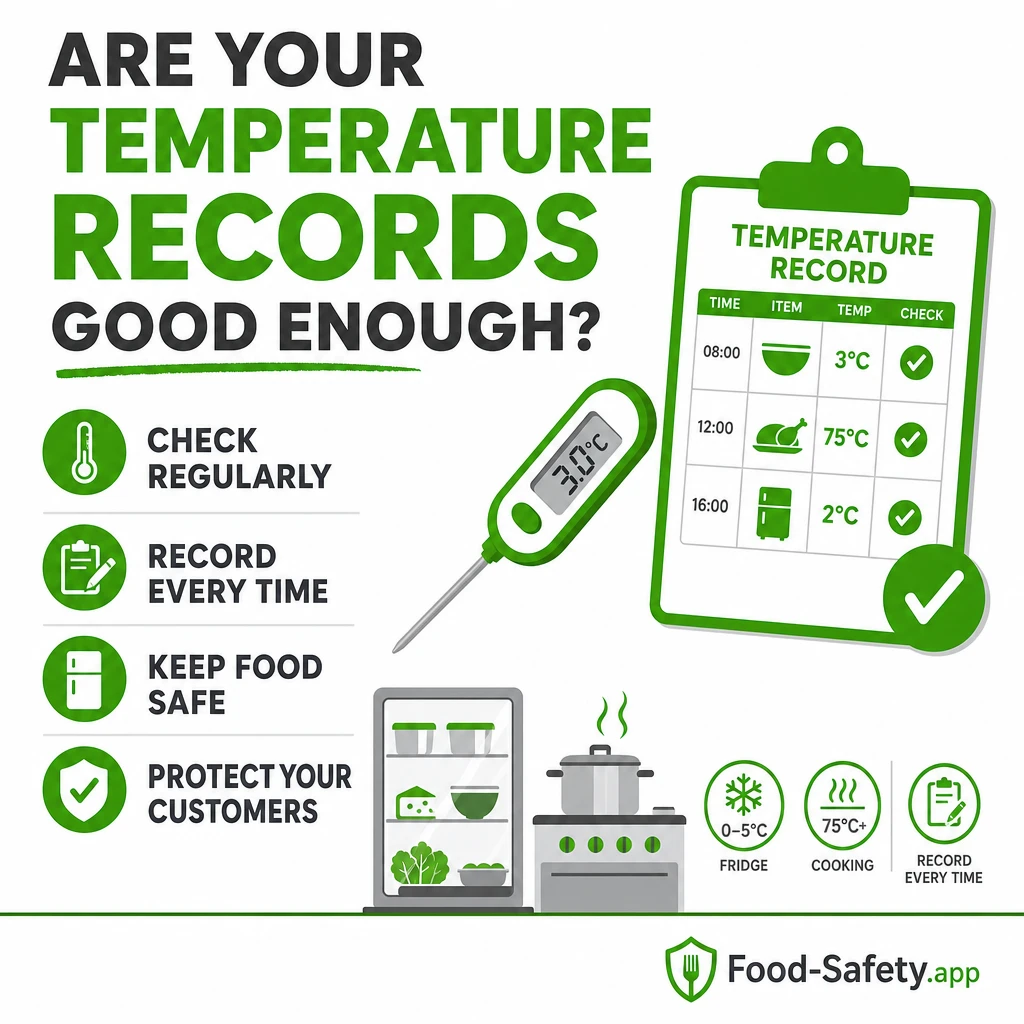
Why records need to be clear, complete and time stamped
Clear records are actionable records: they show not only what was done, but when and what followed.
Clarity means every line is unambiguous and easy to scan during an audit. Completeness means all fields are filled for every entry, including item name, equipment, date, time and result. Time stamping is essential for establishing sequence, identifying delays, and proving corrective actions were implemented promptly. Digital logs that automatically capture date and time can reduce human error, but they still must be regularly reviewed and kept accessible.
A well-maintained log supports risk communication within your team and with inspectors. It also helps you pinpoint patterns—for example, recurring high fridge temperatures or delayed corrective actions—so you can adjust procedures rather than chasing symptoms after the event.
Common failings that weaken due diligence
These gaps erode confidence in your controls and can invite questions from inspectors about whether the HACCP plan is being followed in real time.
Many gaps in temperature records aren’t about complex technicalities; they’re about leaving data incomplete or unexamined. Common failings include:
- Missing temperatures or readings not recorded within the shift
- Blank fields such as time, item or equipment
- Late entries after service or after a shift end
- No corrective action noted when a reading is out of spec
- Inconsistent checking intervals across shifts or sites
These gaps erode confidence in your controls and can invite questions from inspectors about whether the HACCP plan is being followed in real time.
Practical examples
- Hot holding check recorded with no action when food drops below safe limits
- Fridge log showing repeated high temperatures with no follow-up
- Cooling records that miss times, making it impossible to prove safe cooling
- Reheating checks completed without noting the final core temperature
- A busy service where one person checks and another records, causing inconsistent entries
The safest procedure is the one that can be followed consistently during a busy service.
How poor record keeping undermines confidence in your food safety controls
The value of a log lies in its completeness, not its length.
When records aren’t reliable, the entire control system loses credibility. Auditors and managers rely on logs to confirm that hazards are being controlled and that deviations trigger timely management action. If a reader cannot determine who performed a check, when it happened, or what corrective steps were taken, the logs function less as a protective mechanism and more as a potential liability. Regular review and prompt follow-up are as important as the measurements themselves.
Poor records also make it harder to learn from near-misses or to demonstrate continuous improvement. If patterns aren’t visible, you’ll miss opportunities to adjust procedures, calibrate probes, or simplify checks to fit real shifts. That’s why a standardised, easy-to-use format matters as much as the data it contains.
The difference between recording temperatures and controlling risk
Recording temp is the first step; treating it as a risk signal and acting on it is the second.
Recording temperature is not the same as controlling risk. A good log should link measurements to actions that reduce hazard. For example, a reading that’s within spec is valuable only if it’s part of a continuous control plan; a single compliant reading is not proof that your cooking, cooling, or holding processes consistently keep pathogens in check. Conversely, a single corrective action that is completed and documented can prevent a hazard from escalating if a later reading is marginal.
Consider a busy Friday service: a thermocouple reads 65°C in a hot-held sauce that should stay above 60°C. If the log simply records the number without noting the corrective action (e.g., move to hotter hold, extend time, or re-check core temp after rethermalisation), you’ve documented a compliant moment without evidencing a risk-reduction step. The risk is that future faults can go unchecked if the action isn’t clearly captured and verified.
Practical steps to improve consistency and compliance
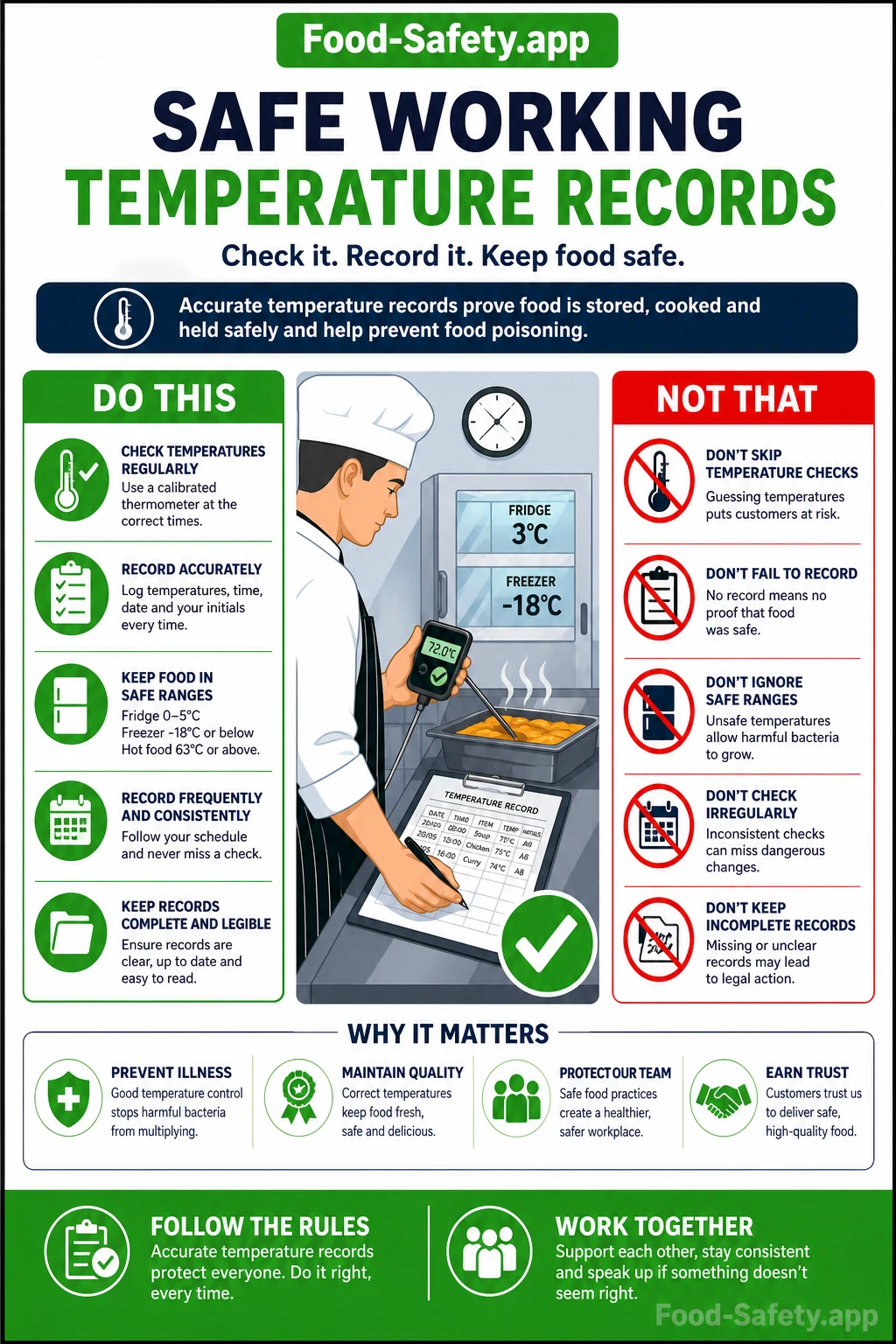
Training and simple, repeatable formats reduce errors and improve timely corrective action.
Improving consistency doesn’t require a radical overhaul of your system. Start with a clear, universal approach that’s easy for staff to use during busy shifts.
- Use structured temperature records for cooking, cooling, cold storage, reheating, and hot holding
- Define the required fields and keep them identical across all sites
- Make sure entries are automatically time-stamped for traceability
- Prefer digital systems that log time and operator ID
- Record corrective actions alongside any out-of-spec result
- Include the action taken, who authorised it, and whether follow-up checks were completed
- Set clear safe limits for each item of equipment or process
- Align limits with your HACCP plan and any relevant guidance, avoiding vague language
- Review records daily so issues are spotted early, not after an inspection
- Designate a supervisor or manager to sign off on daily checks and chase follow-ups
How to improve consistency in practice
- Train staff on the correct method for probe use and record completion
- Keep checks simple, consistent, and easy to follow during busy shifts
- Use the same format across all shifts and sites
- Link temperature checks to equipment, cleaning, and probe calibration records where relevant
- Make supervisors responsible for reviewing logs and chasing follow-up actions
Training and simple, repeatable formats reduce errors and improve timely corrective action.
Final notes
Temperature records matter because they are a direct indicator of your ability to manage risk in real time. Clear, complete, and time-stamped entries, paired with documented corrective actions, make it easier to demonstrate due diligence to inspectors and to drive ongoing improvements in your kitchen.
If you’d like a quick-start checklist to audit your current logs, or a template that families all five key processes—cooking, cooling, cold storage, reheating and hot holding—along with automatic timestamps, you’ll find practical templates and guidance in our digital resources.