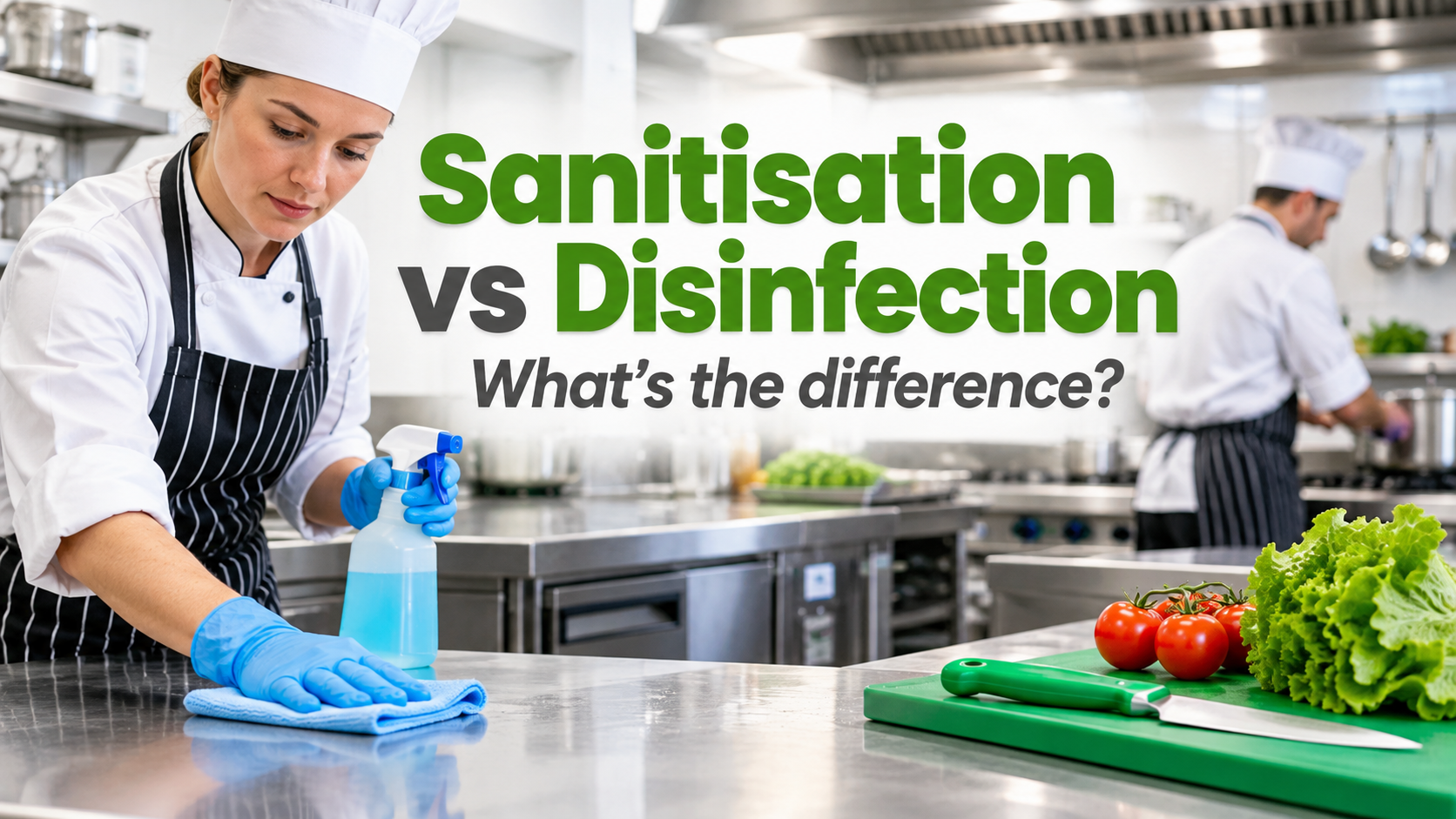
Sanitisation and disinfection are often treated as though they mean the same thing. They don’t.
For food businesses, cleaning teams and anyone responsible for hygiene, understanding the difference matters because each process has a different purpose.
What is sanitisation?
Sanitisation is the process of reducing microorganisms on a surface to a level considered safe.
It’s commonly used in food environments where surfaces regularly come into contact with food, hands, utensils or equipment.
A sanitiser is normally used after visible dirt, grease and food debris have been removed.
Typical examples include:
- Food preparation surfaces
- Chopping boards
- Utensils
- Food contact equipment
- Handles and touch points
The aim isn’t necessarily to kill every microorganism. It’s to reduce contamination to an acceptable level.
What is disinfection?
Disinfection is a stronger process designed to kill or deactivate harmful microorganisms on a surface.
Disinfectants are commonly used where there’s a greater risk of contamination, particularly where illness, bodily fluids or harmful bacteria and viruses may be present.
Examples might include:
- Toilets and washrooms
- Waste areas
- High-touch surfaces
- Areas contaminated following illness
- Surfaces exposed to potentially harmful microorganisms
A disinfectant must still be used correctly. Applying more product doesn’t automatically make it more effective.
Cleaning comes first
Neither sanitisation nor disinfection works properly on a dirty surface.
Food debris, grease and other contamination can prevent chemicals from reaching the microorganisms they’re meant to control.
A typical process is:
- Remove loose food and debris.
- Wash the surface using suitable detergent.
- Rinse if required.
- Apply sanitiser or disinfectant.
- Leave it on the surface for the required contact time.
- Rinse afterwards if the manufacturer requires it.
- Allow the surface to dry or follow the manufacturer’s instructions.
Always follow the product label and the manufacturer’s instructions.
What is contact time?
Contact time is the amount of time a sanitiser or disinfectant must remain on a surface to work properly.
This is sometimes called dwell time.
If a product requires five minutes of contact time but it’s wiped away after 30 seconds, it may not achieve the required level of microbial reduction.
This is one of the most common mistakes in cleaning routines.
Staff should know:
- Which chemical they’re using
- The correct dilution
- Where it can be used
- The required contact time
- Whether rinsing is required afterwards
Sanitisation vs disinfection
| Sanitisation | Disinfection |
|---|---|
| Reduces microorganisms to safer levels | Kills or deactivates a wider range of harmful microorganisms |
| Commonly used on food contact surfaces | Often used where contamination risk is higher |
| Usually follows normal cleaning | Also requires effective cleaning first |
| Suitable products may be food-safe | Not every disinfectant is suitable for food contact surfaces |
| Effectiveness depends on correct dilution and contact time | Effectiveness also depends on correct dilution and contact time |
What should food businesses use?
There isn’t one chemical that’s automatically suitable for every situation.
Food businesses should select products based on:
- The surface being cleaned
- The type of contamination
- Whether the surface comes into contact with food
- Manufacturer instructions
- The required contact time
- The business’s cleaning and food safety procedures
Products used on food contact surfaces should be suitable for that purpose.
Staff should also understand that spraying a surface and immediately wiping it dry may not provide effective sanitisation or disinfection.
Keep cleaning procedures simple
A cleaning schedule shouldn’t just say “clean worktop”.
It should make clear:
- What needs cleaning
- How often it needs cleaning
- What chemical should be used
- What concentration or dilution is required
- How it should be applied
- The required contact time
- Who is responsible
Clear instructions make it much easier for staff to clean consistently and provide evidence that the business has suitable hygiene controls in place.
Record your food safety checks digitally
Food-Safety.app helps food businesses manage routine food safety records without relying on paper folders.
You can record cleaning checks alongside temperature monitoring, opening and closing checks, corrective actions, pest control, training records and other food safety information.