Understanding the UK’s food safety training expectations isn’t about ticking a fixed level for every employee. It’s about ensuring the right knowledge and supervision for the job and the risks it carries. This guide explains why training is role- and risk-based, what Level 1, Level 2 and Level 3 typically cover, and how to evidence competence for inspections. It also shows practical ways to build a training plan that works in a busy catering operation.
In the UK there isn’t a universal legal “level” that all staff must reach. The duty on businesses is to provide suitable, supervised and hygienic training appropriate to each role and the risks it carries. Training should enable staff to perform tasks safely and support the overall HACCP plan. Environmental Health Officers (EHOs) expect to see competent people carrying out defined tasks under proper supervision, with records that show what was learned and when.
What the law requires for food safety training in the UK
Important: training must be fit for the job, not just a certificate. Supervision and practical competence matter as much as the moment of training.
In the UK there isn’t a universal legal “level” that all staff must reach. The duty on businesses is to provide suitable, supervised and hygienic training appropriate to each role and the risks it carries. Training should enable staff to perform tasks safely and support the overall HACCP plan. Environmental Health Officers (EHOs) expect to see competent people carrying out defined tasks under proper supervision, with records that show what was learned and when.
Practical takeaway
Tailor training to the tasks your team actually performs and to the risks your menu creates. That alignment is what inspectors notice most.
Level 1: basic awareness and induction
Level 1 is an induction, not a substitute for ongoing supervision and task‑specific coaching.
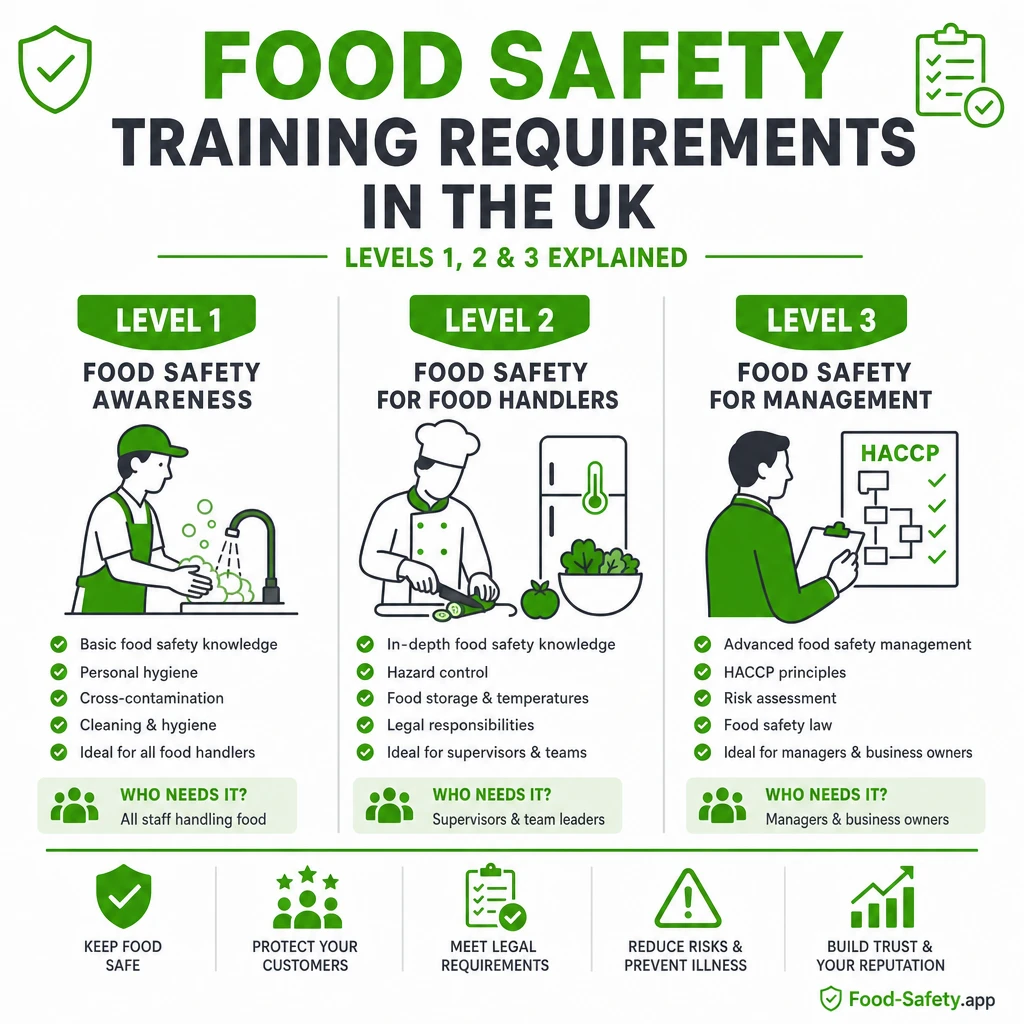
Level 1 covers basic awareness and short induction for staff with limited handling of high‑risk tasks or when starting a new role. It’s about building confidence to avoid the obvious safety slips while new staff learn where and how things are done.
Typical content
- Personal hygiene and handwashing
- Basic cross‑contamination concepts
- Cleaning and sanitising fundamentals
- Temperature awareness at a high level
- How to report problems or suspected spoilage
Who it’s for
- New starters who won’t handle high‑risk foods yet
- Front‑of‑house staff with occasional food contact
- Low‑risk prep tasks or wash‑up roles
Duration
- A few hours to a couple of days, depending on the setting and tasks
Examples to visualise practice
- A new kitchen porter starting on wash‑up and light prep tasks
- A café assistant learning where to dispose of waste and how to log entry screen temperatures
Examples to visualise practice
- A new kitchen porter starting on wash‑up and light prep tasks
- A café assistant learning where to dispose of waste and how to log entry screen temperatures
Practical takeaway
Keep Level 1 records clearly separate and show the transition to Level 2 when staff take on broader responsibilities.
Level 2: standard training for most food handlers
Regular refresher training helps maintain competence.
Level 2 is the standard requirement for the majority of staff who handle or prepare food regularly. It builds on Level 1 by adding practical, task‑specific competencies that keep food safe through handling, cooking, cooling and storage.
Typical content
- Safe food handling and hygiene practices
- Temperature controls and safe cooking/cooling/reheating
- Correct storage, rotation and date marking
- Allergen awareness and communication
- Cleaning schedules and sanitising procedures
- Basic HACCP concepts and role in daily tasks
Who it’s for
- Kitchen staff, cooks, chefs, and many front‑of‑house staff who touch food
- Those who open or close the kitchen and manage basic logs
Evidence you might expect to see
- A signed training record or certificate indicating Level 2 completion
- A brief competency check or practical signs of knowledge demonstrated during tasks
A quick reference aid
| Typical role | Suggested training level | Why it matters |
|---|---|---|
| Chef de partie or line cook | Level 2 | Manages cooking, cooling and reheating within safe limits |
| Front-of-house serving with food contact | Level 2 | Handles portions, sauces and allergens with controlled practices |
| Kitchen porter with light prep | Level 1 or Level 2 depending on tasks | Transition to Level 2 when handling higher‑risk items |
Level 2 Regular refresher training helps maintain competence.
Practical takeaway
Create a simple, living training plan that links courses to specific tasks and to your daily checks.
Level 3: supervisors and managers
The person in charge must be able to demonstrate how controls are implemented and how issues are addressed.
Level 3 is designed for those who oversee safety controls, staff training and daily operations. It’s aimed at ensuring supervisors and managers can run the safety system, check compliance and take action when things go wrong.
Typical content
- Advanced HACCP principles in practice
- Monitoring and recording critical limits (e.g., fridge temperatures)
- Investigating and correcting non‑compliant practices
- Training others and supervising a team
- Internal auditing, cleaning schedules and documentation
- Allergen management at team and kitchen level
Who it’s for
- Supervisors, head chefs, kitchen managers and team leads responsible for safety controls
- People who review logs and sign off on opening/closing checks
Example scenario
Example scenario
A supervisor verifies fridge temperatures, completes opening checks and initiates corrective actions when a thermometer reads high.
Practical takeaway
Level 3 isn’t a theoretical badge; it’s about leadership in safety, coaching others and maintaining the daily system.
Matching training to roles, menus and risk
Training should map to actual tasks, not just job titles.
A core principle across Level 1, 2 and 3 is fit for purpose. Training should reflect the actual tasks staff perform, the complexity of the menu and the level of risk in each activity. A high‑volume kitchen serving high‑risk dishes will need more robust oversight and evidence of competence than a small café with mostly simple, ready‑to‑eat items.
Key ideas
- Use risk assessment to decide who needs Level 2 or Level 3 training
- Adapt training content when menus change or new hazards emerge
- Align training with your HACCP plan, allergen controls, temperature checks and cleaning duties
Training should map to actual tasks, not just job titles.
Practical takeaway
Create a simple, living training plan that links courses to specific tasks and to your daily checks.
Recording, refresher training and evidence for inspections
Keep structured records so evidence is ready for inspection and internal review.
Keeping good records makes inspections smoother and protects your business. A clear system shows who’s trained, when and under what supervision, and how staff are progressing.
Recommended practices
- Maintain a staff training matrix with names, roles, course levels and review dates
- Record induction dates, refresher sessions and task‑specific coaching
- Store certificates, sign‑off sheets and competency checks in one accessible place
- Link training to practical controls such as HACCP tasks, allergen handling, temperature checks and cleaning duties
- Review training after staff changes, menu changes or repeated safety issues
What EHOs might look for
- Evidence of induction and supervision for new staff
- Documentation showing Level 2 or Level 3 training for relevant roles
- Evidence of ongoing coaching, not just completed courses
- Records of routine temperature logs and corrective actions
Keep structured records so evidence is ready for inspection and internal review.
Refresher training should be triggered by menu changes, staff changes or recurring issues.
Practical takeaway
Treat your training records as a working tool, not a box to tick. Regularly audit them and keep them accessible for internal reviews and external checks.
If you’re building or updating a training plan, start with a simple matrix that links roles to expected training levels, add a schedule for refreshers and keep all evidence in one place. With a clear, role‑based approach, your kitchen can stay compliant, safer and more efficient, even in busy periods.