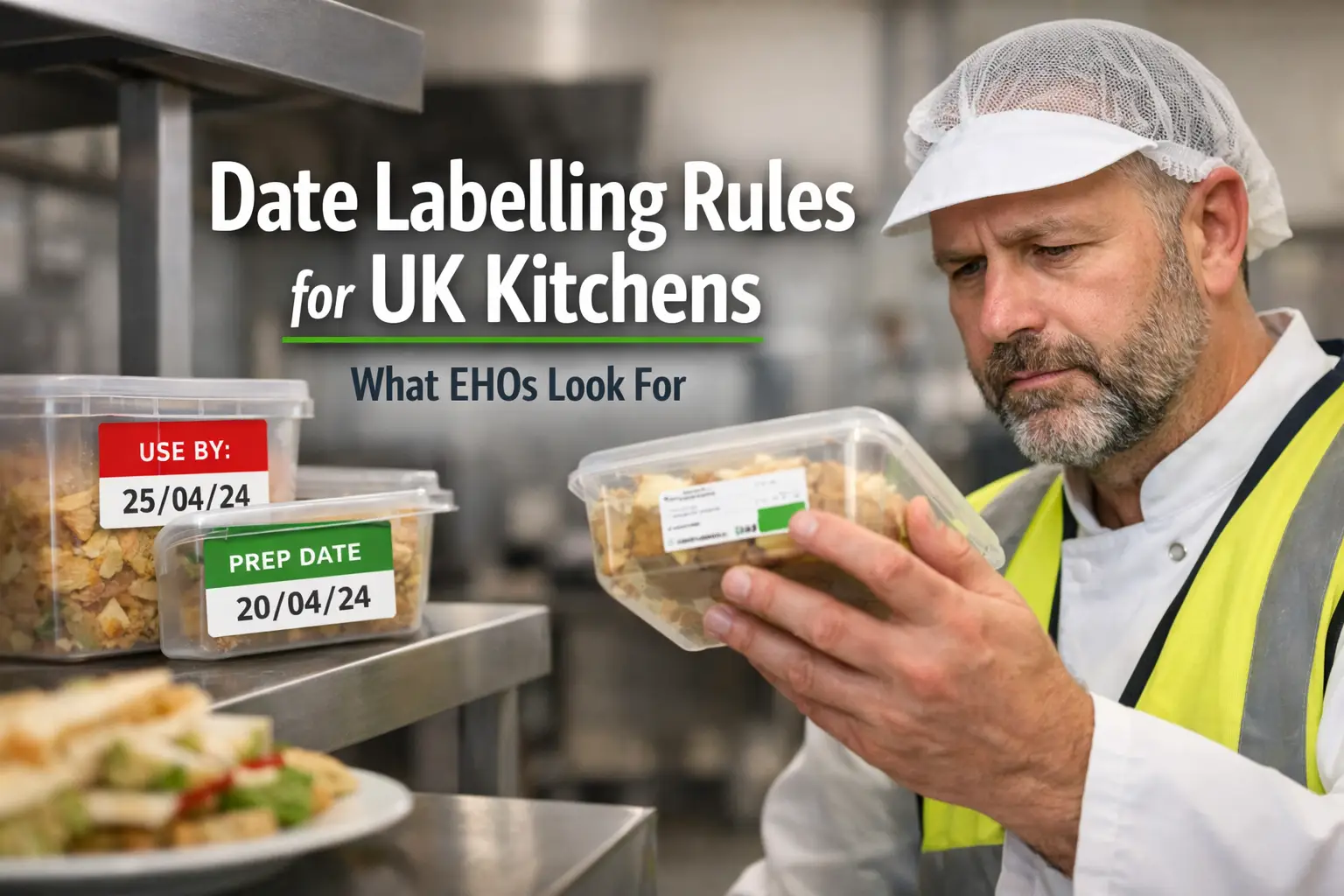
Date labels in busy kitchens are a key safety control. Clear, consistent labelling supports safety, stock rotation and traceability, and helps EHOs assess controls at a glance.
This article breaks down how to apply date labels in practice, explains the difference between use-by and best-before, and outlines a simple system you can use across shifts.
Why date labelling matters for food safety, stock rotation and traceability
Date labels help staff identify whether an item is safe to eat, when it should be used or discarded, and how long it has been in store.
They underpin stock rotation (FIFO) and enable traceability if a problem arises.
In practice, clear labels reduce waste and minimise the risk of serving unsafe food.
For a busy team, a simple, consistent format makes decision-making quick during service and handovers.
Clear labels save time during busy periods and support consistent decisions across shifts.
High-risk items, such as ready-to-eat or post-prepare foods, depend on reliable dating to prevent cross-contamination and bacterial growth.
A standard approach to dating underpins both safety and efficiency across the kitchen.
Use-by vs best-before: definitions and practical implications
Use-by dates govern safety; best-before dates relate to quality and should be interpreted accordingly.
Use-by dates indicate safety-critical limits. Do not consume or serve foods after the use-by date. Best-before dates relate to quality; foods may still be safe beyond the date, though their taste or texture might degrade.
Apply use-by dating to items that become hazardous quickly after preparation or opening. Best-before is common on shelf-stable items and non-perishable products where safety is unlikely to be compromised solely by date expiry.
Do not rely on appearance, smell or taste to judge safety; the label is the guide.
Understanding the difference helps prevent both waste and safety risks, and keeps your service aligned with internal policies and customer expectations.
Consistent use of the correct date type reduces confusion for staff and EHOs.
What every label should include for clarity and traceability
A standard label format across all items reduces errors and saves time during busy service.
A reliable label should be legible and durable, with clear fields that support traceability and quick decisions.
- Product name
- Prep/open date
- Discard date
- Staff initials
- Storage instructions
- Batch/lot number (where applicable for traceability)
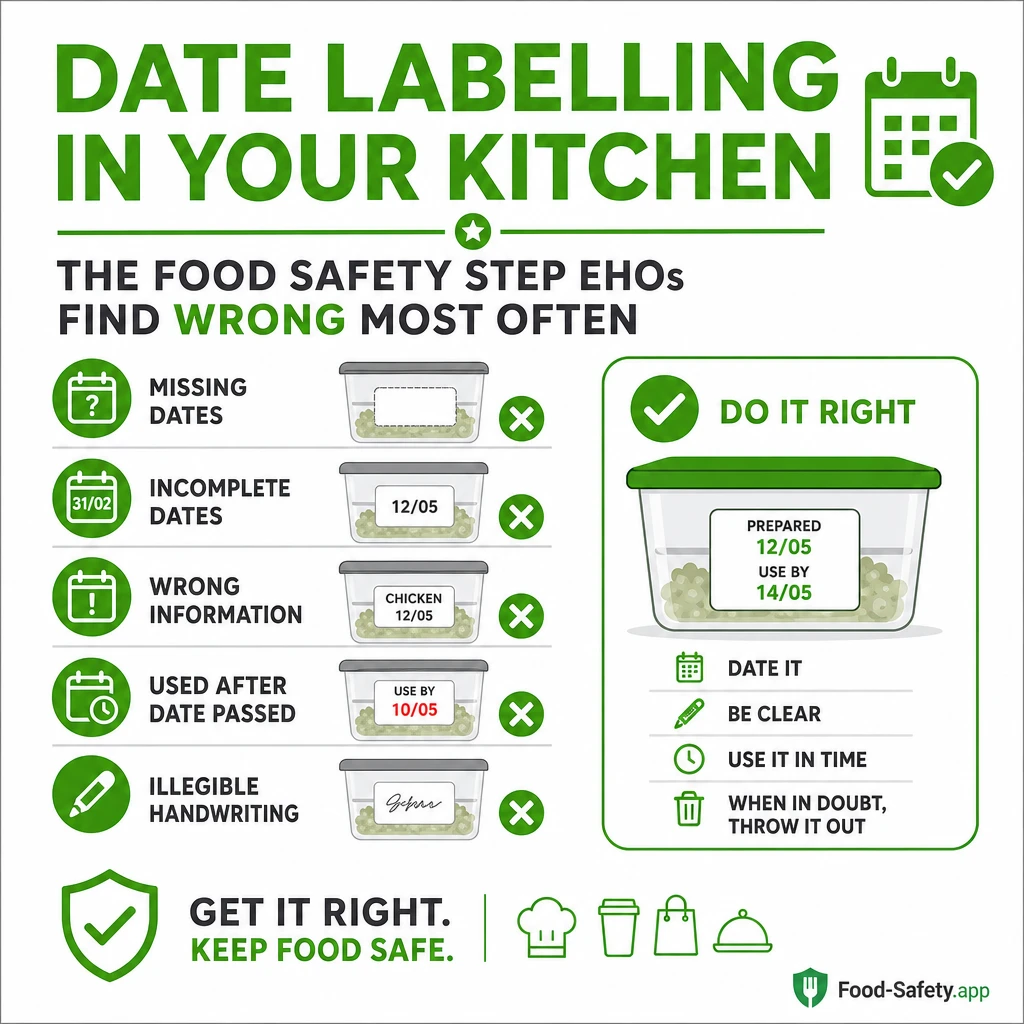
If a label is difficult to read or missing, it effectively has no information at all.
For decanted items and multi-batch ingredients, ensure the label reflects the most recent batch and opening date to prevent cross-mixing.
Label readability is as important as the data on it.
Labelling high-risk foods, prepared ingredients and decanted items
If a label can’t be read, it doesn’t exist.
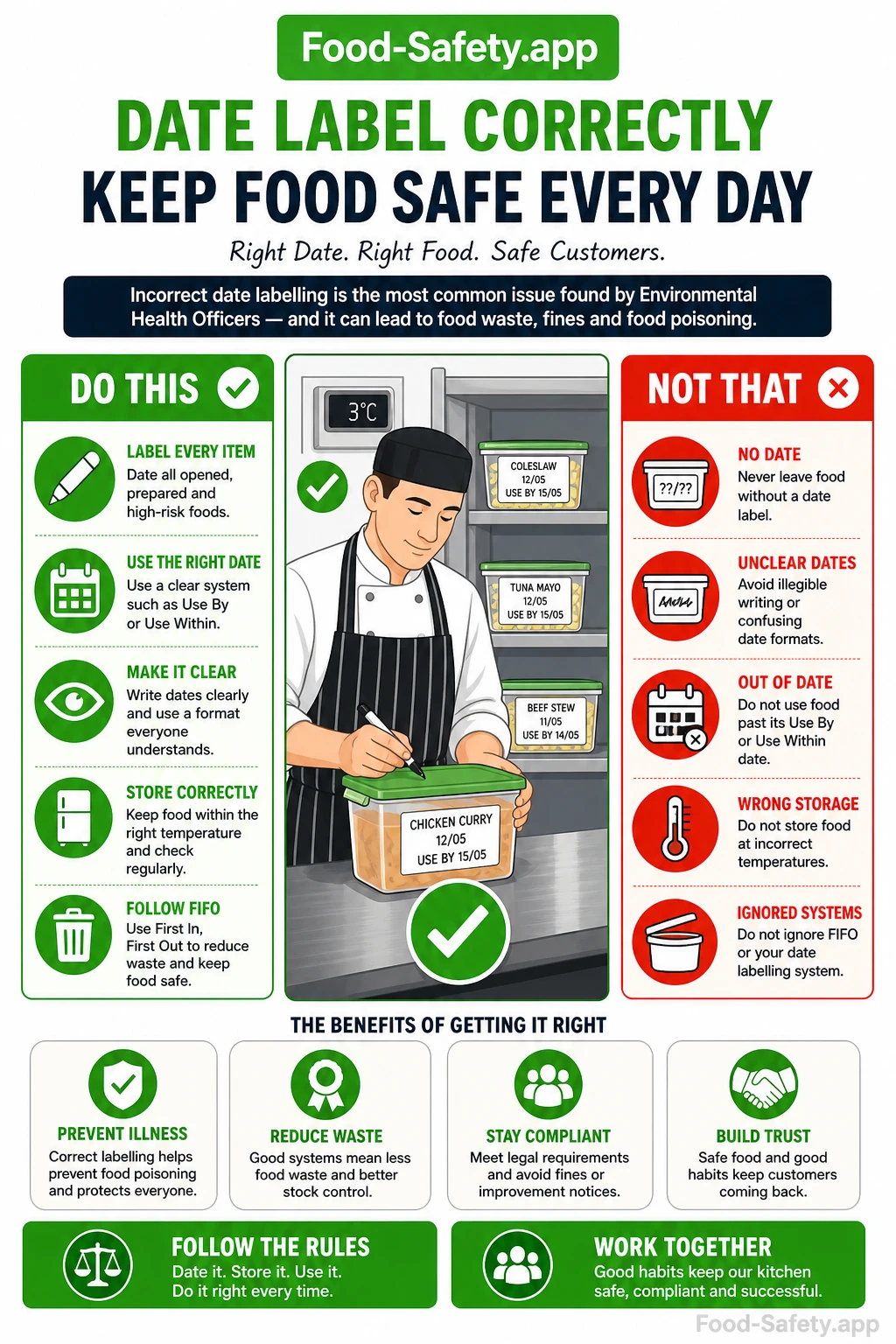
- High-risk foods (ready-to-eat, perishable) should carry a discard date and a prep/open date.
- Prepared sauces or dressings moved into gastro tubs must be re-labeled with the new date and batch information if batches are mixed.
- Decanted items (foods transferred to separate containers) must be relabeled with the date of opening and the discard date; old packaging alone is not a reliable indicator.
Use durable labels or printed labels where possible and ensure handwriting is clear if hand-written.
High-risk foods and prepared ingredients require particularly careful labelling to support safety and rotation.
Internal date rules for chilled prep, opened packs, cooked foods and leftovers
Missing or illegible dates are the most common inspection failings.
Establish clear internal rules so every item is dated consistently.
- Chilled prep items: label with the prep/open date and a discard date that reflects your internal policy.
- Opened packs: treat as a new item — label with a fresh prep/open date and discard date.
- Cooked foods and leftovers: label with a discard date and place in the coldest area of the fridge; use FIFO to rotate stock.
- Handover checks: ensure labels are checked at both opening and closing, and that anything without a date is flagged immediately.
Consistency is the backbone of traceability and inspector confidence.
Building a simple date-control system for shifts
A date-control system works only if every shift follows it consistently.
Create a single house rule for date labels across all kitchens and shifts, supported by a standard label format and routine checks.
- Establish one house rule and deploy it everywhere
- Use the same label format on all items, and verify during opening and closing checks
- Link date control with fridge checks, stock rotation and cleaning cycles
- Record any out-of-date food as a corrective action when found
- Use a digital system to maintain full history for traceability and audits
- Keep the date-labelling training simple, visible and part of daily supervision
Training should be hands-on and quick to apply, with refreshers during busy periods to prevent drift.
If you’d like practical templates and digital support for opening and closing checks, corrective actions, and full history records, consider how a dedicated food-safety management tool can help you maintain robust date control across all shifts.