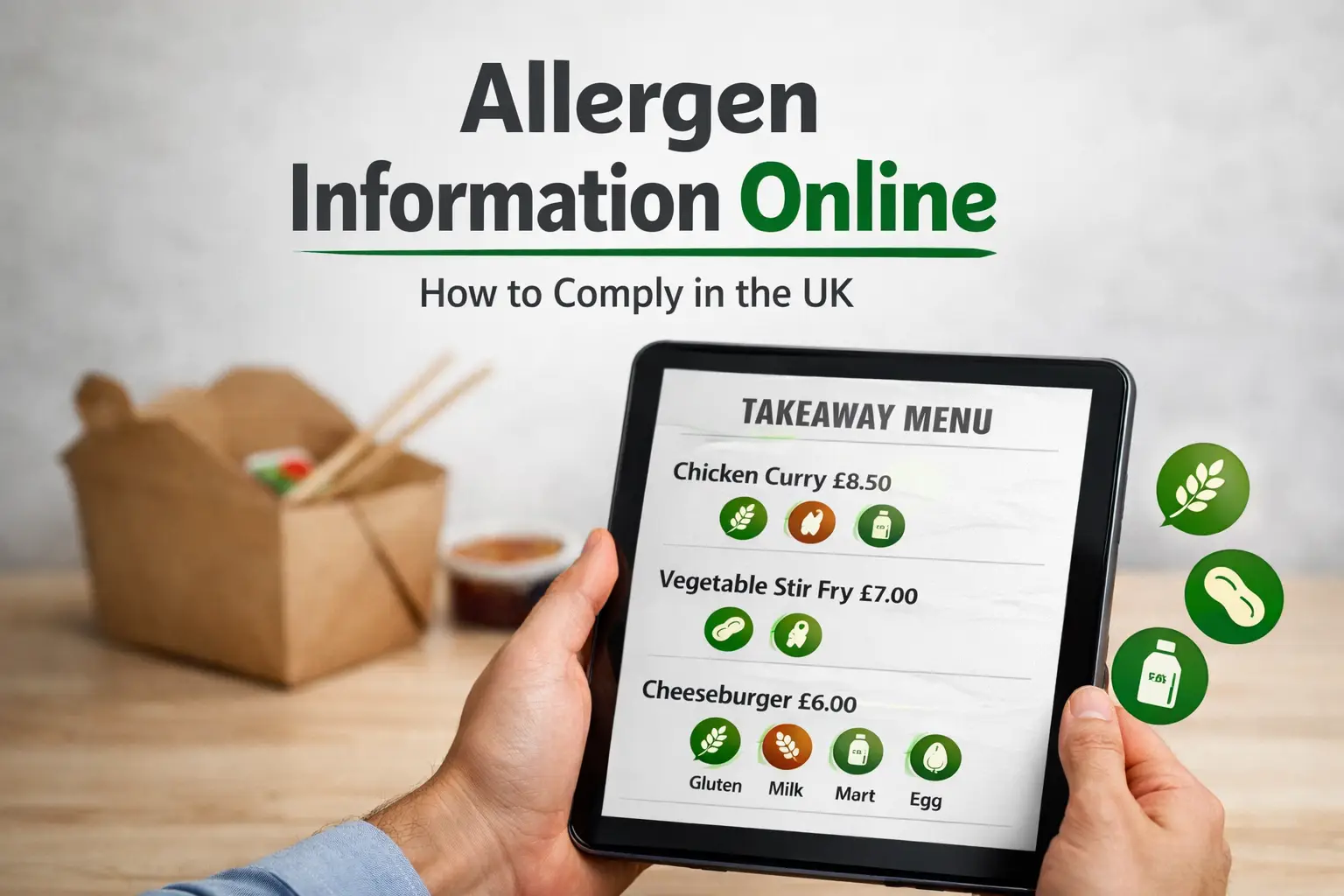
Clear, accessible allergen information online is essential for safer ordering and smoother handovers. This guide explains practical steps to present allergen details across websites, apps, menus and social posts in the UK. Learn what customers must see before they order, how to signpost information, how to write it in plain English, how to manage order notes, what to check at handover, and how to keep online details aligned with menu changes.
How to show allergen info online for food businesses
Important: The allergen reference should be readily accessible before the customer commits to the purchase, not tucked in after payment.
Make allergen information visible and easy to locate before customers place an order. Put it on product pages, menus, and ordering platforms, and mirror it across app listings and social posts when possible. Consistency is key: use the same wording and the same list of allergens everywhere. A practical approach is to attach a dedicated allergen section to each menu item, with a straightforward, readable format.
Keeping information aligned with changes
When a recipe or supplier changes, update all online channels promptly and maintain a change record so any historic references are still understandable.
The safest procedure is the one that can be followed consistently during a busy service.
Practical example
- Café item: a list of allergens shown for every item, e.g. “Allergens: Cereals containing gluten; Crustaceans; Eggs; Fish; Lupin; Milk; Nuts; Peanuts; Sesame seeds; Soy; Sulphites; Celery; Mustard; Molluscs.”
- If you use a takeaway app, ensure there’s a clear link or banner stating “Allergen info available here” before the checkout.
Blockquote content should appear naturally across sections and not feel forced, and it should help readers remember a takeaway principle.
Online allergen information before order
Customers expect to see allergen details before they reach the payment stage. Place allergen information in clear places such as:
- Product pages and item cards
- Menu PDFs and printable versions
- App screens and pre-order prompts
- Social posts and highlights where relevant
Signposting should lead users directly to the detailed allergen list, not bury the information behind small print or late-stage prompts. If you publish on multiple channels, keep wording consistent: “Allergen information available here” or “Contains these allergens” in the same phrasing across channels.
A clear “allergen info available here” link before checkout helps customers decide and reduces last-minute changes.
Practical example
- A takeaway app shows a prominent link labeled “View allergen info” near each item, and a summary line on the checkout page confirms the item’s allergens before finalising the order.
reinforce that customers should not be forced to dig for details, and information should be clearly surfaced early.
Clear allergen signposting for customers
Clear signposting reduces confusion and supports safer choices.
Signposting is how customers know where to find allergen details. Use simple, direct language and consistent terms. Avoid jargon; be precise about what the item contains and what it may contain due to cross-contact risks. Use a consistent signpost across all channels, for example:
- A visible banner on item pages: “Allergen info here”
- A dedicated allergen link near the add-to-basket button
- A short, plain-English note in social posts about changes to the recipe
Signposting checklist
- Is there a direct link to allergen info on every product page?
- Is the language plain and consistent with other channels?
- Is the information updated within 24–48 hours of any recipe change?
Do not bury important details in small print or after payment. If there’s a change, customers must be able to see it before ordering.
How to write allergen details clearly
The plain language rule is essential: avoid jargon and be precise about what is present.
Plain English is the backbone of good allergen information. Use simple terms and avoid industry jargon. A straightforward format helps staff and customers alike. A practical template for each item might look like:
- Allergens present: Cereals containing gluten; Crustaceans; Eggs; Fish; Lupin; Milk; Nuts; Peanuts; Sesame seeds; Soy; Sulphites; Celery; Mustard; Molluscs
- Allergen notes: May contain traces due to shared equipment
- Supplier changes: If ingredients change, re-check allergen listings and update all platforms
Plain language also means avoiding contradictory statements and being precise about what is in the dish rather than what might be there.
Example wording variants
- “Contains almonds” instead of “May contain tree nuts”
- “Contains gluten” instead of “Produced in a facility that handles gluten”
- “ May contain traces of peanuts” only if there’s a documented risk and you’re sure it’s relevant
Use plain terms and a consistent structure across all channels so customers know exactly what to expect.
reinforce that customers should not be buried in jargon; be clear and consistent across all touchpoints.
Managing allergen notes on orders
Order notes and customer requests can help, but they must not be the sole control. Treat notes as supplementary inputs rather than primary evidence. Practical steps:
- Require a published allergen reference on file and visible to kitchen staff
- Cross-check any customer note (for example, “no nuts”) against the item’s allergen list
- If a note contradicts the listed allergens, escalate to a supervisor and confirm with the customer
Example scenario:
A delivery order note asks for “no nuts.” The team checks the item’s allergen list, confirms whether the dish can be prepared nut-free, and communicates back with the customer before dispatch.
Do not rely on customer notes alone; there should be a published allergen reference that staff can verify.
Staff training focus
- How to interpret allergen lists
- How to respond to varying customer phrases
- How to document decisions for future reference
Allergen checks at collection and delivery handover
Handover is a critical control point. Staff should verify allergen details with the customer and re-confirm packaging integrity. Consider a simple handover checklist:
- Confirm the dish name and its allergens with the customer
- Re-check any special requests against the item’s allergen list
- Record the confirmation in a handover log or a trusted internal system
- Provide any written allergen information to the customer if available
For collections, staff can repeat allergen information aloud and offer it in writing if practical. This reinforces accuracy and helps the customer trust the process.
The safest procedure is the one that can be followed consistently during a busy service.
Change management
If a supplier ingredient changes, adjust the online allergen listing first, then update any physical menus or handover scripts. Schedule a quick quarterly review to catch any drift.
At collection or handover, repeat the allergen details to the customer and confirm back.
Practical handover example
A collection order is ready; staff pronounce the item’s allergens, confirm they match the printed allergen sheet, and note the confirmation in a simple internal log.
Keeping online information aligned with menu changes and recipe updates
Regularly review all channels when there’s a menu change. Establish a lightweight governance process:
- Maintain a central record of all recipe changes and the allergens involved
- Update the website, app, social posts and menus in a single coordinated run
- Train front-line staff on the latest allergen information and the handling process
- Schedule periodic audits to verify that online listings reflect current reality
This alignment reduces mismatches that can confuse customers and cause risky handovers.
Consistency across channels builds trust and reduces the chance of cross-contact errors.
Quick audit checklist
- Are all items updated when a recipe changes?
- Do online listings reflect the same allergens as the physical menu?
- Is the change log accessible to staff and, where appropriate, customers?
The simplest way to stay compliant is to keep a single, current source of truth for allergens and publish updates everywhere.
Final notes
- Make allergen information easy to find before purchase; do not hide details behind payment.
- Use consistent wording across website, menus and ordering platforms.
- Train staff to answer questions confidently and reference the published allergen information.
- Build a simple review process for menu updates and online publishing.
- Use a dedicated allergen management system to store items, link allergen information, and export records for review or inspection.
A well-communicated allergen policy is not a gimmick; it’s essential for customer safety and business resilience.
If you’re looking to streamline this work, consider adopting a dedicated allergen management approach that stores menu items, links allergen information, and exports records for review or inspection. This supports safer ordering, smoother handovers, and better staff confidence across all customer touchpoints.