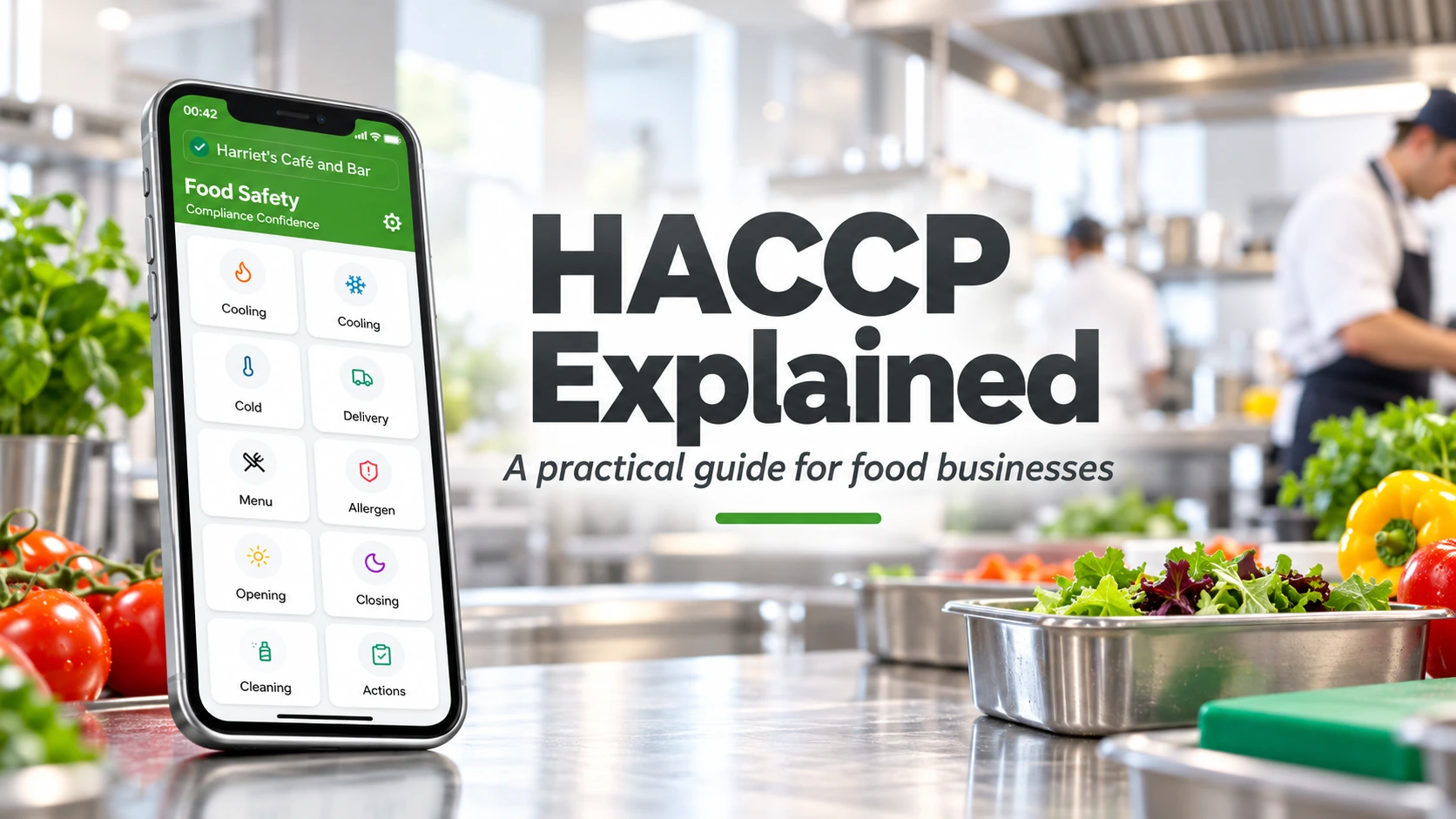
If you run a café, restaurant, takeaway, pub, bakery, catering business or another food operation, you’ll probably come across the term HACCP fairly quickly.
It can sound technical, but the basic idea is straightforward. HACCP is about working out what could make food unsafe, deciding how you’ll control those risks, checking that your controls are working and taking action when something goes wrong.
This guide answers the most common HACCP questions food business owners ask.
Contents
What does HACCP stand for?
HACCP stands for:
Hazard Analysis and Critical Control Point.
It’s a systematic way of identifying food safety hazards and putting controls in place to stop those hazards causing harm.
What is HACCP?
HACCP is a method of managing food safety.
Rather than relying only on checking finished food, you look at each stage of your operation and ask:
- What could go wrong?
- What could make the food unsafe?
- How can we prevent that happening?
- What needs to be checked?
- What limits need to be met?
- What do we do if something goes wrong?
For example, cooking raw chicken presents a microbiological hazard because harmful bacteria may be present.
Your control might be making sure the chicken is thoroughly cooked. You may then use an appropriate cooking temperature and time as your critical limit, check it using a temperature probe and record any corrective action if the required limit isn’t achieved.
Is HACCP a legal requirement?
Food businesses are required to have food safety procedures based on HACCP principles.
The Food Standards Agency states that food businesses must use HACCP procedures or an appropriate HACCP-based food safety management system.
That doesn’t necessarily mean every small business needs a large traditional HACCP manual. The system should be proportionate to the nature and size of the business.
Do all food businesses need HACCP?
Food businesses need suitable procedures for managing food safety based on HACCP principles.
What those procedures look like can vary considerably.
A large food manufacturer might need a detailed HACCP study covering numerous products, processes and Critical Control Points.
A small café serving relatively straightforward food may be able to use a simpler HACCP-based food safety management system such as Safer Food Better Business.
The FSA specifically recognises flexibility for smaller businesses.
Do small food businesses need a full HACCP plan?
Not necessarily.
The important point is that you have an effective food safety management system that’s suitable for what your business actually does.
For many restaurants, cafés, sandwich shops and other businesses with relatively simple processes, the FSA recommends systems such as Safer Food Better Business (SFBB) rather than a complex traditional HACCP study.
More complicated food production may require a more detailed HACCP system.
What are the 7 principles of HACCP?
The seven HACCP principles are:
- Identify and analyse food safety hazards and appropriate control measures.
- Determine the Critical Control Points.
- Establish critical limits.
- Establish monitoring procedures.
- Establish corrective actions.
- Establish verification procedures.
- Establish appropriate documentation and records.
The FSA’s MyHACCP guidance follows these principles when helping businesses construct a food safety management system.
What is a food safety hazard?
A hazard is something that could make food unsafe or cause harm to the person eating it.
Your HACCP assessment looks at the hazards associated with your ingredients, processes, equipment, people and working environment.
You then decide which controls are needed to reduce those risks to an acceptable level.
What are the main types of food safety hazards?
Food safety hazards are commonly grouped into several categories.
Biological hazards
These include harmful microorganisms such as bacteria, viruses and parasites.
Examples include:
- Salmonella
- E. coli
- Campylobacter
- Listeria
Chemical hazards
These could include:
- cleaning chemicals
- pesticides
- excessive concentrations of additives
- chemicals accidentally introduced during food preparation
Physical hazards
These are foreign objects that could contaminate food, including:
- glass
- metal
- plastic
- stones
- pieces of equipment
Allergen hazards
Allergens also need careful management.
Cross-contact, incorrect recipes, incorrect labelling or poor communication can result in somebody being exposed to an allergen they need to avoid.
What is a Critical Control Point?
A Critical Control Point, normally shortened to CCP, is a stage where control is essential to prevent, eliminate or reduce a significant food safety hazard to an acceptable level.
Cooking is a common example.
If food needs cooking to destroy harmful microorganisms, losing control at that stage could result in unsafe food being served.
Not every check within a food business is necessarily a CCP.
What is a critical limit?
A critical limit defines the boundary between acceptable and unacceptable control at a Critical Control Point.
It needs to be measurable or otherwise clearly defined.
A limit might relate to:
- temperature
- time
- pH
- concentration
- another measurable food safety parameter
If the critical limit isn’t achieved, you need to take appropriate corrective action.
What’s the difference between a control point and a CCP?
Lots of activities within a food business help control food safety, but they aren’t necessarily all Critical Control Points.
For example, cleaning surfaces, staff handwashing, pest control and appropriate storage are all important food safety controls.
A CCP is a specific point where losing control could result in a significant food safety hazard that isn’t adequately controlled later in the process.
Businesses should avoid labelling every routine check as a CCP simply because it’s important.
How do I create a HACCP plan?
Start by understanding exactly how food moves through your business.
This could include:
receiving → storage → preparation → cooking → cooling → refrigeration → reheating → hot holding → service
For each stage, consider:
- what hazards could occur
- how significant those hazards are
- what controls you already have
- whether the stage represents a CCP
- what limits apply
- how you’ll monitor the control
- what you’ll do if something goes wrong
- what records you’ll keep
Before applying the seven HACCP principles, the FSA’s MyHACCP approach also recommends preparatory work including defining the scope, describing products, considering their intended use, preparing a flow diagram and confirming that the diagram reflects what actually happens in the business.
What is a HACCP flow diagram?
A HACCP flow diagram shows the stages food passes through within your operation.
For example:
Delivery → chilled storage → preparation → cooking → hot holding → service
A more complex product might follow:
Delivery → frozen storage → defrosting → preparation → cooking → cooling → refrigerated storage → reheating → service
The purpose isn’t to create an attractive diagram. It’s to make sure every stage of the process has been considered when identifying hazards.
You should check the flow diagram against what actually happens in your kitchen or production area.
What should be included in a HACCP plan?
Depending on the complexity of the business, a HACCP plan may include:
- scope of the HACCP study
- product descriptions
- intended use
- process flow diagrams
- identified hazards
- control measures
- Critical Control Points
- critical limits
- monitoring procedures
- corrective actions
- verification arrangements
- review arrangements
- supporting procedures
- records
Your system should reflect the food you actually prepare and the way your business operates.
Copying another business’s HACCP plan without adapting it is unlikely to give you an effective system.
What HACCP records should I keep?
Records should provide evidence that your controls are being followed.
Depending on your business, records might include:
- cooking temperatures
- reheating temperatures
- hot-holding checks
- chilled food temperatures
- cooling checks
- fridge and freezer checks
- delivery checks
- opening checks
- closing checks
- cleaning records
- probe calibration
- pest control
- allergen controls
- staff training
- corrective actions
The FSA’s SFBB guidance says smaller businesses don’t necessarily need large numbers of daily records. The records required should reflect the size and nature of the business.
Do I have to record everything every day?
No.
HACCP isn’t about generating paperwork for the sake of it.
Your records should be proportionate to your risks and provide enough evidence to show that your food safety procedures are working.
For businesses using SFBB, the FSA states that the diary should be completed each day, although some businesses may need additional records depending on their size and activities.
Your own HACCP system may specify different monitoring frequencies depending on the particular control.
How long should I keep HACCP records?
There’s no single retention period that applies to every HACCP record in every food business.
Your retention arrangements should take account of factors such as:
- the type of food you produce
- shelf life
- traceability requirements
- the purpose of the record
- any sector-specific legal requirements
- advice from your local authority or competent authority
Your HACCP system should state how records are controlled and retained.
Can HACCP records be digital?
Yes.
HACCP records don’t have to be kept in a paper folder simply because that’s how they’ve traditionally been managed.
Digital records can provide an effective way of recording and demonstrating food safety controls, provided they’re accurate, accessible and suitable for the business.
A digital system can also make it easier to:
- find historic records
- identify missed checks
- record corrective actions
- standardise records
- reduce lost paperwork
- review trends
The important issue isn’t whether the record is paper or digital. It’s whether the business can demonstrate that its food safety procedures are being followed.
What is monitoring in HACCP?
Monitoring means checking that a food safety control remains within the required limits.
For example:
- measuring a cooking temperature
- checking a hot-holding temperature
- inspecting a delivery
- confirming a cooling process has been completed correctly
Monitoring should tell you quickly enough that something is going wrong so that action can be taken.
What is corrective action?
Corrective action is what you do when a check shows that your control hasn’t worked as intended.
For example, if a food temperature check is outside your specified limit, simply writing the temperature down isn’t enough.
You need to decide what happens next.
Corrective action might involve:
- continuing cooking
- rapidly chilling the food
- moving food to another refrigerator
- rejecting a delivery
- disposing of food
- repairing faulty equipment
- retraining a member of staff
- investigating why the problem happened
The action should address both the food involved and, where appropriate, the underlying cause.
What happens if a critical limit is exceeded?
You need to take the corrective action specified in your food safety system.
That normally means:
- Make the food safe if this can be done.
- Prevent unsafe food from being served.
- Record what happened where your system requires it.
- Identify why control was lost.
- Take action to prevent the problem recurring.
For example, recording a failed refrigerator temperature without taking any further action wouldn’t demonstrate effective control.
What is HACCP verification?
Verification asks:
Is our HACCP system actually working as intended?
This could include:
- reviewing completed records
- observing staff practices
- checking corrective actions
- checking equipment
- reviewing probe calibration
- reviewing complaints
- checking whether procedures are actually followed
- internal audits
Verification is different from simply completing the routine check itself.
What is HACCP validation?
Validation asks whether the controls you’ve chosen are capable of controlling the hazard.
For example, before relying on a particular cooking process, you need evidence that the process is capable of achieving the required food safety outcome.
Validation therefore supports the design of your HACCP system, while verification helps confirm that the system continues to work in practice.
How often should HACCP be reviewed?
Your HACCP system should be reviewed regularly and whenever something significant changes.
Examples include:
- introducing a new menu
- changing ingredients
- changing suppliers
- introducing new equipment
- changing your cooking process
- changing packaging
- moving premises
- introducing delivery services
- discovering a recurring food safety problem
- receiving a relevant complaint
- receiving advice following an inspection
Don’t treat HACCP as a document that’s written once and then left in a folder for years.
Who is responsible for HACCP?
The food business operator is responsible for ensuring appropriate food safety procedures are established and maintained.
Day-to-day responsibilities can be delegated to managers or employees, but responsibility for ensuring an effective system exists remains with the business.
Staff should also understand the controls relevant to their own duties.
Do staff need HACCP training?
Staff need suitable food safety instruction, supervision and training for the work they carry out.
That doesn’t mean every employee needs advanced HACCP training.
A chef responsible for controlling cooking temperatures needs to understand the relevant procedure, limits and corrective actions.
A manager responsible for maintaining the overall HACCP system needs a broader understanding.
Training should be proportionate to each person’s responsibilities.
Do I need a HACCP certificate?
A HACCP training certificate and a HACCP food safety management system are two different things.
Having completed a HACCP course doesn’t by itself prove that your business has an effective HACCP system.
Equally, food law doesn’t simply require every food business owner to buy a particular HACCP certificate.
The important requirement is that the business has appropriate food safety procedures and that the people responsible for those procedures have the necessary knowledge and competence.
Is Safer Food Better Business a HACCP system?
Yes, SFBB is a food safety management system based on HACCP principles.
It’s specifically designed to make HACCP easier to apply in smaller food businesses without forcing operators to deal with unnecessary technical terminology.
The FSA describes SFBB as a HACCP-based food safety management approach suitable for many smaller businesses.
What’s the difference between HACCP and SFBB?
HACCP describes the principles used to identify and manage food safety hazards.
SFBB is a practical system designed to help smaller businesses apply those principles.
For example, instead of expecting a small café owner to develop a highly technical HACCP study from scratch, SFBB provides safe methods and management arrangements covering common food safety risks.
More complicated manufacturing operations may require a more traditional HACCP approach.
Will an Environmental Health Officer check my HACCP records?
Food safety officers can look at your food safety management system as part of an inspection.
They may want to establish:
- whether you’ve identified significant hazards
- how those hazards are controlled
- whether staff understand the controls
- whether procedures are being followed
- whether records support what you say you’re doing
- whether corrective action is taken when things go wrong
- whether your system is being maintained and reviewed
An impressive folder isn’t enough if staff aren’t actually following the procedures.
What are the most common HACCP mistakes?
Common problems include:
Using a generic HACCP plan
The document doesn’t reflect the actual menu, equipment or processes used by the business.
Recording checks without taking action
A failed temperature is written down but nobody records what was done about it.
Creating too many records
Staff are expected to fill in excessive paperwork that adds little food safety value.
Creating too few records
The business can’t demonstrate that important controls are being monitored.
Not updating the system
Menus, equipment or processes change but the HACCP system remains unchanged.
Staff don’t understand the system
Managers know what’s written in the HACCP plan but the people preparing the food don’t know the controls that apply to their work.
Treating HACCP as paperwork
HACCP isn’t the folder.
It’s the system your business uses every day to identify hazards, control them, monitor those controls and act when something goes wrong.
Can a food safety app replace paper HACCP records?
For many businesses, yes.
A digital food safety system can be used to manage routine records such as:
- cooking
- cooling
- reheating
- hot holding
- cold storage
- deliveries
- opening checks
- closing checks
- cleaning
- probe calibration
- corrective actions
- pest control
- staff training
The system still needs to reflect the food safety procedures used within the business.
Moving a poorly designed paper system onto a phone doesn’t automatically make it a good HACCP system.
The advantage of digital records is that businesses can reduce paperwork while keeping food safety information organised and easier to retrieve.
For smaller food businesses, this can be particularly useful when the alternative is maintaining numerous paper forms and folders.
Do HACCP records need to be complicated?
No.
The purpose of HACCP documentation is to help you control food safety and demonstrate that those controls are working.
For a small food business, the most useful system is normally one that staff can realistically follow every day.
Good records are:
- relevant
- easy to complete
- easy to understand
- linked to actual food safety risks
- able to show what happened when something went wrong
More paperwork doesn’t automatically mean better food safety.
What should I do first if I don’t have a HACCP system?
Start with your actual operation.
Write down how food moves through your business, from delivery to service or sale.
Then identify the significant hazards at each stage and how you control them.
For a straightforward catering business, an established HACCP-based system such as SFBB may provide a practical starting point.
For more complex manufacturing operations, the FSA’s MyHACCP tool provides a structured process covering the preparatory stages and seven HACCP principles.
The aim isn’t to create the biggest HACCP document possible.
It’s to have a food safety management system that reflects what your business actually does, that your staff understand and that helps you consistently produce safe food.