Corrective actions show not just that something went wrong, but what was done to stop it from causing harm again. In a busy catering operation, clear, auditable actions prove you’re actively managing food safety risks day-to-day. This guide explains what a robust corrective action looks like, what to avoid, how to document it, and practical scenarios you’ll encounter on shift.
Why corrective actions matter
Strong records reduce doubt during audits by linking problem, action and verification.
A corrective action is a concrete, auditable plan, not a vague note about “fixing” something.
Corrective actions record the response to a deviation, not just the detection. They tie the observed issue to an intentional, verifiable fix, showing inspectors that risk is being managed in real time. A well-documented action includes what went wrong, how it was contained, and how you’ll prevent recurrence.
Key points to cover:
- The exact risk or non-conformance and where it occurred
- Immediate steps taken to contain or correct the issue
- Verification that the root cause has been checked
- Who is responsible and when the action happened
- Follow-up checks to confirm the risk is controlled
Weak examples to avoid
Vague notes are not a substitute for traceable actions. Clarity is the safeguard.
Ambiguous notes fail inspections and leave teams guessing. Vague phrases such as “fixed,” “sorted,” “cleaned area,” or “checked later” don’t prove what happened or who owned the action. They don’t show why the corrective action was necessary or how recurrence will be prevented.
Good practice avoids these pitfalls by naming: the problem, the immediate action, and the verification step, with a date and a person responsible.
What strong corrective actions include
Good corrective actions connect the immediate fix to the underlying risk and assign accountability.
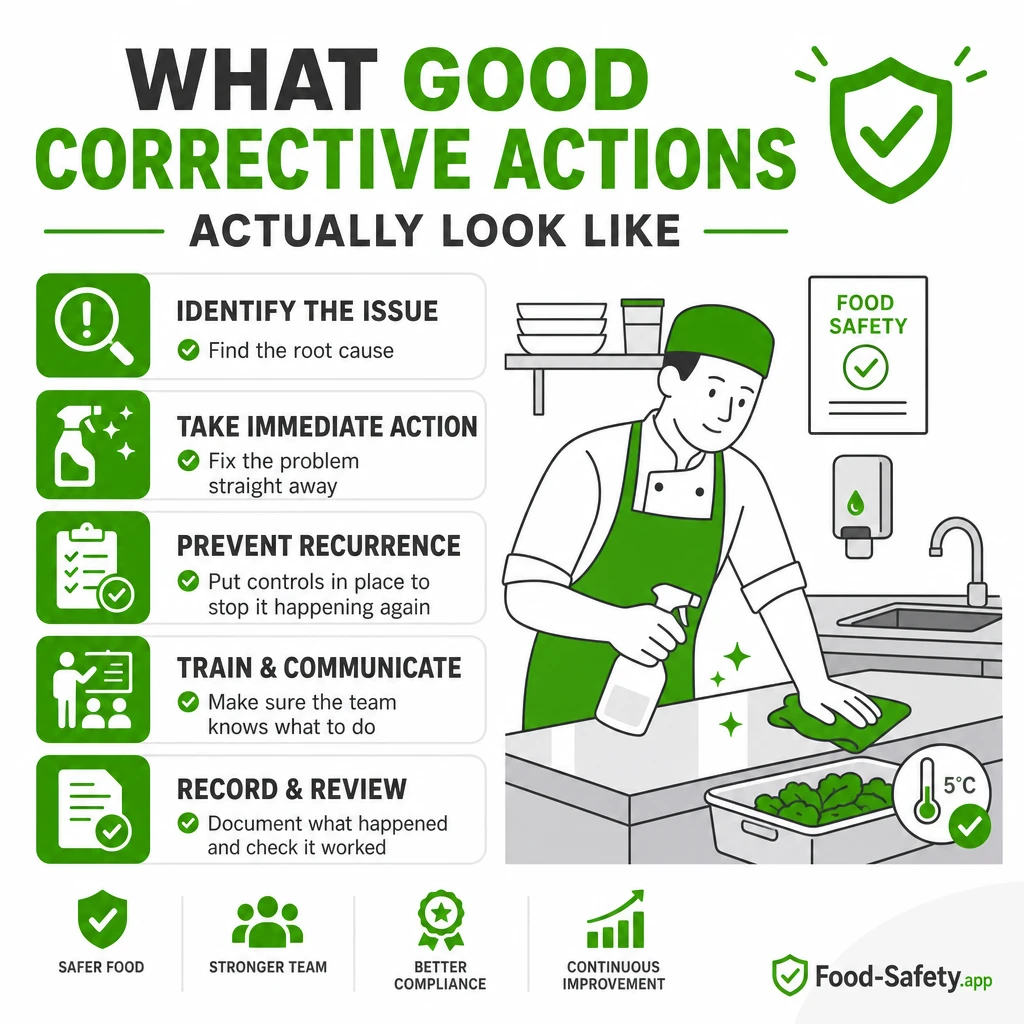
A robust corrective action should read as a complete mini-incident report embedded in the record. Include:
- Issue found: the specific hazard or deviation and where it occurred
- Immediate action: what was done to stop the risk now
- Root cause checked: confirm or rule out the underlying reason
- Person responsible: who led the action
- Time/date and location: exact timestamps and place
- Follow-up: how and when the issue will be rechecked or re-evaluated
A practical template line might look like:
Issue: Fridge measured above safe temperature (3–5 °C above target) in fridge 2.
Action: Moved affected items to cold storage; recalibrated probe; service scheduled.
Verification: Temperature recheck at 15 minutes; double-check after service.
Follow-up: Daily temperature log for 3 days; supervisor sign-off.
Why supervisor review matters
Supervisor review is the quality gate that confirms the action is complete and effective.
Supervisors provide a quality-control check that confirms the action was appropriate and completed. Their review should verify that the recorded actions address the risk and that follow-up checks are scheduled or completed. A supervisor sign-off signals closure and readiness for inspection without ambiguity.
Proof for inspections
If the record is hard to interpret, inspectors will fill in gaps with assumptions, which isn’t helpful.
Auditors look for clear, exportable records with timestamps and evidence that problems were controlled and risks reduced. Useful proof includes:
- A concise, dated description of the issue and action
- A verifiable verification step (recheck readings, photos, or logs)
- Evidence of follow-up and trend checks to confirm recurrence isn’t occurring
- Clear retention and easy export of records
Practical scenarios and examples
In all scenarios, link the corrective action to the specific risk, record who is responsible, and set a clear follow-up. This is what inspectors expect to see.
Fridge found above safe temperature
- Issue: A fridge probe shows 6–8 °C higher than target.
- Action: Move affected foods to a functioning unit; log the exact items affected; recalibrate or replace the probe; arrange service.
- Verification: Recheck temperatures after 15 minutes; confirm all items are at or below target; note service confirmation.
- Follow-up: Increase frequency of temperature checks for the next 48 hours; supervisor signs off.
Cooling too slow
- Issue: Large batch won’t pass through the blast chiller within acceptable time.
- Action: Split product into smaller containers; reorder cooling setup; retrain staff on batch sizing.
- Verification: Temperature reach to target within the new timeframe, with time stamps.
- Follow-up: Monitor next three cooling cycles; record any deviations and action taken.
Cleaning task missed
- Issue: A critical cleaning task wasn’t completed on schedule.
- Action: Complete the task immediately; document why it was missed (staffing, miscommunication); adjust rota or supervision if needed.
- Verification: Checklists updated; supervisor validates completion.
- Follow-up: Briefing to reinforce the schedule; confirm next completion window.
Delivery too warm or damaged
- Issue: A supplier delivery arrives warmer than expected or with damage.
- Action: Reject stock; isolate it; document condition; inform supplier and obtain replacement or credit.
- Verification: Temperature and appearance notes; return receipt or approval documented.
- Follow-up: Review receiving checks with the team; retraining if necessary; supplier contact logged.
Pest sighting
- Issue: Pest sighting in a storage area.
- Action: Isolate affected zone; escalate pest-control action; document treatment plan.
- Verification: Follow-up checks by pest control; logs show activity and outcomes.
- Follow-up: Increase monitoring frequency; review sanitation routines.
In all scenarios, link the corrective action to the specific risk, record who is responsible, and set a clear follow-up. This is what inspectors expect to see.
Keeping records easy to export for audits helps your team stay aligned during busy service and makes inspections smoother.
If you’re looking for a streamlined way to log corrective actions, add precise timestamps, and export complete histories for audits, consider how Food-Safety.app can support your team. Learn how to centralize corrective actions, ensure timely reviews, and improve inspection confidence with a single, auditable system.