Busy service is when allergen mistakes happen. This guide shows how to control menu changes staff communication and customer answers more safely.
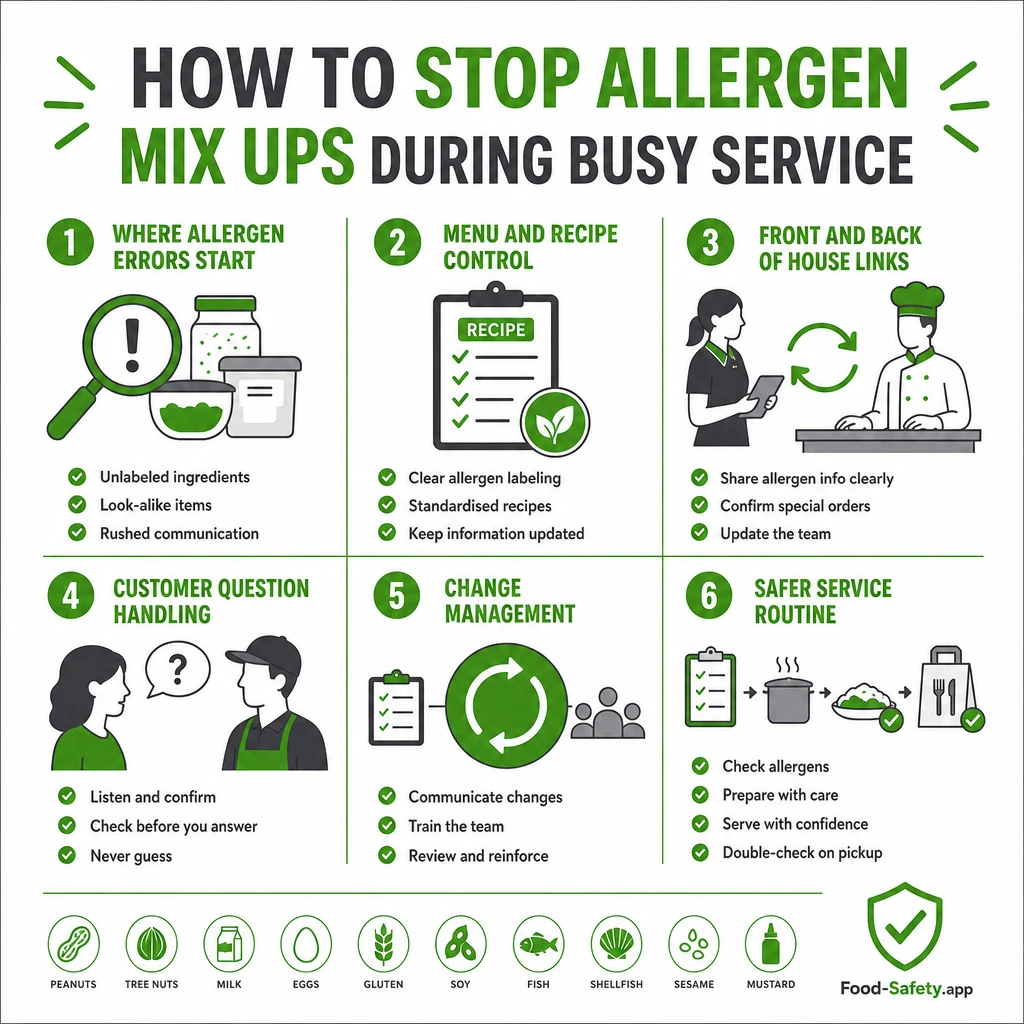
Where allergen errors start
Most allergen errors begin before a dish ever reaches a customer. Recipe changes, missing or outdated labels, and rushed prep contribute to miscommunication and misinformed decisions at the pass. When the kitchen team isn’t fully aligned with the front-of-house, a single overlooked detail can cascade into a full-service mix‑up. The key is to recognise the common fault lines and reinforce small, repeatable checks that function under pressure. Allergen management protocol.
Common scenarios include:
- A sauce recipe changes and milk is added without updating the allergen record.
- Rushed prep leads to missing labels or misread orders at the pass.
- A hurried handover between kitchen and waiting staff during a shift change leaves critical notes out.
Menu and recipe control
Link allergen details to each menu item
Every menu item should carry a clear allergen profile that’s easy to view and update. Use a single source of truth—whether a digital item file or a simple ledger—that is linked to the item code. When ingredients change, update the allergen record immediately and ensure substitutes are checked for allergen status before service. allergen matrix.
Update records when ingredients change
Adopt a straightforward change log for recipes and ingredients. Quick entries such as date, item, change description, and the person approving the change help ensure everyone is working from the same information. Review the log at least once per service period and after any supplier substitution. Consider how to maintain an allergen matrix for your menu as changes happen.
Check substitutes before service
When a substitute is used, verify its allergen implications with the kitchen and service staff. If a substitute introduces a new allergen or removes an allergen, update the menu item record and brief the team before the product hits the line. For guidance on allergen matrices, see how-do-you-create-an-allergen-matrix-for-your-menu.
Front and back of house links
Clear system for passing allergen questions
Establish a simple, standard flow for allergen queries. Waiting staff should capture details in a consistent format (allergen name, level of risk, and whether cross-contact is a concern) and pass this information to the kitchen with every relevant order. A small checklist can help ensure nothing is missed during busy periods. For cross-contamination prevention guidance, see cross-contamination-in-food-safety-explained-causes-examples-and-prevention.
Handover protocol at shift change
Use a fixed handover sequence that includes allergen notes. The outgoing team highlights active allergy considerations, lists open questions, and confirms the kitchen has seen any changes to ingredients or prep methods. This routine reduces the chance that critical allergen information gets dropped during handover. cross-contamination explained.
Customer question handling
Ask the right follow-up questions
Train staff to ask targeted questions rather than guessing. For example: “Are you avoiding all nuts, or is cross-contact a concern?” and “Is dairy acceptable, or is lactose intolerance the issue?” Document the answers clearly so the kitchen can act on them without revisiting the customer. For allergen training, see allergen training for new and agency staff.
Confirm details before serving
Before plating, confirm back to the kitchen the exact order and any restrictions. A quick recap on the line reduces the likelihood of serving a dish that doesn’t meet the customer’s needs. See allergen training for further guidance.
Avoid guessing
Never assume. If any doubt exists, halt the plating process and escalate to the chef or supervisor for a final check. A short pause is preferable to a rushed misstep. For more on cross-contamination prevention, refer to cross-contamination-in-food-safety-explained-causes-examples-and-prevention.
Change management
Routine for recording supplier swaps
Record supplier changes with a simple form: supplier name, product code, date of change, and how the allergen status is affected. Ensure the allergen profile on the item is updated in tandem with the supplier change to keep records accurate. For practical compliance, consider hygiene ratings as a benchmark for supplier controls. hygiene ratings.
New recipes and temporary menu changes
Introduce a clear protocol for new dishes and temporary changes. Require a quick allergen review by a senior staff member before the item goes on the menu or is offered to diners. Maintain a visible reference sheet for all team members during shifts. For safety fundamentals, explore the four Cs of hygiene.
Communication with staff
Keep all allergen information in one accessible place (paper or digital). Use concise, repeatable language for training and refresher sessions, and schedule regular bite-sized updates to reinforce correct practices during busy periods. For ongoing training, see allergen-training-for-new-and-agency-staff.
Safer service routine
Separate allergen-free prep area where possible
When feasible, establish a dedicated prep zone for allergen-free items. Clear separation reduces cross-contact risk and makes it easier to enforce strict hygiene routines. For practical cleaning guidance, read how-cleaning-stops-allergen-cross-contact.
Use clean equipment and utensils
Assign dedicated utensils, boards, and containers to allergen-free tasks. Label equipment clearly and confirm its use before starting any allergen-free prep. For cross-contact explanations, see cross-contamination-in-food-safety-explained-causes-examples-and-prevention.
Label plates clearly
Plate labels or quick toppers should indicate the customer’s allergen considerations. Visible labelling helps front-of-house staff communicate accurately at the pass and avoids misinterpretation by service staff or guests. For training resources, refer to allergen-training-for-new-and-agency-staff.
Double-check before food leaves the pass
A final check by the chef or supervisor before the dish leaves the pass greatly reduces errors. Confirm the allergen profile aligns with the customer’s order and that any last-minute changes were captured in the records. For safety fundamentals, see the four Cs of hygiene.
Opening checks and closing checks
Incorporate allergen checks into opening and closing daily routines. A brief briefing at opening and a quick sign-off at closing help maintain consistency and accountability across shifts. For compliance and inspections guidance, check hygiene ratings.
Putting it into practice
Implement a simple, repeatable routine that covers day-to-day service and responds quickly to changing menus or suppliers. Assign ownership for each step, keep records up to date, and review performance after busy periods to identify gaps and reinforce good habits.
For practical guidance on allergen labelling, see the Food Standards Agency: Food Standards Agency.
Food-Safety.app is a food safety management system for catering businesses.
Learn more: HACCP and food safety systems.
Learn more about food safety
Discover practical guidance on allergen controls, HACCP, training resources, and safer service routines to help your team protect guests and stay compliant.