Why a food business can fall below a 3 rating
When people search for why a food business drops below a 3 rating, they usually want one thing: the weak points that most often pull an inspection result down, and what to do about them before it happens again. In the UK, a poor hygiene rating usually points to gaps in food hygiene, the cleanliness of the premises and how well food safety is managed day to day. For catering and hospitality businesses, that can happen quickly if a busy service, staff changes or a few overlooked routines start to stack up.
The good news is that most low scores are preventable. The same issues tend to appear again and again in restaurants, cafes, hotel kitchens, school canteens and takeaways: poor temperature control, weak cleaning schedules, cross-contamination, pests, bad documentation and not having enough evidence that the system is actually being followed. This guide explains the main reasons businesses drop below a 3 rating and gives practical fixes that work in a professional kitchen.
Table of contents
- How the rating drops
- Food hygiene failures that drag scores down
- Cleanliness and kitchen condition problems
- Management, records and due diligence
- Common operational mistakes in busy service
- How to recover before the next inspection
- Final checklist for managers
How the rating drops
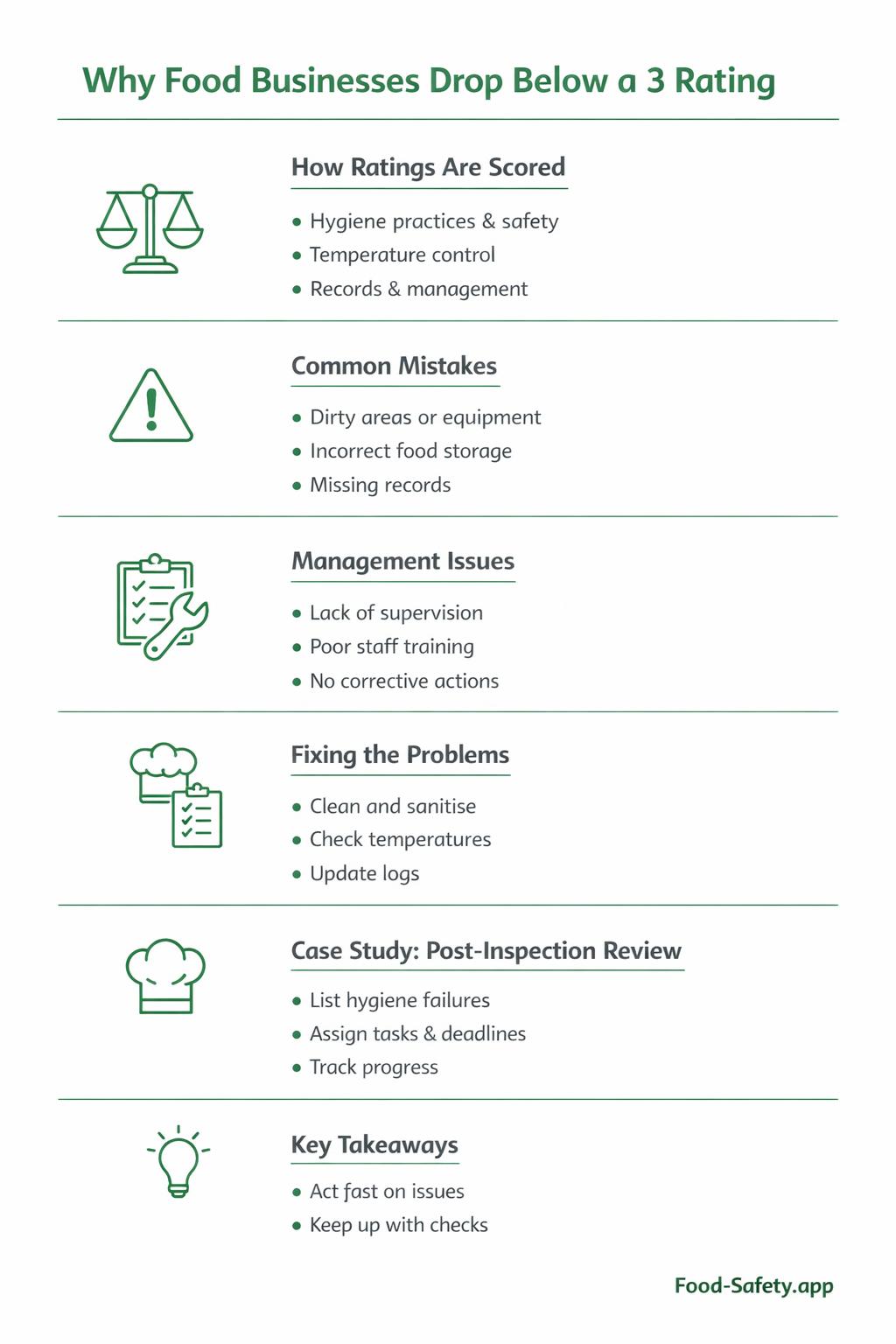
A food business usually falls below a 3 rating because one or more of the three core areas has slipped far enough to concern the inspector. Those areas are generally:
- How hygienically food is handled
- The cleanliness and condition of the premises
- How well food safety is managed
In practice, that means a kitchen may look busy and still score badly if staff are not following safe routines. For example, a takeaway might have plenty of order volume but still lose marks if raw chicken is prepared next to ready-to-eat salad, fridges are overfilled and temperature checks are patchy. A hotel kitchen may have strong chefs but still fall short if cleaning records are incomplete and there is no consistent manager oversight.
The key point is that a low rating rarely comes from one dramatic mistake. More often, it comes from repeated small failures that show the operation is not under control.
Food hygiene failures that drag scores down
Cross-contamination risks
One of the fastest ways to lose points is poor separation of raw and ready-to-eat food, i.e., cross-contamination risks. That includes using the same board, knife or prep bench without cleaning and disinfecting between tasks, storing raw meat above cooked items in a fridge, or handling cash, packaging and food without proper handwashing in between.
In a busy service, the problem is often speed. Staff may know the rule, but if prep space is tight and the pass is under pressure, shortcuts creep in. The fix is simple in theory and disciplined in practice: separate equipment, clear labels, colour-coded tools where helpful, and enough prep space for the menu you actually serve.
Temperature control problems
Fridge and hot-holding failures are another common reason businesses fall below a 3 rating. If chilled food is stored too warm, if cooked food is left out for too long, or if reheating is inconsistent, the inspector will see a system that cannot reliably protect customers. See temperature control guidelines for more detail.
- Check fridges at opening and during service where needed
- Record hot-holding checks at regular intervals
- Reject or rapidly cool food when control is lost
- Keep probe thermometers clean, calibrated and easy to access
Poor personal hygiene
Staff hygiene is still one of the clearest signals of control in a commercial kitchen. A business may score badly if staff are not washing hands properly, wearing clean protective clothing, covering cuts correctly or staying away from food when unwell.
The issue is often training that has not been reinforced after induction. During busy service, people revert to habit. Managers should watch for real behaviour, not just assume the policy is being followed. Simple actions such as visible handwash prompts, clean aprons and a clear illness reporting process can make a noticeable difference.
Cleanliness and kitchen condition problems
Cleaning that looks fine on paper but not in the kitchen
Many businesses have a cleaning schedule, but the rating still drops because the schedule is not actually working. Inspectors look at evidence and outcomes. A signed sheet means very little if the extractor canopy is greasy, the walk-in fridge is dirty, the floor corners are built up with debris or the wash-up area is cluttered.
The strongest cleaning systems are specific. They name the task, the frequency, the person responsible and the standard expected. For example, “clean fridge handles” is better than “clean fridge”. In a professional kitchen, that level of detail helps teams stay on top of daily and weekly jobs, and you can implement it via cleaning schedules.
Equipment and building issues
Sometimes the rating falls because the kitchen itself makes safe work difficult. Broken seals, damaged walls, missing tile grout, poor drainage, rusting shelving or a non-functioning handwash basin can all affect the score if they create cleaning problems or allow contamination to build up.
Hospitality businesses often delay maintenance because trading comes first. That is understandable, but recurring defects become inspection problems. The practical approach is to keep a small maintenance log, prioritise anything touching food or handwashing, and escalate defects before they turn into bigger sanitation issues.
Pest pressure and waste management
Pests do not always mean an infestation, but signs such as droppings, damaged stock packaging, gaps around doors or poor waste storage can quickly reduce confidence in the business. Rubbish left near loading areas or bins overflowing after service are common triggers in takeaway and late-night operations.
Keep external waste areas tidy, empty bins often enough for your trade pattern and make sure staff know to report early signs of pest activity immediately. If a problem is suspected, do not wait for it to get worse.
Management, records and due diligence
Not being able to prove control
A strong food safety culture needs evidence. If records are missing, incomplete or only filled in at the end of the week, it suggests the business may not be managing food safety properly. That can pull a rating down even when the kitchen looks acceptable at first glance.
Common gaps include:
- HACCP-based system or weak food safety paperwork
- Missing temperature records
- Cleaning records that are not checked
- Training records not kept up to date
- Allergen controls not documented
- No action log for defects or incidents
Weak management presence
Inspectors want to see that managers know what is happening on the floor and can correct problems quickly. If the duty manager cannot explain what happens when a fridge fails, how allergens are controlled, or who signs off cleaning, the operation may be viewed as poorly controlled.
In smaller businesses, the owner may be hands-on but still not have a clear system. In larger sites, the issue can be inconsistent supervision between shifts. Either way, the answer is the same: make responsibilities clear, train supervisors properly and review standards every day, not just before an inspection.
Common operational mistakes in busy service
Rushing prep and service
Busy service exposes weak systems. If the team is constantly improvising, hygiene slips are more likely. A prep list that is too ambitious, poor mise en place or not enough space at peak times can lead to food being left out, boards being shared and cleaning being postponed until “later”, which often means never.
The fix is to design the work around the trade you actually do. Reduce unnecessary steps, stage prep earlier in the day where safe, and make sure the service plan matches the size of the team on shift.
Allergen control gaps
Although a hygiene rating is not a full allergen audit, poor allergen management can still indicate weak control overall. Mislabelled items, unclear recipe changes and casual ingredient swaps suggest that the kitchen is not managing risk properly.
Keep ingredient information current, train staff to check every substitution and make sure front-of-house teams know how to answer basic allergen questions accurately. In takeaways and cafes, this is especially important because menu changes are often frequent.
Training that fades after induction
One-off training is not enough. Staff forget, habits slip and new people pick up the wrong behaviours if nobody is watching. Refreshers should be short and practical. Focus on handwashing, cross-contamination, chilling, reheating, cleaning and illness reporting. The more the team understands the “why”, the more consistent they will be under pressure.
How to recover before the next inspection
If you think your business could drop below a 3 rating, do not wait for the inspection to reveal it. Start with a short, honest walk-through of the kitchen and back-of-house areas. Look for the things an inspector will notice first: food storage, cleanliness, handwash stations, fridge control, pest signs and staff behaviour.
Then build a corrective action list with owners and deadlines. A practical recovery plan might include:
- Deep clean the areas that are hardest to reach during daily service
- Reset storage so raw, ready-to-eat and allergen-sensitive items are separated clearly
- Review temperature monitoring and fix any broken equipment
- Retrain staff on the highest-risk tasks
- Check paperwork and make sure records are actually being completed
- Fix maintenance defects that affect cleaning or hygiene
If your business has multiple sites, make sure every venue is using the same standards. A single weak outlet can damage the reputation of the whole group.
For official guidance on hygiene ratings and inspection expectations in the UK, the Food Standards Agency is a useful place to check current advice. For a quick overview, see Understanding food hygiene ratings.
Final checklist for managers
- Can every shift explain how food is kept separate and safe?
- Are fridge, hot-holding and reheating checks happening consistently?
- Are cleaning schedules specific, realistic and verified?
- Are defects, pests and breakdowns logged and fixed quickly?
- Can the person in charge show evidence of control on demand?
- Do staff know what to do if they feel unwell or spot a food safety issue?
A low hygiene rating is rarely about one bad day. It is usually the result of repeated gaps in daily control. If you tighten routine checks, improve supervision and make the standards easier for staff to follow, the rating usually improves with the operation itself. For teams that need better visibility and record-keeping across shifts, Food-Safety.app, a food safety management system for catering businesses, can help support consistent control without adding extra confusion.
When a business understands why food businesses drop below a 3 rating, it becomes much easier to prevent it. Focus on the basics that inspectors can see and verify: safe food handling, a kitchen that is genuinely clean, and management that can prove control. That is what protects customers, supports your reputation and gives your team a better chance of passing with confidence.