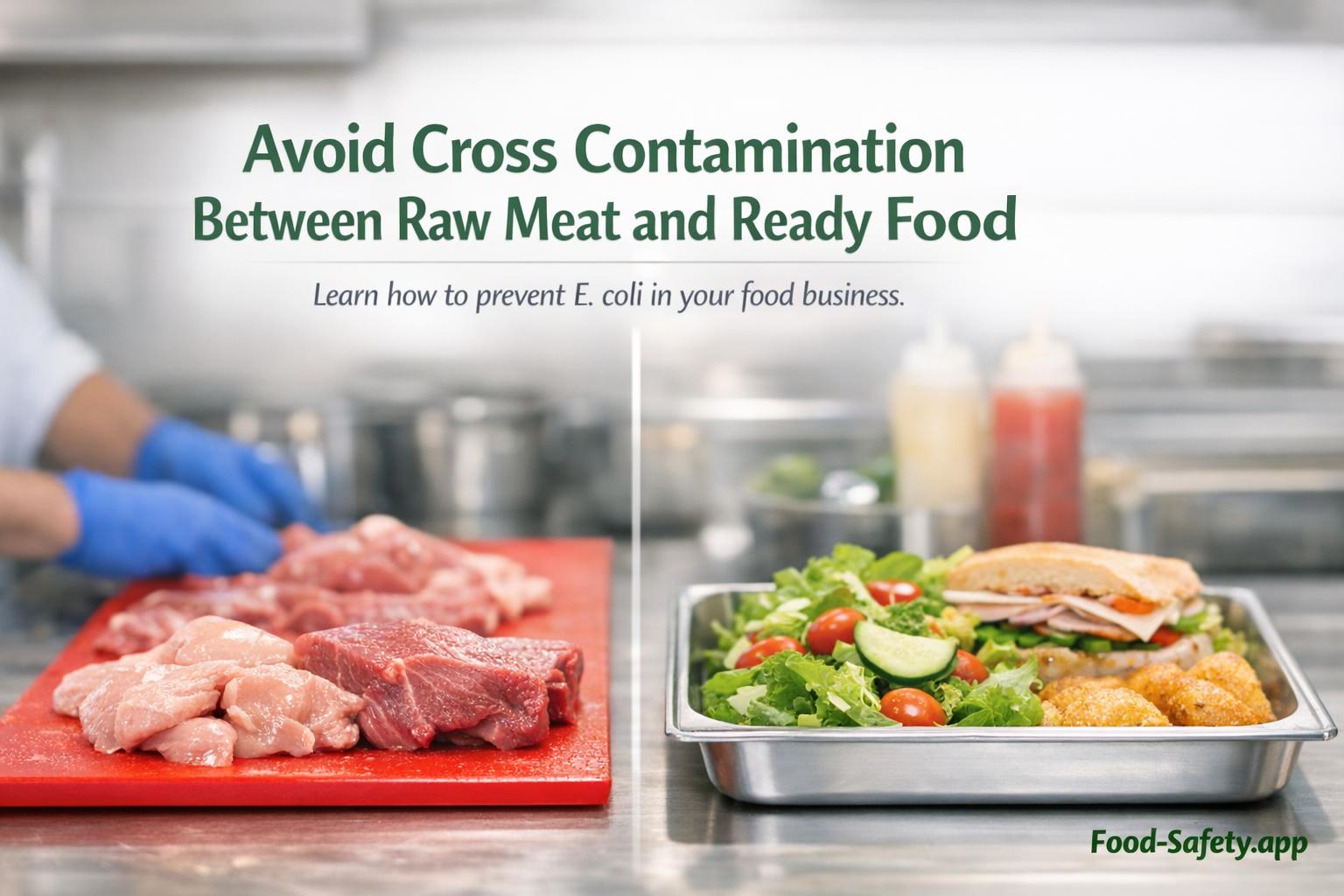
Preventing E. coli in a food business is not about one rule or one temperature check. It is about stopping cross-contamination during the moments when kitchens usually fail: deliveries arriving during prep, raw meat stored badly in a full fridge, shared cloths on busy counters, and staff jumping between raw and ready-to-eat tasks when service starts. This guide explains the controls that matter most, where they break down in real life, and what managers should monitor to keep customers safe.
Preventing E. coli contamination in food businesses
Why E. coli is a serious kitchen risk
Harmful E. coli can make customers seriously ill, and it does not take much contamination to create a problem. A small splash of raw meat juice in the wrong place, one missed handwash, or one unclean board used for salad prep can be enough. That is why E. coli control matters so much in catering businesses, cafés, takeaways, school kitchens, care settings, and any operation preparing both raw and ready-to-eat food.
The business risk is just as real as the health risk. An E. coli incident can lead to customer complaints, discarded stock, disruption to service, enforcement attention, and lasting damage to trust. For businesses serving children, older adults, or anyone with a weaker immune system, the consequences can be even more serious. In practice, this is not a rare theoretical hazard. It is a daily control issue that needs to be managed during storage, prep, service, cleaning, and supervision.
Where cross-contamination actually happens in a working kitchen
E. coli problems usually start in ordinary moments, not dramatic ones. A delivery driver drops off chilled goods at the same time the breakfast rush is building. Staff sign for the boxes quickly, stack raw mince above washed lettuce in the walk-in, and tell themselves they will reorganise it later. They do not. By lunchtime, the risk is already there.
Storage is one of the most common weak points. Raw meat can drip in fridges. Containers can be uncovered. Shelves can become mixed when stock is moved around in a hurry. A small sandwich bar might only have one under-counter fridge, so separation has to be planned carefully rather than assumed.
Prep is another major failure point. In a busy pub kitchen, a chef may trim raw burgers on a red board, then get pulled across to plate tomato and onion garnish when tickets start printing. If handwashing, board change, and sanitising are missed because service feels urgent, ready-to-eat food becomes the victim of the workflow.
Shared sinks, cloths, knives, probe thermometers, fridge handles, and prep benches also spread risk when controls are vague. It is rarely one huge mistake. More often, it is several small shortcuts in a row. If you need stronger foundations on this, read cleaning hygiene and cross-contamination and what systems help run a safe food business.
The controls food businesses need to prevent E. coli
The most important control is separation of raw and ready-to-eat food. That starts with storage, but it has to continue through prep, service, and cleaning. Raw meat should never be stored where it can drip onto salads, cooked foods, or ingredients that will not be cooked again. Staff should know exactly which shelves, containers, utensils, and work areas are for raw products and which are for ready-to-eat food.
Handwashing has to be treated as a control point, not a polite reminder. After handling raw meat, waste, dirty cloths, chemicals, or contaminated packaging, staff must wash hands properly before touching anything clean. Gloves do not solve this. In fact, gloves often make things worse when staff use them as a substitute for washing.
Cleaning and disinfection need to be clear enough to follow under pressure. A cloth wiped over a board is not enough. A board used for raw chicken and then used for bread rolls after a quick rinse is an obvious failure, but the same applies to knives, tongs, containers, and worktops. Cleaning has to match the risk of the task, and managers should be able to explain what chemical is used, how it is diluted if needed, and when food-contact surfaces are safe to use again.
Temperature control still matters, but it should be handled as part of the wider system, not as filler. Cooking, chilling, cold holding, reheating, and hot holding all reduce risk when they are monitored properly. If your team needs a practical reference point, see temperature control and the danger zone.
Staff illness rules also matter. Anyone with diarrhoea or vomiting should not be handling food. That sounds basic, but kitchens still get this wrong when they are short-staffed and trying to cover shifts. The right answer is not to hope for the best. The right answer is to follow the exclusion rule, protect the food, and document the decision.
A simple daily E. coli checklist for small food businesses
Managers often know the rules but still struggle to make them happen consistently. That is why a simple daily checklist is more useful than another generic hygiene paragraph.
Opening checks
- Confirm fridges and freezers are at the correct temperature before prep begins.
- Check raw and ready-to-eat food are stored separately and nothing is dripping or uncovered.
- Make sure handwash stations are stocked with soap, hot water, and drying materials.
- Confirm sanitiser, cloths, boards, and utensils are clean and ready for the right zones.
- Check probe thermometers are available, clean, and working.
Prep-period checks
- Keep raw meat prep physically separate from salad, sandwich, dessert, or garnish prep.
- Stop staff moving between raw and ready-to-eat tasks without handwashing and changing equipment.
- Sanitise benches, boards, knives, and handles between tasks.
- Do not let dirty outer packaging sit on clean prep surfaces.
Service checks
- Keep ready-to-eat garnishes, salad items, and cooked foods protected during service.
- Replace utensils that fall, get mixed between foods, or are used in the wrong area.
- Watch buffet, deli, and sandwich stations closely because staff often cross over tasks quickly.
- Act immediately if food is stored, held, or handled in a way that risks contamination.
Closing checks
- Discard food that may have been contaminated rather than trying to save it.
- Deep-clean food-contact surfaces, fridges, sinks, handles, and reusable equipment.
- Record anything that went wrong, what was done about it, and what needs checking tomorrow.
Common mistakes that lead to contamination
Many kitchens do not fail because staff are careless. They fail because the routine encourages shortcuts.
- Using one cloth everywhere: A blue cloth that wipes a raw prep counter, then a fridge handle, then a salad bench has just carried contamination through the kitchen.
- Stacking fridges badly: In a small café, a tray of raw burger mix placed above sliced tomatoes may seem temporary, but temporary mistakes are enough.
- Rinsing instead of cleaning and disinfecting: A “quick wash” is not the same as proper cleaning.
- Using gloves as a shortcut: Gloves worn while handling raw chicken and then used to pick up burger buns or salad are just contaminated gloves.
- Moving staff between stations without controls: A prep cook who handles raw lamb skewers and then starts assembling wraps without washing hands creates a direct transfer risk.
- Assuming ready-to-eat foods are low risk: Salad, garnish, desserts, and sandwich fillings are high consequence because they may not be cooked again.
This is where stronger systems make the difference. The best kitchens remove guesswork so staff do not have to invent safe behaviour during a busy shift. Related support on HACCP food safety systems and compliance law and inspections can help connect these controls to what inspectors expect to see.
What to record in your food safety system
If your controls are real, you should be able to prove them. That does not mean creating endless paperwork. It means recording the checks that actually show control.
- Opening fridge and freezer checks
- Cooking, reheating, chilling, and hot-holding records where relevant
- Cleaning schedules and sign-off for food-contact areas
- Delivery checks for temperature, condition, and rejected items
- Staff training and refresher records
- Probe calibration or thermometer checks
- Corrective action logs when something goes wrong
For example, if a chilled delivery arrives warm, “checked and accepted” is a weak record. A better record shows the temperature found, what items were affected, whether the stock was rejected, who made the decision, and what happened next. That is useful for management, useful for inspections, and useful when spotting patterns.
Training records matter too. If a new starter is moved onto sandwich prep, you should be able to show they were trained on handwashing, cross-contamination, allergens, and cleaning before working alone. For that side of the system, see why staff training records should be kept and small food business support.
Examples of corrective action when controls fail
Corrective action is where many food safety systems become vague. “Spoke to staff” is not enough. Good corrective action shows what happened, how risk was controlled immediately, and how repeat failure will be prevented.
Example 1: Fridge too warm at opening
A deli opens at 7:00am and finds the ready-to-eat fridge at 10°C. The correct action is to stop using the unit, assess affected food, move safe stock to another fridge, call for repair, and record everything clearly. The wrong action is to shut the door and hope it drops later while service continues.
Example 2: Raw meat stored above salad items
During a supervisor check, raw chicken is found on a top shelf above prepared slaw. The correct action is to discard any food at risk, reorganise storage immediately, clean and disinfect affected areas, and brief staff on shelf layout before the next delivery is put away.
Example 3: Staff member moves from raw prep to wrap assembly
At lunchtime, a team member is seen handling raw kebab strips and then touching tortilla wraps without washing hands. The correct action is to stop the task, discard any contaminated ready-to-eat food, sanitise the area, retrain the staff member, and record the incident rather than treating it as a minor slip.
Example 4: No sanitiser available on the prep bench
A prep area is fully set up for service but the sanitiser bottle is empty. The correct action is to stop prep until the correct product is available and ready to use. “We will refill it later” is not control.
Example 5: Staff reports diarrhoea before shift
A kitchen porter phones in unwell before a Saturday shift. The correct action is to exclude them from food handling, follow your sickness reporting rule, arrange cover if needed, and record the decision. Letting them come in because the team is stretched is exactly how bad decisions become outbreaks.
How digital records make E. coli controls easier to prove
Once the practical controls are in place, the next challenge is consistency. Paper systems often fail in busy kitchens because checks are missed, sheets get backfilled, and managers cannot see patterns quickly enough. That is where digital records can help.
Food-Safety.app fits naturally here because it supports the parts of E. coli control that are hardest to keep consistent under pressure: opening and closing checks, temperature logs, cleaning records, training records, delivery checks, and corrective action notes. Instead of relying on memory or a clipboard that disappears during service, teams can keep time-stamped evidence of what was checked, what failed, and what was done about it.
The app should not replace good practice, but it can make good practice easier to repeat and easier to prove. That matters when a manager is reviewing repeated fridge issues, when a new team member needs closer supervision, or when an inspector asks how the business knows its controls are actually being followed.
Final takeaway
Preventing E. coli is really about controlling kitchen flow. Keep raw and ready-to-eat food apart, make handwashing and cleaning non-negotiable, watch the points where busy teams cut corners, and record the checks that prove risk is under control. The kitchens that manage this well do not rely on good intentions. They build routines that still work when the delivery arrives late, the lunch rush hits early, and half the team is under pressure.