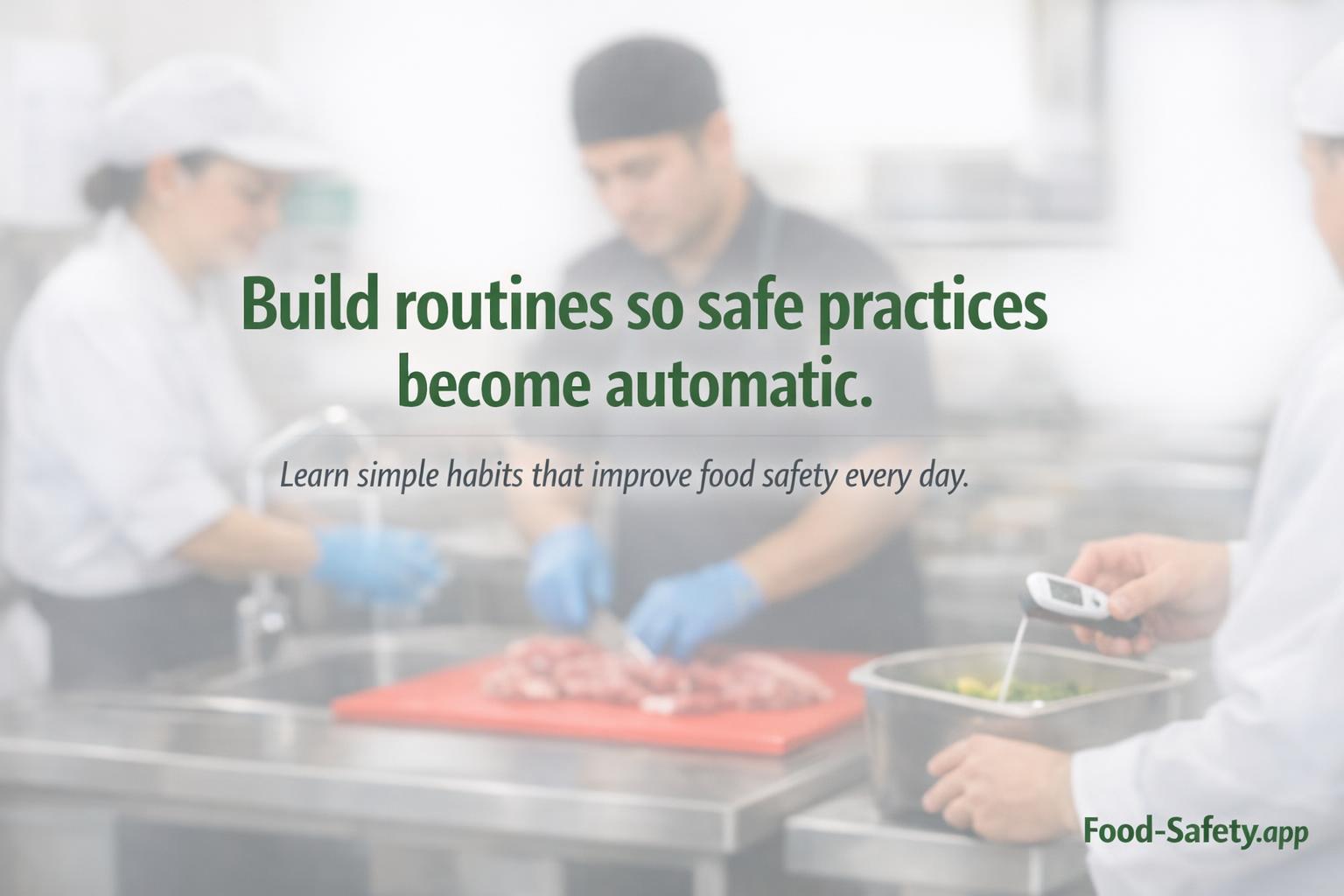
Practical kitchen habits are what prevent real food safety mistakes during busy service. This guide breaks down the exact habits commercial kitchen teams should follow every shift, with real-world examples and simple checklists you can actually use.
Why habits matter in real kitchens
Food safety failures rarely happen because someone does not “know the rules.” They happen because small habits break down during pressure — a busy lunch rush, a late delivery, or a short-staffed shift.
In real kitchens, safety depends on repeatable actions:
- Washing hands at the right moment (not just occasionally)
- Checking temperatures even when everything “looks fine”
- Separating raw and ready-to-eat food without shortcuts
When these habits are consistent, teams make fewer mistakes and managers can prove due diligence. If you need a foundation, start with food safety fundamentals.
12 essential kitchen habits every shift
These are the habits that actually prevent incidents in commercial kitchens:
1. Wash hands at trigger points
After raw food, waste, cleaning, deliveries, or phones — not just “regularly.”
2. Keep raw and ready-to-eat food separate
Different boards, shelves, and utensils. No exceptions during rush.
3. Check temperatures at set times
Fridges, cooking, reheating, and hot holding — even when things seem fine.
4. Label and date everything clearly
No guessing shelf life during service.
5. Verify allergens before serving
Never rely on memory — always check.
6. Check deliveries immediately
Reject warm, damaged, or out-of-date stock on arrival.
7. Cool and reheat food safely
Do not leave food sitting out “just for a few minutes.”
8. Control cleaning cloths and chemicals
Wrong cloth = cross-contamination risk.
9. Reset stations during quiet moments
Prevents build-up of unsafe conditions.
10. Escalate problems immediately
If unsure, stop and check — do not guess.
11. Record checks at the time of work
Not later, not from memory.
12. Complete opening and closing routines
Consistency across shifts prevents gaps.
Common habits that cause food safety failures
Most incidents come from everyday shortcuts like these:
- Topping up food: Adding fresh chips onto old ones in a fryer holding tray
- Fridge shortcuts: Storing cooked chicken under raw chicken “just for now”
- Missed delivery checks: Accepting chilled food without checking temperature
- Assumptions: “Someone else must have logged that already”
- Allergen guessing: Telling a customer “it should be fine” without checking
Real example: A café received a delivery during peak service. Staff signed it off quickly and stored it. Later, they found chilled desserts at 12°C — already unsafe. The issue was not knowledge, it was a broken habit during pressure.
Opening checklist for safer shifts
A simple opening routine prevents most early-shift risks:
- Check fridge and freezer temperatures
- Confirm probe thermometer is working
- Inspect deliveries and stock condition
- Check cleaning supplies and sanitizer strength
- Ensure allergen information is available
- Identify any equipment faults
Real example: A breakfast chef skipped the fridge check because “it was fine yesterday.” The unit had failed overnight, and milk was already unsafe. A 30-second check would have prevented waste and risk.
Closing checklist to prevent next-day risks
Closing habits protect the next shift:
- Label and date all remaining food
- Store raw and ready-to-eat food correctly
- Clean and sanitise all food contact surfaces
- Dispose of unsafe or expired food
- Log issues for the next team
Real example: A team left cooked rice unlabeled overnight. The next day, staff reused it, unsure of its age. This is a common and avoidable risk.
How managers reinforce habits without slowing service
Strong habits do not come from long audits. They come from consistent, simple checks:
- Focus on 3–5 key behaviours per shift
- Do quick spot checks during service
- Correct issues immediately, not later
- Use real mistakes as teaching moments
Example: A supervisor checks handwashing, temperature logs, and storage every shift. That consistency builds habits faster than occasional deep inspections.
To support this, structured systems like paperwork and digital food safety can improve visibility without adding extra workload.
Tools that make good habits easier
Even strong teams struggle to maintain habits consistently without a system.
Digital tools can help by:
- Prompting checks at the right time
- Recording automatic timestamps
- Highlighting missed tasks
- Keeping a clear audit trail
For example, instead of relying on memory or paper logs, a system like Food-Safety.app allows teams to complete checks during service and keeps everything organised in one place.
If you are improving specific areas, explore:
The goal is simple: make safe habits the easiest habits to follow, even during the busiest shifts.