
Fridge checks fail in busy kitchens for a very simple reason: service gets in the way. When orders pile up, deliveries arrive, staff change over and the pass starts shouting, temperature checks can slip to the bottom of the list. The problem is that missed fridge checks do not just create paperwork gaps; they can hide early signs that cold storage is drifting out of control. In UK food businesses, a strong fridge checks routine should be quick, clear and built for pressure, not for an ideal quiet moment that never comes.
For a quick grounding in HACCP principles as they apply to kitchen checks, see HACCP principles explained.
This guide explains why fridge checks go wrong in professional kitchens and what to change so the routine actually sticks. Guidance can vary by country, but this article is written for UK catering and hospitality businesses and uses practical food safety expectations commonly applied here.
For how to write a HACCP plan, see how to write a HACCP plan.
Table of contents
- Why fridge checks fail in busy kitchens
- What a good fridge check routine looks like
- Common mistakes that cause missed checks
- Corrective actions when a fridge is out of range
- How to make fridge checks stick during service
- Records, training and accountability
- Final thoughts
Why fridge checks fail in busy kitchens
Most fridge checks fail because they are treated as a task to squeeze in, rather than part of the daily rhythm. In a commercial kitchen, that creates predictable gaps. A chef may do the morning temperature round, then get pulled into prep. A café supervisor may assume someone else has checked the dessert fridge. A hotel kitchen may have three different teams using the same cold room, but no clear handover. Once the routine becomes dependent on memory, it starts to fail.
Another common issue is poor timing. If checks are only done at the start of service, you can miss the point when a fridge warms up under heavy use. Constant opening, overfilling, warm product being added, damaged seals, blocked vents and overloaded door shelves all affect performance. A fridge can look fine on paper early in the day and still struggle later on.
There is also a simple human factor: people do what is easy under pressure. If the thermometer is awkward to reach, the record sheet is in the office, or the person responsible is not clearly named, the check gets delayed. Once delayed, it is often forgotten entirely.
For how to write a HACCP plan, see how to write a HACCP plan.
What a good fridge checks routine looks like
Good fridge checks are short, repeatable and easy to verify. They should not depend on one perfect person or one quiet time of day. The aim is to spot problems early, protect food safety and give you a clear record if something goes wrong.
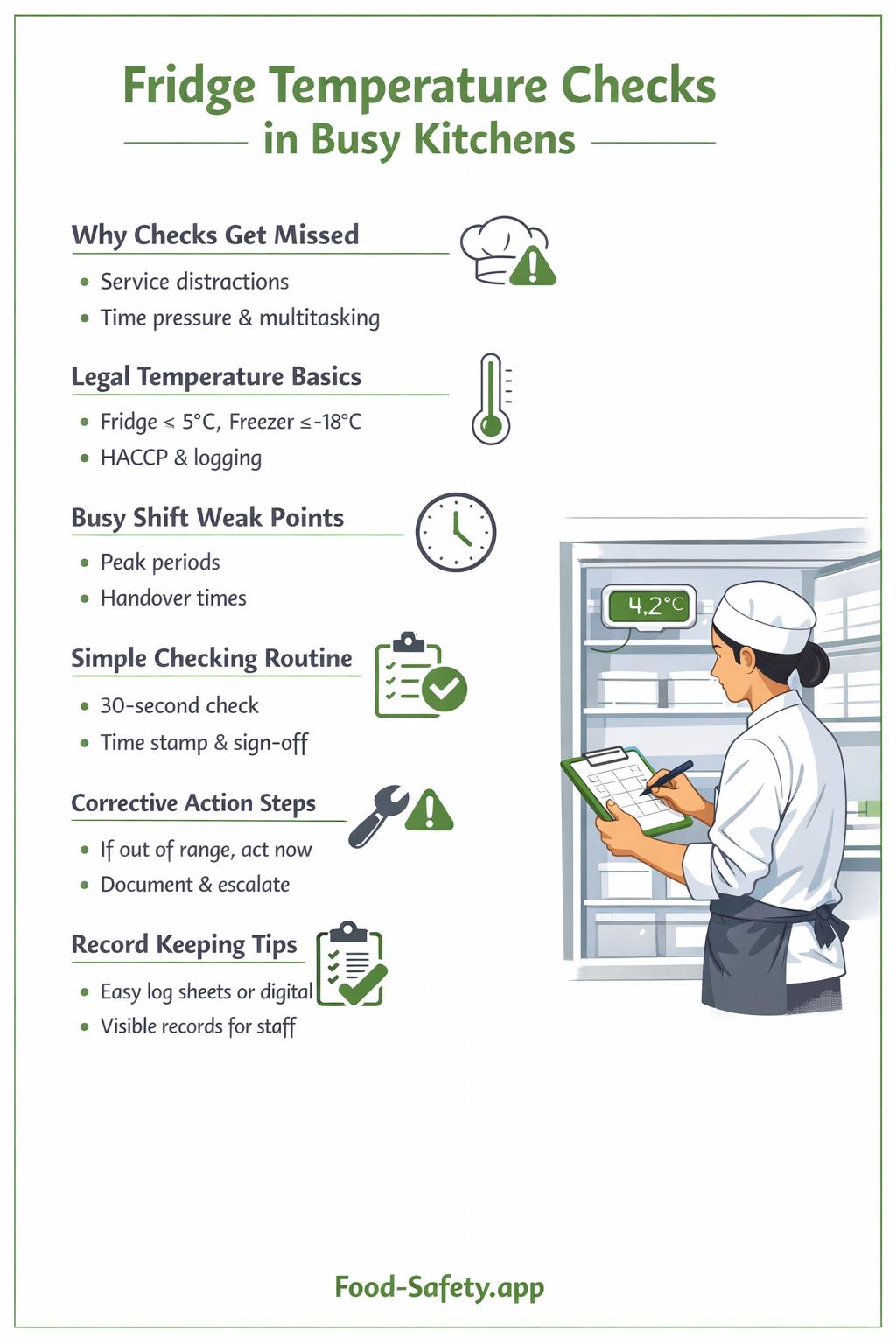
Include these core checks
- Check and record the temperature of each relevant fridge or cold room.
- Look for signs of overloading or poor airflow.
- Check that doors close properly and seals are intact.
- Make sure food is covered, dated and stored correctly.
- Confirm that raw and ready-to-eat foods are separated properly.
- Note any faults, unusual readings or corrective action taken.
In a busy service kitchen, the best approach is usually a set routine at agreed times, plus extra checks when conditions change. For example, after a delivery, after a deep clean, when a fridge is heavily loaded, or if staff notice warmer air, condensation or an unusual noise.
Keep the process practical. Use one simple sheet or digital log per fridge bank, with clear naming, a space for the reading, a space for initials, and a space for action taken. If a member of staff can complete it in under a minute, it is much more likely to happen.
Common mistakes that cause missed checks
The biggest mistake is relying on memory. In a restaurant or school canteen, the person doing prep may assume the manager has already checked the fridges. In a takeaway, one colleague may be off sick and the replacement may not know the routine. A missed handover can mean a missed temperature check for the whole shift.
Another mistake is writing down readings without looking at the fridge properly. A number on its own is not enough. If a fridge is packed too tightly, if food is blocking the fan, or if the door is not sealing, the temperature may look acceptable for the moment but the fridge is clearly under strain.
Other common failures include:
For general kitchen safety and practice, see General kitchen safety and practice.
- Using the same check time every day, even when service is unusually heavy.
- Completing paperwork after the event from memory.
- Leaving a fault unreported because “it seems to be fine for now”.
- Not calibrating or checking thermometers regularly.
- Not assigning one clear person to act when a reading is out of range.
For practical support on food hygiene expectations and safe storage principles, the Food Standards Agency is a useful trusted source for UK businesses.
Corrective actions when a fridge is out of range
Fridge checks only help if staff know what to do when something is wrong. A corrective action should be immediate, sensible and recorded. Do not just note the problem and move on.
Use this simple response:
- Check the reading again with a reliable thermometer.
- Inspect the door, seals, vents and product loading.
- Reduce opening if possible and move non-essential items.
- Move food to another working fridge if needed.
- Label any food that may have been at risk and follow your food safety procedure.
- Report the fault for repair without delay.
If the fridge is not holding temperature properly, the issue should be treated seriously. A quick adjustment may not be enough. In a busy kitchen, the safest decision is often to isolate the fridge, protect the food and get technical support fast. Keep all actions written down so the next shift knows exactly what happened.
How to make fridge checks stick during service
The easiest way to improve fridge checks is to build them into existing habits. Do not create a separate “extra job” that everyone resents. Link the checks to things staff already do: opening the kitchen, changing over shifts, post-delivery put-away, and end-of-service close-down.
In restaurants and hotel kitchens, assign one named person per shift. In schools and care settings, build the checks into the daily start-up list. In cafés and takeaways, keep the log next to the fridge, not buried in a folder in the office. If the record is visible, it gets used.
It also helps to make expectations obvious. A short wall prompt near the cold room, a laminated checklist, or a digital reminder can be enough to reduce missed steps. If staff are regularly forgetting, the fix is usually not more pressure. It is better layout, clearer ownership and simpler paperwork.
Also consider cross-contamination risks: Cross contamination.
Records, training and accountability
Good records do more than satisfy an inspection. They show patterns. If one fridge keeps drifting late in the week, if a door seal is failing, or if a delivery routine is causing warm-up problems, the log will reveal it. That gives you something useful to act on instead of a vague complaint.
Training should be short, direct and practical. Show staff how to use the thermometer, where to record the result, what a normal check looks like and who to tell if something is wrong. New starters should be shown the routine on their first day, not after they have already missed it.
For training resources, see Training and induction.
Where possible, review fridge logs as part of manager checks, not only during inspections. That makes the routine feel real and keeps everyone accountable. A good system is not about collecting paperwork; it is about making sure cold food stays safe during a hectic service.
Final thoughts
Fridge checks fail when they are too complicated, poorly timed or left to memory. They succeed when they are fast, visible and built into the way the kitchen already works. If you want fewer missed checks, focus on clear ownership, simple records, sensible corrective actions and regular review. That approach is far more realistic for a commercial kitchen than hoping staff will remember everything during the rush.
For building a strong food safety culture in your kitchen, see Food safety culture and management.
For teams that want a more organised approach, a food safety management system for catering businesses like Food-Safety.app can help keep checks, records and follow-up actions in one place without adding more confusion to service.
When fridge checks are done well, they protect food, reduce waste and make life easier for the whole shift. In busy kitchens, that is exactly what good food safety should do.