Busy service does not leave much room for guesswork, which is why simple food safety tips for busy kitchens need to be practical, quick to follow and easy for every team member to use. In a restaurant, hotel, café, school canteen or takeaway, the safest routines are usually the ones that fit naturally into prep, service and close-down without slowing the pass. This guide sets out straightforward habits that help reduce avoidable food safety risks in a professional kitchen, based on common UK good practice, in line with HACCP principles explained. Rules and expectations can vary in other countries, so always check local guidance if you work outside the UK.
Why simple routines matter in a busy kitchen
In a kitchen under pressure, food safety often fails at the small moments: a rushed hand wash, a tray left too long on the prep bench, a cloth used for one job and then another. These are the things that can happen in any operation, from a busy lunch service in a café to a late-night takeaway rush. The answer is not more paperwork for the sake of it. It is a few dependable routines that staff can follow even when orders are stacking up.
The best food safety tips for busy kitchens are the ones that protect service rather than interrupt it. That means making the safe way the easiest way: clear stations, labelled containers, clean cloths, working thermometers, and staff who know what to do when something looks off.
Keep handwashing easy and visible
Handwashing is still one of the simplest controls in any food business, but it only works if it is practical. If the sink is blocked, the soap has run out, or staff have to walk too far, people will skip steps under pressure. Make handwashing obvious and unavoidable. For guidance, see good hygiene practices in kitchen.
Simple actions that help
- Keep the handwash sink stocked with soap, paper towels and a clear bin.
- Place it where staff naturally pass during prep and service.
- Remind teams to wash hands after handling raw food, rubbish, cleaning chemicals, money, phones, or touching their face.
- Use a quick verbal prompt during peak service if someone has moved from one task to another.
If hands are visibly dirty, washing is not optional. If a member of staff has cuts or skin damage, they should cover them properly before handling food. In a busy kitchen, a good supervisor keeps an eye on this throughout service rather than waiting for a problem to appear.
Control temperatures without slowing service
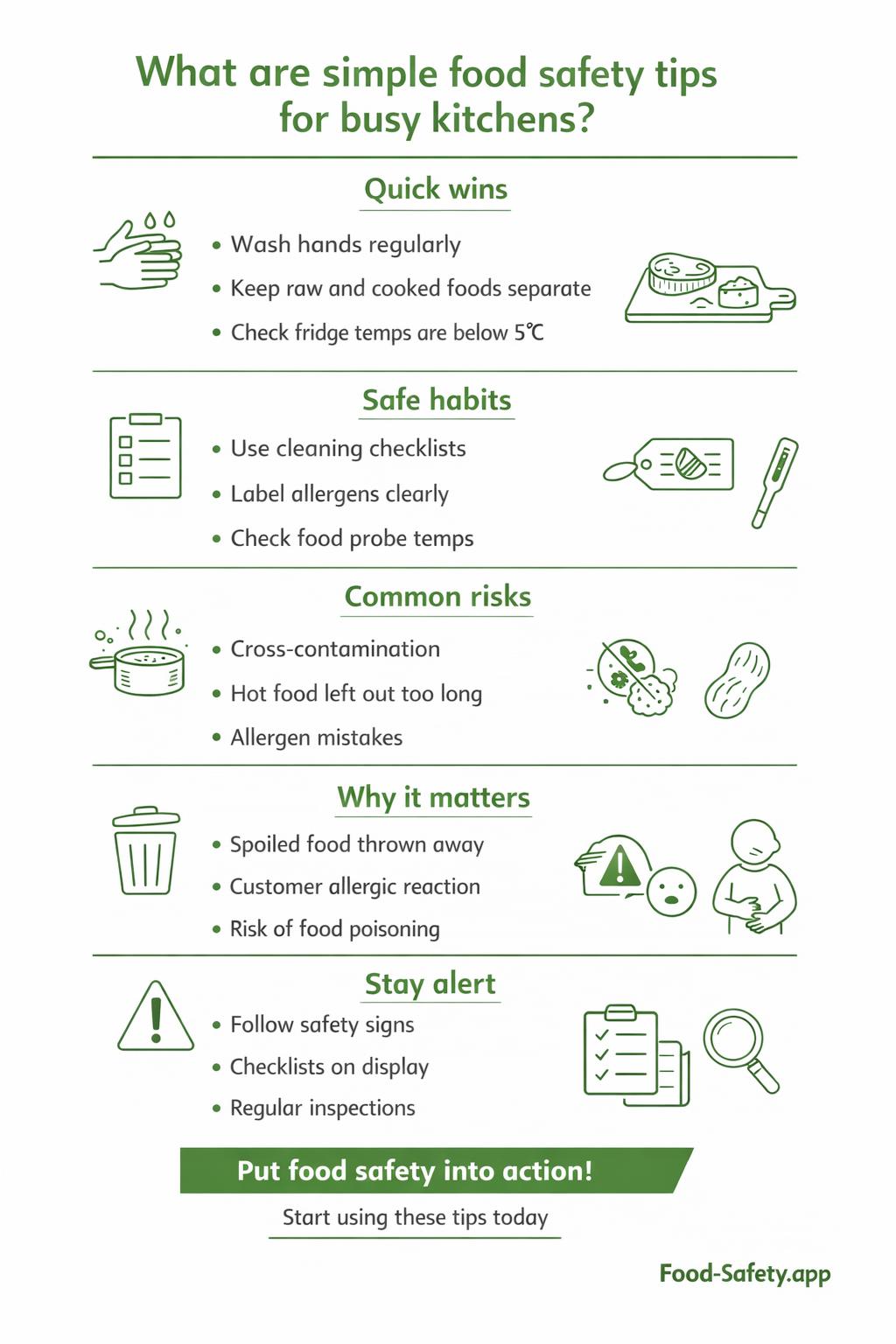
Temperature control is one of the core food safety tips for busy kitchens because it affects food quality and safety at the same time. The practical aim is simple: keep chilled food cold, keep hot food hot, and avoid leaving food in the danger zone for longer than necessary. In the UK, the Food Standards Agency gives guidance on safe cooling, chilling, cooking and reheating, and the Food Standards Agency is a useful place to check current advice. For practical fridge temperature monitoring, see fridge temperature monitoring.
What to do in service
- Check fridges at the start of prep and again during the day.
- Use a probe thermometer that is clean, working and easy to reach.
- Take small batches from the fridge rather than leaving full crates or trays out on the counter.
- Return unused chilled ingredients quickly, rather than letting them sit by the pass.
- Keep hot holding under close review, especially at buffets, carveries and school service points.
If food has been left out too long or the temperature is not right, do not try to rescue it by guessing. The safer move is usually to discard it, remake it or reheat it properly if the product and process allow that. A busy kitchen needs that decision to be quick and clear, not debated at the pass.
Practical checklist for managers
- Are fridge temperatures logged at a sensible frequency?
- Are probes cleaned between checks?
- Do staff know which foods need extra care after cooking or cooling?
- Is there a clear rule for what happens if a unit fails during service?
Separate raw and ready-to-eat food
Cross-contamination is one of the easiest hazards to introduce when the kitchen is busy (cross-contamination and food safety management). A raw chicken tray on a prep bench next to salad garnish, or a knife used on raw meat and then on cooked food, can create a serious problem in seconds. The fix is to make separation a routine, not a memory test.
Keep raw and ready-to-eat food apart
- Use separate chopping boards, knives and trays for raw and ready-to-eat items.
- Store raw meat and poultry below ready-to-eat food in the fridge.
- Use colour coding if your team follows it consistently.
- Never place cooked food back on a plate, tray or board that held raw food.
- Change gloves, wash hands and clean surfaces after moving from raw to ready-to-eat tasks.
This matters in every setting, but it is especially important in mixed-use kitchens where one team may be handling burgers, salad, sandwiches and desserts in the same service window. If the layout is cramped, use timed workflows: raw prep first, clean down, then ready-to-eat preparation.
Clean as you go, not at the end
In many busy kitchens, cleaning gets pushed to the end of service, which is when mess has already built up and contamination risks have increased. Cleaning as you go is far more reliable because it stops dirt, grease and food debris from spreading across the kitchen.
Easy cleaning habits that work under pressure
- Keep wipes, sanitisers and sanitised cloths where they are actually used.
- Clear spillages straight away, especially on floors and around prep areas.
- Replace cloths often rather than using one cloth for every surface.
- Clean high-touch points such as handles, taps, switches and fridge doors during service breaks.
- Assign short cleaning jobs during quieter moments, not just at close-down.
Food waste should also be removed promptly. Overflowing bins attract pests and make it harder to keep hands, tools and surfaces clean. In a compact commercial kitchen, one full bin can create more risk than a whole sink full of dirty pots if nobody deals with it in time. For a practical cleaning routine, see the kitchen cleaning schedule in action.
Train for the busy moments
Simple food safety tips for busy kitchens only work if every team member can follow them without constant supervision. That means training should focus on the moments that actually cause mistakes: the lunch rush, a delivery arriving during prep, a last-minute menu change, or a member of staff covering a new station.
What good quick training covers
- What to do when a fridge is too warm.
- How to handle raw and ready-to-eat food separately.
- When to change gloves and when to wash hands instead.
- How to clean probes, boards and utensils between tasks.
- Who to tell if food looks, smells or behaves strangely.
Short, repeated reminders are often more useful than long classroom sessions. A chef on the line is more likely to remember a one-minute briefing before service than a thick folder of rules. New starters should be shown the standards on the first day, not left to copy what others do.
Manage allergens carefully
Allergen control needs the same calm discipline as temperature and hygiene, especially in kitchens with a changing menu or high staff turnover. A mistake with allergens can affect a guest immediately, so the system has to be simple and reliable.
Practical allergen controls
- Keep ingredient labels and product information easy to find.
- Check every substitution before serving a dish.
- Use clean utensils and clean prep spaces for allergen-free orders.
- Brief front-of-house teams so they do not guess when answering customer questions.
- Mark allergen orders clearly so they are easy to spot in service.
If there is any uncertainty, stop and check before food is served. In a busy kitchen, it is better to delay one plate than to rush out the wrong one. That is especially true in schools, hotels and catering events where multiple covers may be plated at once. For practical allergen controls, see managing allergens safely in a busy kitchen.
Spot problems early and act fast
Food safety is easier when small issues are caught before they become service problems. A blocked drain, a fridge door not closing properly, a cracked container lid or a pest sighting can all become bigger risks if nobody speaks up.
Look for these warning signs
- Fridges running warmer than usual.
- Food left uncovered on prep benches.
- Dirty cloths, dirty boards or damaged utensils still in use.
- Staff skipping steps because service is busy.
- Stock that is out of date, unlabelled or hard to trace.
Make it normal for staff to report problems immediately. In a professional kitchen, reporting a fault is not overreacting; it is part of the job. If something is not right, isolate the item, label it if needed, and decide quickly whether it can be corrected safely or should be discarded.
Build routines that stick
The best food safety systems are the ones staff can actually follow on a Friday night with full covers. That means setting up the kitchen so safe practice is quick, clear and repeatable.
A simple daily routine
- Start with a clean prep area and working handwash station.
- Check fridge, freezer and hot holding equipment before prep begins.
- Separate raw and ready-to-eat tasks.
- Use small batches and return stock to storage promptly.
- Clean and reset key surfaces during service, not after it all builds up.
- Close down with a final check on waste, temperatures, stock rotation and cleaning.
Visual reminders help too. A simple station checklist, a probe cleaning point, labelled shelves or a clear allergen folder can save more time than they cost. If your team changes often, keep instructions short and practical.
When to check official guidance
Most day-to-day food safety decisions in a busy kitchen can be handled with strong routines and common sense, but there are times when you should check current official advice. This is especially true if you are setting up a new menu process, dealing with cooling or reheating questions, or responding to an equipment failure. UK guidance from the Food Standards Agency is a good starting point, and local authorities may also provide useful advice for your business type.
If you manage multiple sites, a food safety management system for catering businesses such as Food-Safety.app can help keep checks, records and team responsibilities in one place without adding unnecessary complexity.
Conclusion
Simple food safety tips for busy kitchens work best when they are built into the flow of service. Keep handwashing easy, control temperatures, separate raw and ready-to-eat food, clean as you go, and make allergen control part of everyday prep. Most importantly, give staff clear steps they can follow even when the kitchen is under pressure. That is what keeps service moving and helps protect customers, reputation and the business itself.
Centralise checks, training and responsibilities with Food-Safety.app and keep every team member aligned across sites.