Section 21 of the Food Safety Act 1990 provides a due diligence defence for businesses charged with supplying unsafe food. This guide translates that legal concept into plain English for catering teams, showing how everyday records, staff training and controls can support a defence during inspections, complaints or prosecutions. It links regulatory compliance to the real, busy kitchen rhythms you already manage.
In practice, that means having effective systems, training, monitoring and records that demonstrate you acted with due care in the circumstances of your business.
What Section 21 means and why due diligence matters
A simple way to think about it is: the offence happened, but you can prove you did everything reasonably expected to stop it from happening.
Section 21 is a statutory defence that a person charged with an offence relating to unsafe food can rely on if they can show that they took all reasonable precautions to prevent the offence. In practice, that means having effective systems, training, monitoring and records that demonstrate you acted with due care in the circumstances of your business.
In busy kitchens, this defence is not a get-out clause for sloppy practice. It rests on evidence that you planned for risk, monitored controls, and acted promptly when something went wrong. A strong defence is built on a clear, well-maintained evidence trail rather than memories or excuses.
Remember: the defence targets reasonable steps, not perfection. It looks for a consistent, proactive safety culture backed by records.
The legal test: reasonable precautions and all due diligence
The test is not whether something went wrong, but whether, given the risks, you acted with the level of care a reasonable operator would show in the same circumstances.
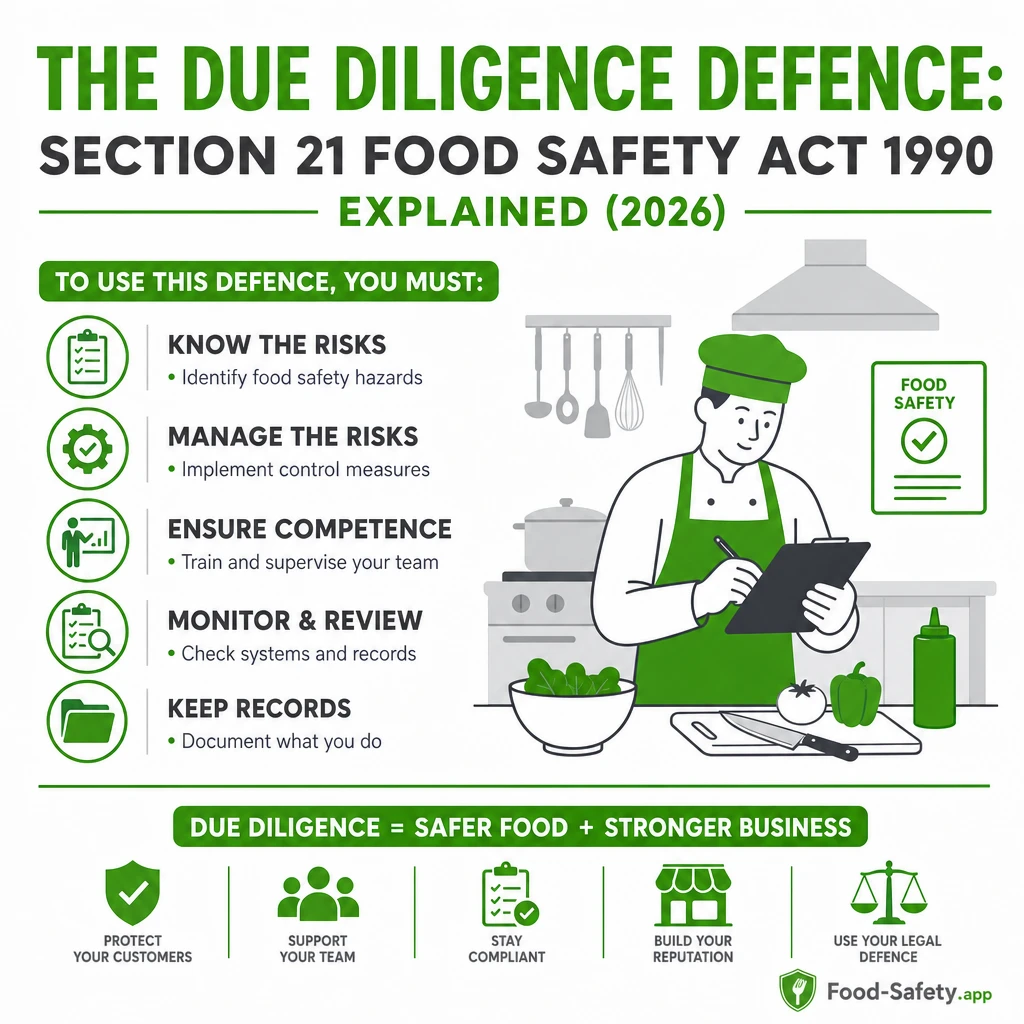
There are two core elements to the Section 21 defence: reasonable precautions and all due diligence. Together they require evidence that the business did what a reasonable operator would do to prevent the specific offence, and that the overall system of prevention was sound.
- Reasonable precautions: the concrete measures you put in place to control hazards. Think HACCP-style analyses, critical control points, monitoring, maintenance, supplier verification and clear procedures for when things go wrong.
- All due diligence: the broader governance that underpins everyday safety. This includes training, record keeping, management oversight, corrective actions, and a culture that learns from near misses and incidents.
In practice, inspectors and courts look for:
- documented controls that match your menu and processes
- up-to-date staff training and refresher reminders
- timely corrective actions following deviations
- an auditable trail showing what happened, when and what you did next
A well-kept log that shows you identified a risk, investigated it, and took corrective action is often the deciding factor in a defence.
Key UK case law and what it means in practice
The takeaway from practice is straightforward: your records must show you did the right thing at the right time, not just that you intended to.
British courts have repeatedly emphasised that a successful due diligence defence hinges on credible, document-driven systems rather than post-event apologies. In practice, this translates to:
- robust, documented controls that align with your HACCP plan and your actual operations
- timely identification and escalation of issues, with records of investigation and corrective actions
- consistent staff training, including how to handle faults, equipment failure, or supplier issues
- evidence that you maintain and test critical equipment (thermometers, probes, calibration)
- clear recordkeeping that makes it easy for inspectors or prosecutors to follow the decision trail
In short, case law supports the idea that a business can defend itself if it can show a proactive, well-documented safety programme that was followed in real life.
Genuine system failures vs poor routine controls
The difference often boils down to the quality and consistency of your routine controls and how quickly you respond when something deviates from standard.
A common question is how to tell apart an unavoidable system failure from poor routine controls. The distinction matters for the strength of a due diligence defence.
- Genuine system failure: an unforeseen fault or external factor that you could not have predicted or prevented with ordinary controls (for example, a sudden thermometer failure that is promptly replaced and calibrations reaffirmed). What matters is promptly diagnosing the fault, isolating affected products and showing evidence of corrective action.
- Poor routine controls: recurring omissions or gaps in daily checks, incomplete cleaning logs, missed calibrations, or delayed repairs. The defence is weak here because the evidence trail reveals a pattern rather than a single event.
What inspectors look for: evidence and records
Inspectors favour evidence that is easy to audit, export and cross-check. A tidy, searchable archive saves time and strengthens your position.
Inspectors will want to see clear, accessible records that demonstrate your due diligence in practice. Useful evidence includes:
- Temperature controls: cooking, cooling, cold storage, reheating, and hot holding with timestamps
- Opening and closing checks that show daily control points were reviewed
- Cleaning schedules, fault reports and corrective actions
- Probe/calibration records for thermometers to prove data accuracy
- Supplier verification and delivery checks showing condition on receipt
- Pest control logs and follow-up actions
- HACCP documentation and any changes made in response to issues
- Training records for new and ongoing staff, including competency checks
- Incident or near-miss reports with root-cause analysis and corrective actions
Inspectors favour evidence that is easy to audit, export and cross-check. A tidy, searchable archive saves time and strengthens your position.
| Evidence type | What it demonstrates | When captured | How it helps your defence |
|---|---|---|---|
| Temperature logs | Control temps are within safe ranges | Daily/shift | Shows proactive monitoring and accountability |
| Calibration certificates | Thermometer accuracy | Before use, then regular intervals | Supports trust in temperature data |
| Cleaning logs | Cleaning completed and verified | After tasks | Demonstrates routine hygiene controls |
| Training records | Staff competence on safety procedures | Periodic | Evidence of ongoing skills and awareness |
Practical scenarios and practical compliance focus
The common thread in all scenarios is a clear, time-stamped trail showing what happened, what was decided, and what was done next.
The following scenarios illustrate how the Section 21 defence translates into everyday kitchen practice. For each, note how you would capture the response in records and how it would influence an inspection.
A fridge temperature breach with checks, repairs, and corrective action logged
A fridge briefly drops below safe temperature. You log the incident, isolate affected products, arrange repair, and recheck temperatures after restoration. You record the fault code, repair ETA, and a revalidated temperature log showing the recovery. This kind of traceability supports the defence by showing prompt, appropriate action rather than denial.
A delivery rejected after goods checks show temperature or condition issues
Delivery is rejected at receipt due to refrigerated goods outside spec. You record the rejection, notify the supplier, and log the subsequent stock discard or return. Documenting supplier communication and the decision rationale demonstrates protective controls at the earliest stage of intake.
A cleaning lapse identified, logged, and corrected before service starts
A cleaner misses a critical area; the issue is logged, remedial action is completed before service, and the area is re-cleaned and rechecked. The corrective action and verification steps become central to the defence, showing you caught the issue and fixed it promptly.
An allergen error risk reduced through menu records and staff briefing notes
A dish carries an allergen risk that is managed by up-to-date allergen mapping, menu changes, and a staff briefing that covers high-risk elements. Documentation includes briefing notes, updated recipes, and cross-contact controls.
A probe calibration record used to show temperature data can be trusted
Calibration of probes is performed regularly, with dates, reference standards, and results recorded. This ensures temperature data used for safety decisions is accurate and credible.
A pest sighting reported with actions taken and follow-up logged
A pest sighting is logged, treated by a licensed service, and followed up with re-inspection and preventive actions recorded. This demonstrates ongoing risk management and a responsive safety culture.