This guide explains what Benedict’s Law means for English schools and contracted catering ahead of September 2026.
It outlines practical steps to tighten allergen controls, staff training, and emergency procedures, turning compliance into everyday routines for small teams. You’ll find actionable guidance on risk points, care plans, and record-keeping, plus real-world scenarios to help you apply it in daily service.
What Benedict’s Law Means for Schools and Contract Caterers
Important: The safest approach is to plan for errors and have a clear, rehearsed process to catch them before they cause harm.
Benedict’s Law represents a shift toward explicit, proactive allergen management across school catering. It isn’t a single regulation, but a framework that encourages clear allergen information flow, documented care plans, staff training for all roles, and well-practised emergency procedures. The aim is to reduce cross-contact and speed safe responses when incidents occur.
What this looks like in a school kitchen
- A live allergen matrix linked to every dish and ingredient.
- A simple briefing and sign-off before each service.
- Ready access to pupil care plans and staff training notes.
“If you can’t prove you’ve checked allergen information before service, you can’t prove it happened.”
Quick scenario
A supplier informs a substitute for a staple item containing an allergen. The kitchen consults the allergen matrix, updates the recipe record, notifies front-of-house, and informs the pupil parents where needed.
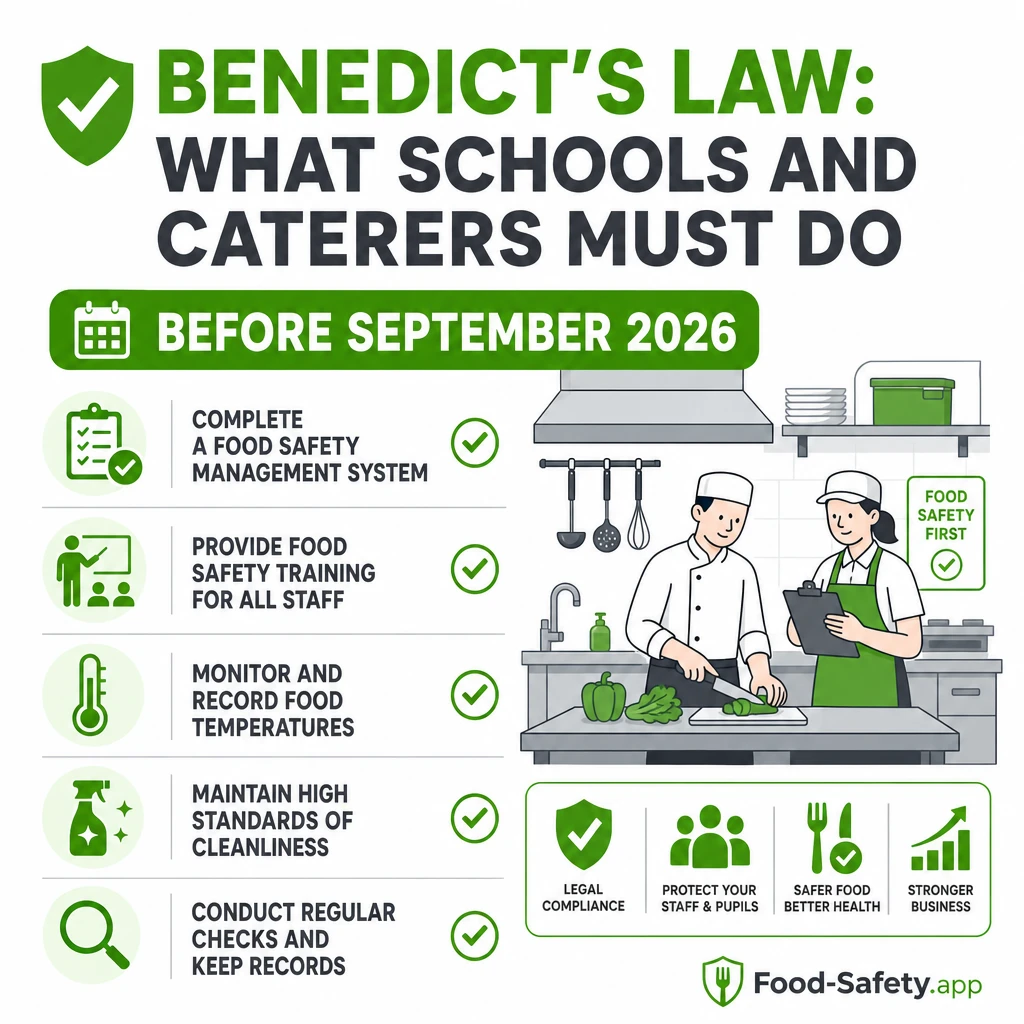
Affected Settings and Service Models
Tip: Align front-of-house staff with kitchen teams through brief huddles and a shared record for each service.
Benedict’s Law is most visible in settings where meals are prepared and delivered to children or other high‑risk groups, and where multiple service models intersect.
- School canteens serving hot meals and salads
- Packed-lunch programmes for classes or trips
- External contract caterers serving multiple schools
- After-school clubs and event catering on site
- Vending or grab-and-go arrangements where ingredients vary by supplier
Key implications
- Operations with frequent substitutions or supplier changes require tighter real-time checks.
- Shared kitchens or equipment increase cross-contact risks unless controls are explicit and verifiable.
Practical example
During a lunch service, a nearby supplier delivers a batch with altered allergen percentages. The team consults the matrix, confirms no new risks for the current menu, and communicates changes promptly to supervising staff and carers.
Allergen Risk Points in Practice
Important: Clear, timely communication between kitchen and front-of-house is essential to prevent accidental service of non‑compliant meals.
Understanding practical risk points helps make Benedict’s Law actionable every day. The following areas cover the main touchpoints from planning to leftovers.
Menus and Recipe Information
- Maintain a live, editable allergen matrix linked to every recipe and sub‑ingredient.
- Require supplier specifications to match the matrix; flag deviations immediately.
Deliveries and Storage
- Check delivered goods against the approved records before storage.
- Store allergen-containing items separately where possible and label clearly.
Preparation and Cooking
- Designate dedicated equipment or time‑slicing when allergens are involved.
- Record when substitutions occur and update the recipe sheet.
Service and Portioning
- Communicate allergens to front-of-house and service staff for every meal.
- Use signage or digital prompts to remind staff about high-risk items on the menu.
Leftovers and Rework
- Log any leftover items and rework plans to prevent cross-contact in subsequent service.
“Important: Clear, timely communication between kitchen and front-of-house is essential to prevent accidental service of non‑compliant meals.”
Quick scenarios
- A packed lunch service must match each item to a pupil’s care plan; if a labelled item cannot be used, substitute and update records before distribution.
- A delivery arrives with a product spec that differs from the approved allergen record; halt use, verify with the supplier, and update the care plan and menus if required.
Training Care Plans and Communication
Reminder: Care plans must be easy to access by both kitchen and front-of-house teams without delaying service.
Staff training, care plans, and effective communication are central to Benedict’s Law. Training should be practical, role-specific, and revisited regularly.
Who needs training
- Kitchen staff and assistants
- Front‑of‑house supervisors and serving staff
- Delivery and receiving personnel
- Management and safeguarding leads
What they must know
- How to read and apply the allergen matrix for every dish
- How to handle substitutions and verify supplier specifications
- How to recognise and respond to potential cross‑contact
- How to communicate allergens to carers and pupils clearly
- How to execute the emergency steps and escalation procedure
How often refreshers happen
- Initial training for new staff on joining
- Refresher training at least annually or sooner after a policy change
- Role-change updates (e.g., moving from kitchen to service side)
Care plans and information sharing
- Store pupil or customer care plans in a single, accessible location
- Ensure care plans accompany relevant orders and menus
- Train staff to verify the care plan before service and to document any changes
Quick checklist
- All staff have completed the latest allergen training
- Care plans for high‑risk pupils are current and visible
- Any substitutions are recorded and communicated to service staff
Emergency Response Escalation and Documentation
Caution: Timely documentation supports learning and protects both pupils and staff.
A clear, practised emergency response minimizes harm and supports swift escalation as needed.
Immediate actions in an incident
- Remove or isolate the allergen if safe to do so
- Alert the supervising manager and call for medical assistance if required
- Provide any prescribed emergency medication as directed in care plans (without delay, if trained to do so)
- Notify carers as soon as possible and record details
Escalation paths
- On-site supervisor to escalate to the school safeguarding lead
- If needed, contact the emergency services and the child’s medical team
- Document escalation steps for review after the incident
Documentation and follow-up
- Complete an incident report with: time, foods involved, staff on duty, actions taken, and outcomes
- Review the incident with managers and kitchen teams; update the allergen matrix if necessary
- Archive records for safeguarding reviews and audits
Quick scenario
A teacher reports a suspected allergic reaction during lunch service. The supervisor initiates the emergency plan, contacts the carer, and documents every action taken, including the food items served and any substitutions.
Menu Control Cross-Contact Prevention and Record Keeping
Bottom line: When the routine of allergen control is written into daily tasks, it’s far easier to stay compliant and protect pupils.
Robust menu control and meticulous record keeping turn Benedict’s Law from theory into daily habit.
Live allergen matrix and supplier specs
- Build a single, live matrix for all dishes and ingredients
- Require up-to-date supplier allergen specifications and verify against records
Substitutions and recipe changes
- Document every substitution and ensure staff are briefed before service
- Update the matrix and care plans accordingly
Cross-contact controls in production, service and cleaning
- Schedule dedicated prep times or equipment when allergens are involved
- Use clear cleaning protocols and verify cleanliness between batches
- Label shared equipment and set strict separation rules
Record keeping and audits
- Keep allergen information, training records, and corrective actions in one accessible repository
- Use timestamped digital checks to demonstrate actions were completed
- Export records for inspections, safeguarding reviews, and internal audits
Suggested operational focus
- Build a live allergen matrix for all dishes and ingredients
- Use a simple staff briefing and sign-off process before each service
- Store care plans, training notes, and incident records in one place
- Review emergency response steps with managers, supervisors, and kitchen teams
- Use digital records and timestamped checks to prove actions were completed
- Export records for inspections and safeguarding reviews
If you’d like to turn Benedict’s Law into a practical, auditable system for your team, start with a single-page allergen matrix and a daily briefing sign-off. It’s about making the right steps easy to perform, every service.