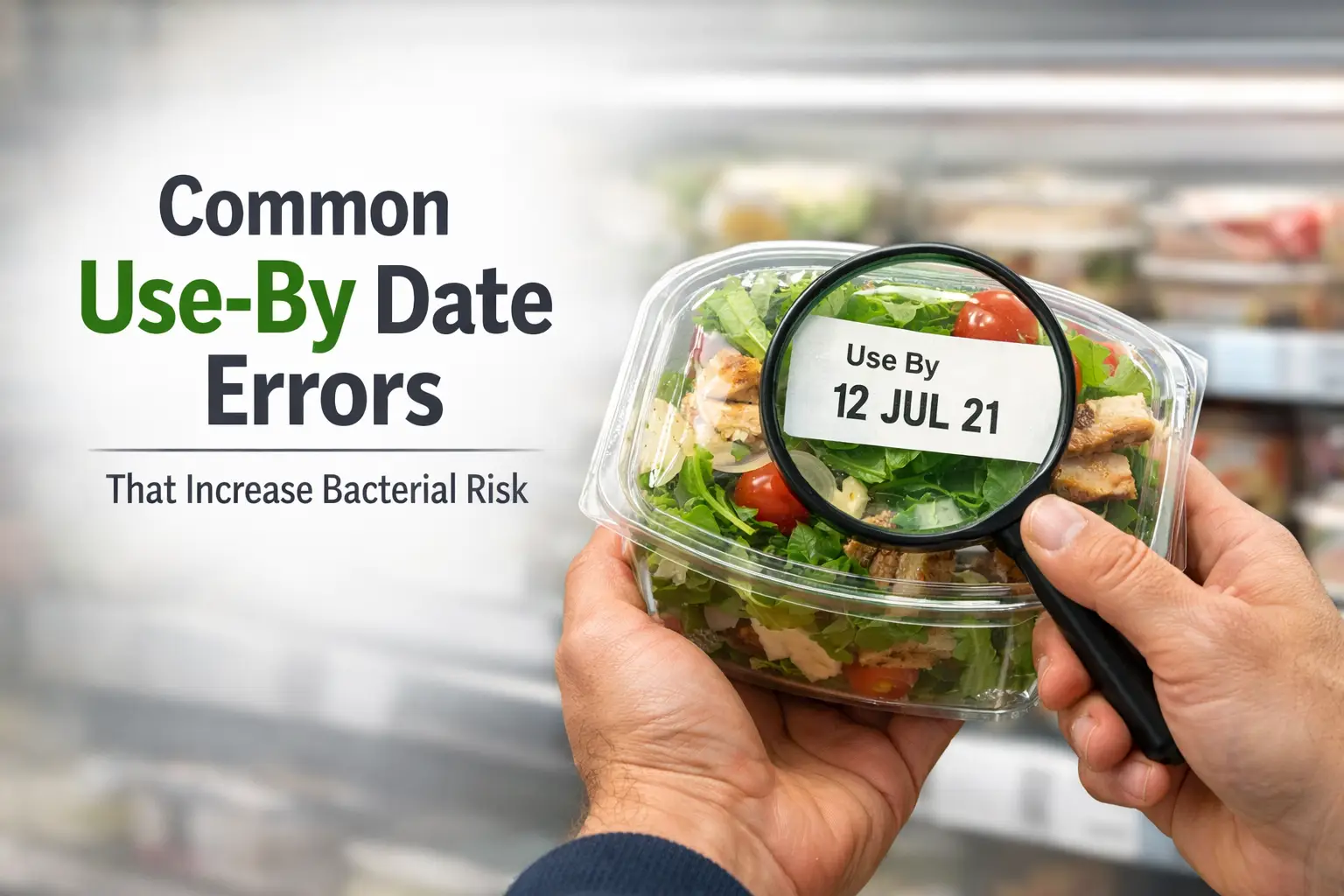
Knowing how to handle use-by dates is essential in catering.
This article highlights the common mistakes that raise bacterial risk in chilled and ready-to-eat foods, and shows practical controls to prevent unsafe items from reaching diners.
Why use-by dates matter for high-risk foods and ready-to-eat items
Listeria monocytogenes can grow at refrigerator temperatures, so strict date control on ready-to-eat items is essential.
Use-by dates are a safety signal. For high-risk foods and ready-to-eat items that don’t require further cooking, these dates indicate when the product should no longer be sold or served. Relying on appearance, smell or texture is not reliable—some pathogens do not change the food’s sensory characteristics in obvious ways, and bacteria like Listeria can persist in the cold chain. Proper date handling helps prevent the growth of harmful organisms during storage, prep and service.
In practice, this means establishing clear rules for every step of the shift: opening, preparation, display, and service. It also means recognizing that certain foods remain hazardous even when they appear fine. The goal is to prevent unsafe food from reaching customers, not to rely on sensory cues.
Practical takeaway:
- Treat all high-risk items as time-sensitive after opening, regardless of initial appearance.
- Prioritise Date Control Points (DCPs) at opening, prepping, and closing checks.
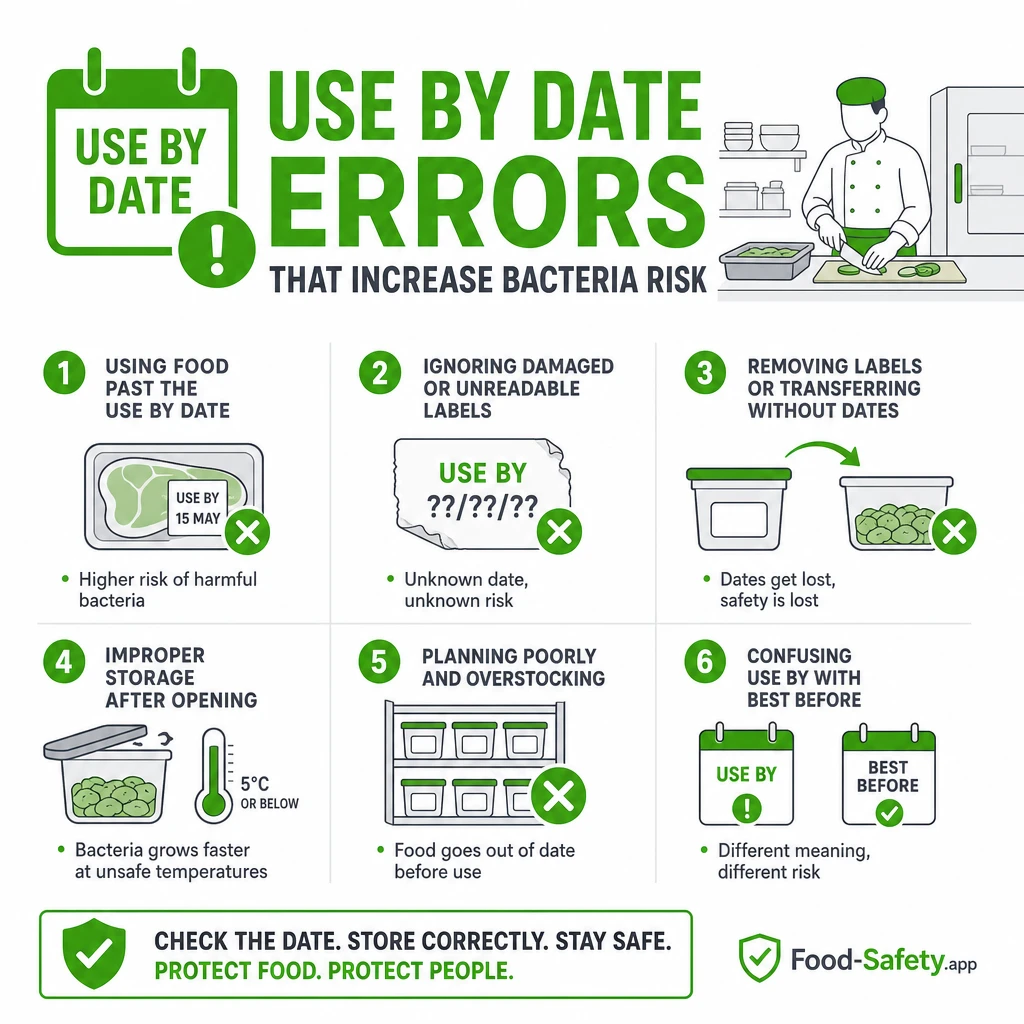
Foods most often mishandled cooked meats dairy chilled ready meals sandwiches cooked rice gravies seafood cut fruit and opened chilled products
Keeping opened dairy or prepared foods in the wrong container can obscure the true discard date and invite cross-use.
Several food groups are routinely mishandled around use-by dates. The consequences aren’t just about waste; they’re about the risk of pathogenic growth in the cold chain or after assembly.
Common culprits include:
- Cooked meats and poultry items that are portioned or repackaged
- Dairy products moved into new containers or opened for extended display
- Chilled ready meals and sandwiches left on display beyond their use-by date
- Cooked rice, gravies and seafood stored in bulk or decanted into other vessels
- Cut fruit and opened chilled products that are treated as less risky after opening
To reduce risk, insist on a visible discard date for every opened item and a consistent rule set that applies across shifts.
The safest procedure is the one that can be followed consistently during a busy service.
Common date label errors
Clear labeling is not decorative; it’s a frontline safety control.
Date-label mistakes are a quiet but deadly risk. They often arise from inconsistent practices or casual substitutions during busy periods.
Frequent errors include:
- Missing labels on new product lines or decanted items
- Applying the wrong date at labeling or re-packaging
- Over-reliance on appearance, aroma or texture to judge safety
- Rewriting labels without a proper checks process
- Using “best before” labels as if they were “use by” dates on ready-to-eat items
A practical fix is to standardize how and when labels are updated. If a container is re-labeled, ensure the new date reflects the product’s safety window from the date of opening or repackaging, and document the change.
Do not assume a label is correct because it looks similar to a previous date.
Opened food and house rules
Treat opened items as a separate category with its own discard schedule.
Opened foods require strict handling rules. Without a robust system, the risk of cross-contamination and mis-timed discard dates increases.
Key house rules to implement:
- Record the date when a product is opened
- Clearly mark a discard date on all opened items
- Rotate stock using FIFO (first in, first out)
- Keep decanted ingredients separate from their original packaging to avoid misdating
- Use a dedicated area for opened or decanted items, with date labels clearly visible
Practical scenario:
- An opened sauce tub in the prep fridge is not labeled with an opening date; a supervisor later discovers it after it has passed the discard date. The rule is to label immediately and log the open date.
Safe disposal decisions
Knowing when to bin or hold is critical. Decisions should be based on the product, the date, and the risk to customers.
Guidance to apply:
- Bin immediately if the use-by date has passed for any item intended to be served without further cooking
- If a product is past its discard date but within a service window and has been stored correctly, it may be held for service only if your policy permits and it is clearly labeled and monitored
- Escalate to a supervisor if there’s any doubt about a product’s safety or labeling accuracy
- When in doubt, discard; better to waste a portion than risk a foodborne illness
When safety is uncertain, err on the side of discard.
A practical checklist for service:
- Is the item within its use-by date?
- Was it stored at the correct temperature during remaining display or service?
- Is labeling complete and traceable to the batch and opening date?
- Has corrective action been recorded and signed off?
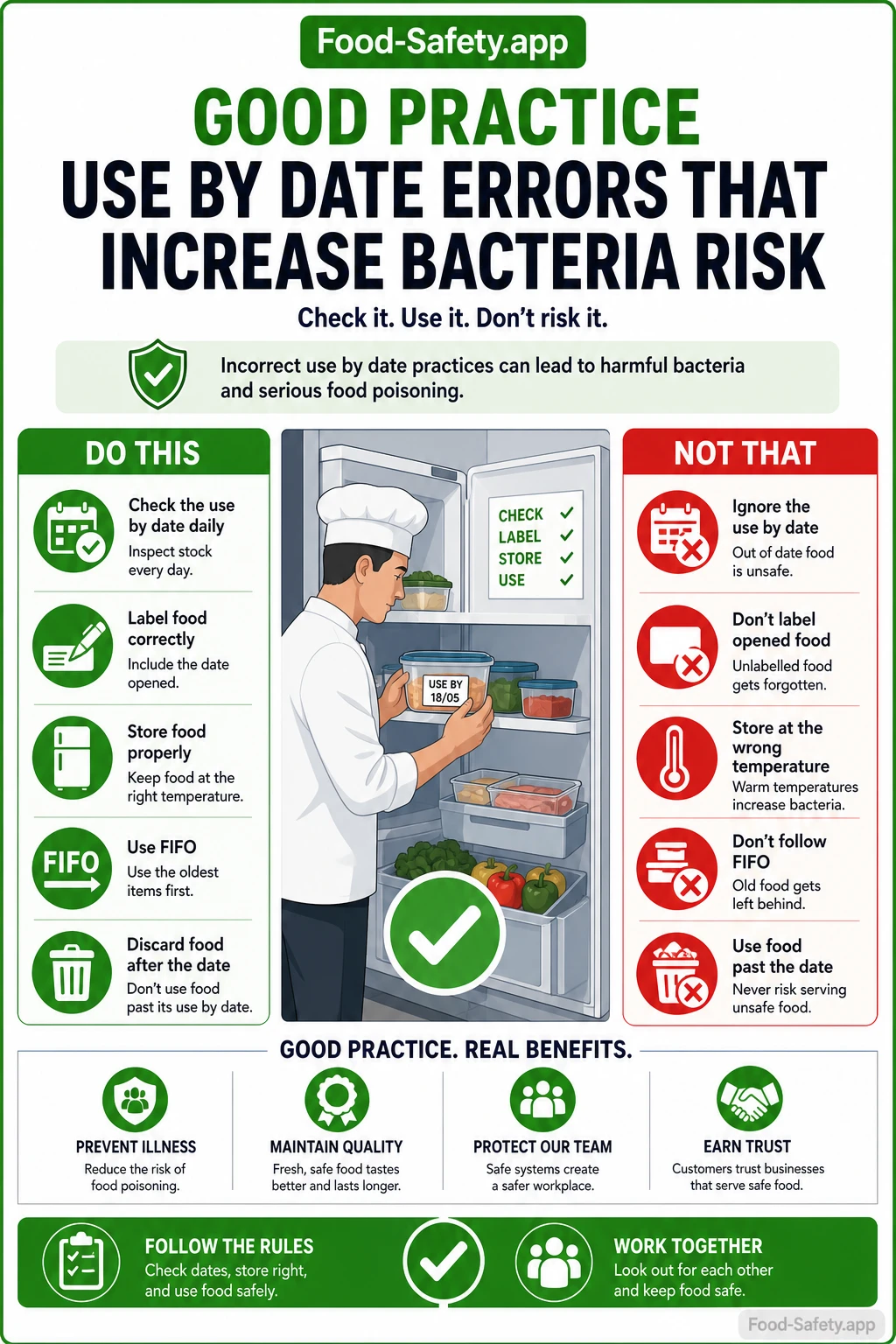
Record keeping tips
Thorough records are a powerful defense during inspections and audits.
Good record-keeping is the backbone of accountability and inspections. It also helps identify trends that could lead to unsafe practice.
Useful records include:
- Opening checks for every product (opening date, discard date)
- Daily fridge and cold-chain temperature logs
- A waste log capturing discarded items and the reason
- Corrective actions taken when a product is found out of date
- Staff sign-off confirming adherence to date controls
Tips for making records effective:
- Keep entries concise and legible
- Link discard events to the product lot and supplier if possible
- Use consistent terminology across shifts
- Review records at shift changeovers to catch gaps early
For teams seeking practical support, Food-Safety.app can streamline these tasks. It offers opening and closing checks, goods-in verification, temperature logging, and a complete history with PDF exports to support inspections and audits. Explore Food-Safety.app
If you found this guide helpful, you can implement these controls quickly with simple, visible labeling, strict opening dates, and routine training. By standardizing date-control rules across shifts, you’ll reduce the risk of pathogenic growth in ready-to-eat and high-risk foods, and you’ll be better prepared for audits and customer safety.