
Understanding food safety culture means looking beyond policies to what teams actually do every day in a kitchen. It’s the shared habits, the leadership example, the accountability and the question: how we do things here. This article explains what culture looks like in practical catering terms, how it supports BRCGS expectations and FHRS inspections, and a simple, workable plan for small teams to improve daily discipline.
Understanding food safety culture means looking beyond policies to what teams actually do every day in a kitchen. It’s the shared habits, the leadership example, the accountability and the question: how we do things here. This article explains what culture looks like in practical catering terms, how it supports BRCGS expectations and FHRS inspections, and a simple, workable plan for small teams to improve daily discipline.
What food safety culture means in catering
A food safety culture is the daily discipline of everyone, not a policy on a shelf.
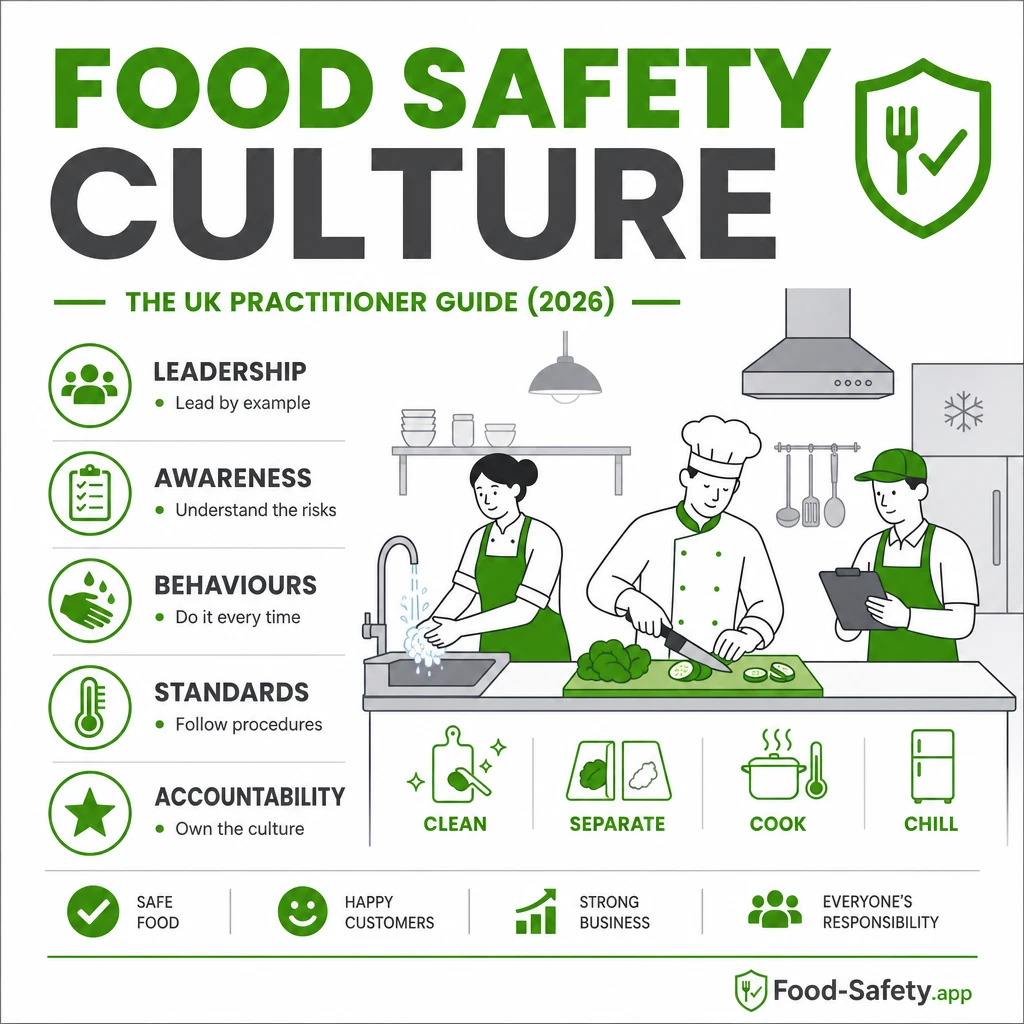
Food safety culture in catering is the cumulative effect of daily decisions, from how incoming deliveries are checked to how quickly a problem is spoken about and resolved. It rests on four recognisable ideas: leadership sets standards, staff understand why controls matter, records show consistency and follow-through, and problems are reported and fixed quickly.
The practical framework looks like this:
- leadership sets clear standards and models the right behaviours
- staff understand why controls matter for guests and for the business
- records show that tasks are done consistently and on time
- problems are reported without delay and fixed promptly
How culture supports BRCGS expectations and FHRS inspections
In practice, culture shows up as evidence rather than words. BRCGS expectations and FHRS inspections both benefit when teams demonstrate that standards are understood and kept up, not merely documented. Key signals include consistent execution, operator training, accessible records, and timely corrective actions.
In regulated environments, inspectors look for evidence that standards are understood and kept up, not just that they exist on paper.
A strong culture translates into everyday reliability: daily checks completed, correct handling of allergens, and proactive communication when something isn’t right. It’s the difference between a file full of policies and a kitchen that routinely protects guest safety through its actions.
A practical improvement plan for small catering teams
The simplest improvement roadmap is to set clear standards, train, record tasks, review failures, and close gaps quickly.
Small teams can implement a straightforward, practical improvement loop. Start with a simple, repeatable cycle:
- Set standards — define what must be done, when and by whom (opening/closing checks, temperature monitoring, allergen controls, cleaning tasks, pest checks)
- Train staff — short, frequent refresher sessions; keep notes of what matters
- Record tasks — use accessible logs that are easy to check during service
- Review failures — weekly or biweekly quick reviews to spot trends
- Close gaps quickly — assign ownership and monitor corrective actions
Structured opening and closing checks, combined with transparent corrective actions, are often the fastest route to tangible improvements. When team members can see a clear path from issue to fix, they’re more likely to report concerns early and follow through.
How culture links to HACCP records and daily checks
A record of a temperature issue that was investigated and corrected before food was affected demonstrates real culture in action.
Culture and systems are two sides of the same coin. HACCP records, opening and closing checks, cleaning schedules, temperature logs, allergen controls, pest checks, and defect reporting all become living evidence of how the kitchen operates. When these records are kept consistently and reviewed for trends, they support safer decision-making during busy service.
- HACCP records underpin decision-making and show what happened, when, and why
- Opening and closing checks confirm handoffs are complete and accurate
- Temperature logs prove that cooling and chilling controls are maintained
- Allergen information linked to menu items reduces cross-contact risk
- Cleaning schedules and pest checks provide accountability and traceability
- Defect reporting creates a clear path from issue to action
Common weak points and quick fixes in catering culture
If a process only exists on paper, it won’t protect service quality or safety; culture proves it by making sure people follow through.
Many kitchens fall into easy traps that undermine culture. Here are common ones and practical fixes:
- Missed checks — fix by introducing a short, visible daily checklist with a quick sign-off
- Poor handover between shifts — fix with a standard handover log and a brief, documented briefing
- “Paper only” systems — fix by digitising critical logs or using a simple shared log with time-stamped entries
- Staff not speaking up about issues — fix by establishing a safe, non-punitive reporting route and leadership encouragement to raise concerns
Addressing these points often yields immediate improvements in daily compliance and staff confidence.
Real-world scenarios and practical takeaways
The daily actions of your team are the clearest signal of your safety culture.
Scenario: fridge temperature issue logged and corrected
A fridge recorded a higher than acceptable reading. It was logged, investigated, and the door was found ajar. The issue was corrected, the unit rechecked, and a follow-up action was added to the rota to prevent recurrence. This shows how quick reporting and a structured response protect safety without delaying service.
Scenario: chef challenges a labelling mistake before service
A labeling error on a ready meal was spotted during prep. The chef flagged it, the item was corrected, and the incident was documented in the goods-in record. The practice reinforces that staff actively check details and escalate issues before they become problems.
Scenario: supervisor notices repeated cleaning misses and updates the rota
Cleaning misses were observed over several shifts. The supervisor updated the cleaning rota, added a specific slot for high-risk areas, and briefed the team on expectations. The change reduced gaps and reinforced that cleaning is a shared responsibility, not someone else’s job.
Scenario: a delivery arrives warm and is rejected with a clear goods-in record
A delivery failed temperature checks on arrival. It was rejected, logged in the goods-in record, and the supplier was informed. The team followed procedure without ambiguity, preserving safety and reducing waste.
Practical takeaway
- Regular, accessible records combined with clear responsibility improve decision-making under pressure.
- staff empowerment to speak up and act on concerns is central to a resilient culture.
- Ongoing training and quick corrective action are as important as the documented policy.
The daily actions of your team are the clearest signal of your safety culture.
If you’re looking to start or refresh a culture-led approach in your kitchen, begin with a simple, public-facing standard set, train in short sessions, log tasks transparently, and review learning points weekly. Small but deliberate improvements accumulate into a culture that supports both safety and service quality.