
Corrective actions convert checks that fail into real control. In busy catering, a temperature drift, missed cleaning step, or allergen mislabel can happen. What matters is what happens next. This guide explains a practical approach to spotting problems, containing them, reporting what occurred, and recording the action taken so the issue can’t recur. You’ll find clear steps, real-world examples, and a starter logging framework you can adopt with Food-Safety.app to make checks meaningful rather than merely bureaucratic.
Why corrective actions matter in catering
Important: A failed check is only useful if staff know what to do next.
A failed check is a data point, not a verdict. When a deviation occurs, the real value lies in the action taken to restore control and prevent recurrence. Corrective actions provide a traceable record that demonstrates your kitchen’s commitment to safety and helps audits and inspections run smoothly. They also guide staff on exactly what to do, reducing guessing during busy service.
In practice, this means moving beyond “we fixed it” to a documented chain of steps: who acted, what was done, when it was done, and what the next verification will be. A well-designed corrective action process keeps checks effective and your team confident.
Corrective actions are not punishment; they’re a reinforcement of safe practice and continuous improvement.
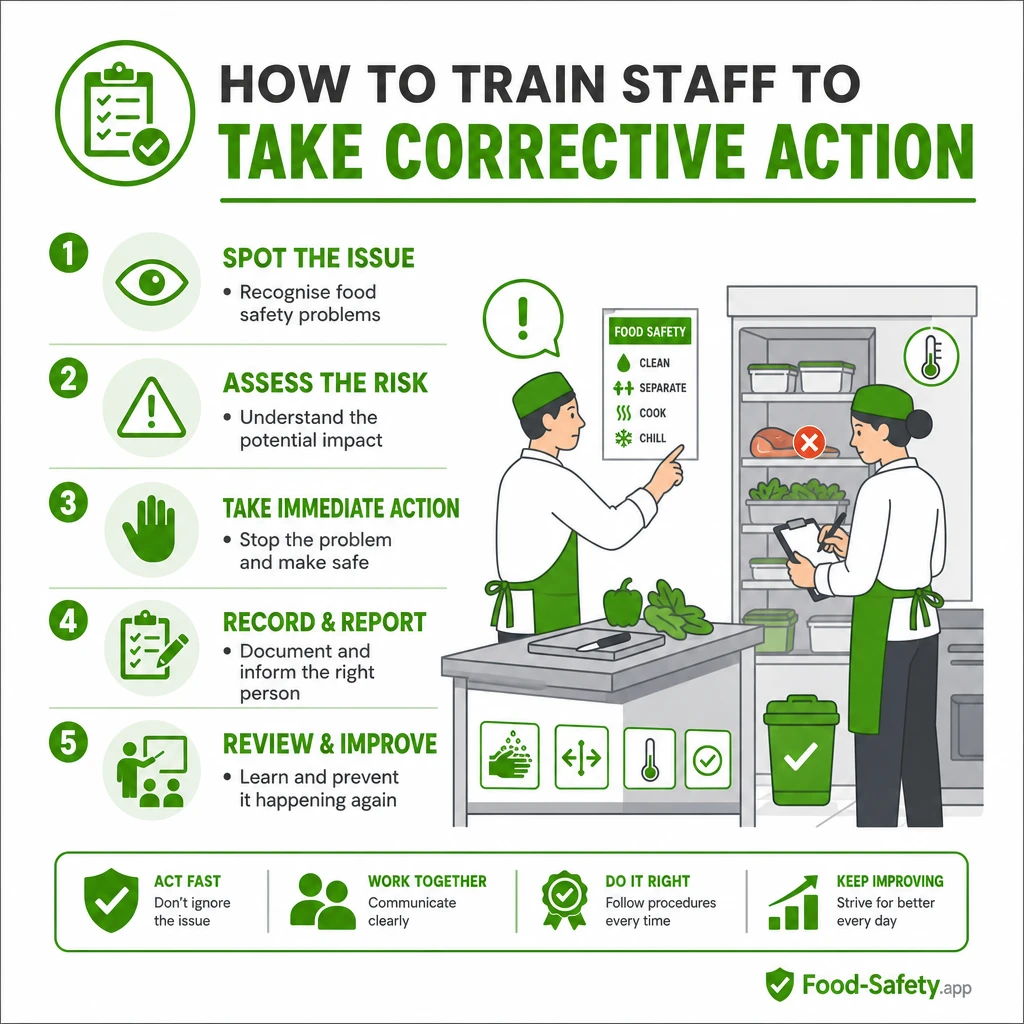
What counts as corrective action in day-to-day operations
Corrective action is more than a note on a form. It’s the concrete, auditable step taken to bring a process back under control.
In day-to-day catering this includes:
- Immediate containment: stop serving the affected item, isolate equipment, or halt the process as needed.
- Reassignment or adjustment: re-temperature or re-check, re-label, re-clean, or re-pot as appropriate.
- Verification steps: re-check temperatures, times, or cleaning completion to confirm control.
- Deferment or replacement: discard unsafe product, replace with a safe alternative, or substitute a process (e.g., use a spare thermometer).
- Communication: brief the supervisor and relevant staff; log the action and outcome.
- Follow-up action: schedule a short recheck or a corrective action review to prevent recurrence.
Practical examples include:
- Fridge found above safe temperature: move food to a cold area, re-check exposure time, log disposal or rapid cooling, inform supervisor.
- Delivery arrives warm or damaged: reject item, note the supplier, record temperature and condition, escalate if repeated.
- Cleaning task missed: complete immediately if safe, record reason, add a follow-up check.
- Probe calibration fails: stop using it, label out of service, use a replacement, record the action.
- Pest sighting or defect reported: isolate risk, inform management, raise maintenance or pest control follow-up.
- Allergen information on a menu item is incorrect: stop service, correct record, brief staff before next shift.
Training framework: spotting, containment, reporting and recording
Spot, contain, report, and record in sequence.
A structured framework makes corrective actions repeatable. Train staff to work through four linked steps.
- Spotting
- Teach what signals a potential deviation looks like: temperature out of range, unexpected smell, damaged packaging, missing log entries, or incorrect allergen data.
- Encourage vigilance and routine checks at defined points (opening, during service, closing) so issues are caught early.
- Containment
- Define immediate actions to prevent harm: separate the item, stop use of a tool, or suspend a task until safe.
- Ensure staff understand when containment becomes a temporary measure and when it requires escalation.
- Reporting
- Establish the required chain of communication: who must be told, in what order, and within what timeframe.
- Use a standard form or digital entry to capture the issue, actions taken, person responsible, and time.
- Recording
- Use a consistent log format with clear fields (issue, action, person, time, verification, follow-up).
- Tie records to relevant HACCP controls, checks, and calibration activities so they’re easy to trace.
Who to inform and when: escalation paths
Time-stamped escalation steps help ensure timely action and evidence for audits.
Not every issue needs the same level of escalation. Define a clear path so staff act quickly and consistently.
- Minor deviations (no immediate safety risk): inform the supervisor on duty; log action and close after verification.
- Moderate risk or repeated incidents: escalate to head chef or operations manager; schedule a follow-up check and review training if needed.
- Major risk or recurring problems across shifts: inform senior management; consider maintenance, supplier contact, or pest control as appropriate; document escalation and response.
- Allergen or legal-facing issues: brief the shift manager immediately; log the corrective action and communicate with the front-of-house team before next service.
Escalation must be time-stamped and visible in your records so audits can show timely response and accountability.
Communication templates help. For example, a quick note to a supervisor might read: “Fridge 3 exceeded safe temp at 10:15; hold and move items; recheck at 10:30; escalate if not back within 15 minutes.” This keeps everyone aligned and speeds corrective action.
Recording and documentation: why fixed it isn’t-enough
Time-stamped records improve traceability for inspections and audits.
A swift fix on the floor isn’t enough if there’s no clear record of what happened. Good record-keeping supports traceability, audits, and continuous improvement.
A practical log should capture:
- Date and time of the deviation
- Location or equipment involved
- Issue description
- Corrective action taken
- Person responsible and the time of action
- Verification result
- Follow-up actions or recheck date
- Sign-off by supervisor
Sample log entry:
| Field | Example |
|---|---|
| Date/Time | 2026-09-22 14:05 |
| Location | Fridge A, Top Shelf |
| Issue | Temperature above safe range (6°C) |
| Action Taken | Move food to cold storage, re-check temp at 14:20, discard any exposed items |
| Responsible | Chef de Partie – A. Patel |
| Verification | Temp back within range at 14:22 |
| Follow-up | Recalibrate thermometer by end of shift |
| Sign-off | Supervisor signature |
Why link to HACCP controls and logs? Because corrective actions that tie directly to specific controls—opening/closing checks, temperature logs, cleaning tasks, goods in, calibration—make it easier to demonstrate control in practice. A well-structured log supports internal reviews, supplier discussions, and any regulatory inquiries, without guessing what happened.
Turning mistakes into coaching and continuous improvement
Mistakes are coaching moments that drive future checks and staff confidence.
Mistakes aren’t a sign of failure; they’re data points for improvement. Use corrective actions to close gaps in training and processes.
- Analyse patterns: repeated temperature issues may indicate equipment drift, improper loading, or insufficient monitoring during peak service.
- Update procedures: revise checklists, adjust holding times, or add a quick refresher on allergen controls where needed.
- Train through coaching: use real corrective-action logs as coaching references during briefings or pre-shift huddles.
- Link to the broader HACCP plan: ensure corrective actions are reflected in prerequisite programs, hazard analysis, and critical control points.
- Ensure documentation readiness: explanations of actions, responsible individuals, and follow-up prove your system works during audits and inspections.
- Use the system features: Food-Safety.app corrective actions log, defect reporting, custom checks, and full history view to keep records structured and easy to export.
Mistakes are coaching moments that drive future checks and staff confidence.
Practical coaching examples:
- A recurring delivery issue prompts a supplier contact and a revised receiving procedure.
- An allergen label correction leads to a quick briefing and a refreshed staff handover note before the next shift.
- A failed probe calibration triggers a temporary switch to a replacement tool and a short retraining point on instrument handling.
Final notes on adopting a practical corrective-action approach
Focus on time-stamped records for traceability, not just the fact a fault occurred.
Use clear wording: issue, action, person responsible, time completed, and follow-up.
Establish escalation steps for repeat failures and non-routine events.
Require staff sign-off and supervisor review to close each entry.
Prepare evidence-ready records for inspections, internal checks, and supplier discussions.
Leverage Food-Safety.app tools to keep corrective actions well-structured and easy to export.
The safest procedure is the one that can be followed consistently during a busy service.
By training your team to spot problems, contain them swiftly, report accurately, and record thoroughly, you turn everyday checks into real, auditable control. The aim isn’t paperwork for paperwork’s sake, but a reliable, traceable system that protects guests and supports staff development.