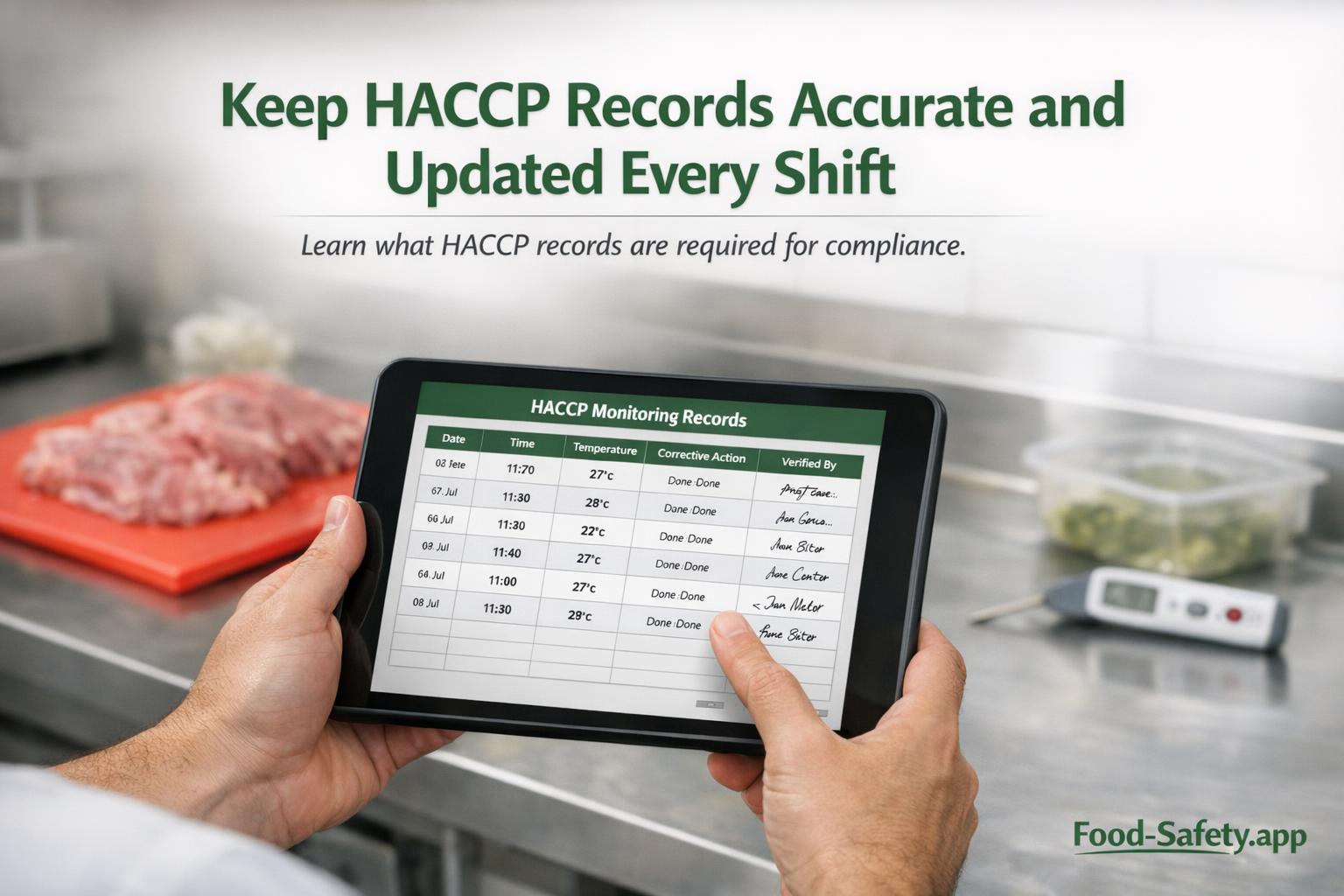
What HACCP records should you keep?
If you are responsible for food safety in a professional kitchen, HACCP records are not just paperwork. They are the evidence that your controls are working during prep, service, storage and cleaning. Keeping the right HACCP records helps you spot problems early, train staff properly and show that your food safety system is being followed consistently. In busy catering environments, the challenge is not only deciding what to record, but making sure the records are practical enough that teams actually complete them.
For a broader understanding of the HACCP framework, see HACCP principles explained.
Good HACCP records should be simple, relevant and easy to check. They need to show what was monitored, when it was checked, who did it and what action was taken if something went wrong. In a restaurant, café, school kitchen or hotel operation, that evidence can make the difference between a well-run system and one that only exists on paper.
Core HACCP records to keep
Every food business should keep records that reflect its main hazards and control points. The exact list depends on your menu, equipment and service style, but the following are the most important in most catering operations.
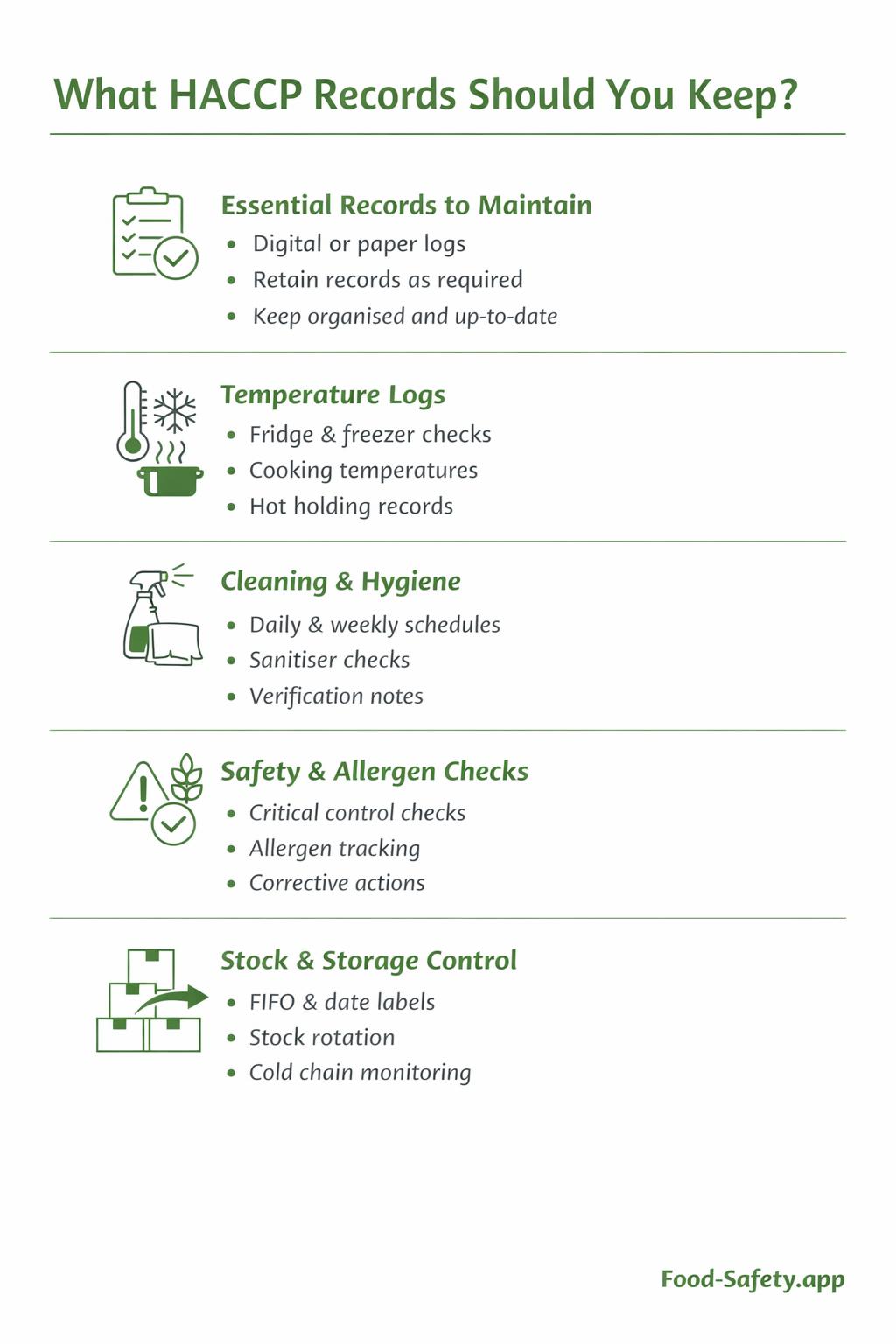
Supplier and delivery checks
Record incoming deliveries where product safety depends on condition, temperature or specification. This is especially important for chilled, frozen and high-risk foods.
What commonly goes wrong:
- Deliveries are accepted without checking packaging damage or temperatures.
- Staff assume the supplier has already done the checking.
- Rejected items are not logged, so patterns are missed.
What to do:
- Record date, supplier, item, condition and any temperature checks where relevant.
- Note any rejections and what happened next.
- Make sure the person checking deliveries knows when to refuse goods.
Why it matters: delivery checks help prevent unsafe stock entering storage and stop avoidable waste later in the day.
Temperature monitoring records
Temperature checks are among the most important HACCP records. They may include fridges, freezers, cold rooms, hot holding units, cooking temperatures and cooling checks where required by your system.
What commonly goes wrong:
- Only one fridge is checked, even though others are used heavily.
- Temperatures are written down but not reviewed.
- Staff do not know what action to take if a unit is out of range.
What to do:
- Record the equipment ID, reading, time and initials.
- Keep the check frequency realistic for the operation.
- Link each check to a clear corrective action if needed.
Why it matters: temperature records are usually the first place inspectors and managers look when assessing whether controls are working.
Cooking, cooling and reheating checks
Where your HACCP plan identifies these as control measures, record the relevant checks for cooked foods, cooled foods and reheated foods.
What commonly goes wrong:
- Large batches are cooled without any evidence of time or temperature checks.
- Reheated foods are assumed to be safe because they are “piping hot”.
- Staff use different methods, so records are inconsistent.
What to do:
- Use one standard process for each product type.
- Record batch identity, check time and outcome.
- Escalate any batch that does not meet your procedure.
Why it matters: cooking, cooling and reheating controls reduce the chance of survival or growth of harmful bacteria.
Cleaning and sanitation records
Cleaning schedules should be backed by completed records, especially for high-risk areas such as slicers, preparation benches, fridges, drains and non-food-contact surfaces that can affect hygiene.
What commonly goes wrong:
- Cleaning charts are signed before the task is done.
- Deep clean tasks are delayed repeatedly.
- Evidence is kept, but it does not show what was actually cleaned.
What to do:
- Record the task, area, date, time and sign-off.
- Include verification where appropriate, such as a manager check.
- Review missed tasks quickly and assign follow-up.
Why it matters: cleaning records show that hygiene controls are maintained between services, not just when there is time.
For practical guidance on cleaning and sanitation, see Cleaning and sanitation.
Allergen control records
Allergen records are vital in catering, where menu changes and substitutions happen frequently. These records may include approved recipes, ingredient checks, menu change notes and service briefing records.
What commonly goes wrong:
- Ingredient swaps are made at the pass and not recorded.
- Allergen information is stored in multiple places and gets out of date.
- Front-of-house teams are not informed when the kitchen changes a garnish, sauce or bread item.
What to do:
- Keep one current source of truth for allergen information.
- Record recipe changes immediately.
- Brief service teams before every menu change or special event.
Why it matters: allergen errors often happen at the handover point, not during cooking.
For more on allergen management, see Allergen management.
Records for daily kitchen operation
Some of the most useful HACCP records are the ones that support daily control, not just the critical points. These can include opening checks, maintenance issues, stock rotation, pest sightings and staff briefing notes.
One operational insight many businesses miss is that records should show the condition of the kitchen at the start of service, not just the end. If a fridge was already overloaded, a sink was blocked or a probe was missing at opening time, that matters. Start-of-shift evidence helps managers see whether failures are being inherited from the previous shift or created during service.
Another practical point: if your team only records “nothing to report”, you may be missing patterns. For example, repeated notes about a front prep fridge icing up or a delivery door not closing properly can reveal a slow equipment failure before it becomes a food safety incident.
Useful daily records often include:
- Opening checks for equipment and cleanliness.
- Fridge, freezer and hot holding checks.
- Stock date marking and use-by checks.
- Pest sighting logs.
- Maintenance fault reports.
- Manager walk-through or shift briefing notes.
These records help staff act on problems early. If a fridge is running warm, the record should show what was moved, where it was moved to and who was told. If a pest issue is reported, the note should show the location, the immediate action and who investigated next.
Corrective action records
Corrective actions are one of the most important parts of HACCP records because they show how your business responds when control is lost. A number on a log sheet is not enough on its own; you need evidence that the issue was recognised and handled.
What commonly goes wrong is that teams record a failed check but do not document the response. For example, a chilled cabinet reads too high, but the log only shows the temperature. That leaves a gap. Did the food get moved? Was the unit repaired? Was the food discarded? Without that detail, the record is incomplete.
Good corrective action records should show:
- What went wrong.
- What immediate action was taken.
- Whether food was held, moved, discarded or reprocessed.
- Who was informed.
- What follow-up action prevented the issue happening again.
For practical guidance on preventing cross-contamination, see Cross contamination.
For example, if a blast chiller fails to cool product within your process limits, the record should show the batch ID, the revised storage decision and the maintenance call. That is much more useful than a tick box that simply says “action taken”.
How long to keep HACCP records
How long you keep HACCP records depends on the type of record, your business risk and any contractual or legal expectations placed on your operation. In practice, many food businesses keep daily records long enough to support trend analysis, audit checks and incident investigations.
What commonly goes wrong is deleting or archiving records too quickly. A problem may only become obvious after several weeks, especially where there is a recurring equipment fault or supplier issue. If you cannot compare records over time, you lose the chance to spot patterns.
What to do:
- Set a retention period in your food safety system.
- Keep records accessible for managers and auditors.
- Make sure archived records can still be retrieved quickly.
If you are unsure what is expected for your business type, check guidance from the Food Standards Agency and align retention to your own documented procedures.
Common mistakes in HACCP record keeping
Busy kitchens usually do not fail because nobody understands food safety. They fail because the system is too awkward to use under pressure.
- Backfilling records: staff complete logs from memory after service, which reduces reliability.
- Too many forms: different sheets for similar checks create confusion and missed entries.
- No review process: records are filed but never checked by a supervisor.
- Unclear responsibility: everyone can fill in the sheet, so nobody owns it.
- Poor corrective action detail: failures are logged without evidence of action.
The fix is to keep records as close as possible to the task itself. If the check happens at the fridge, the record should be at the fridge or accessible immediately on a handheld device. If a manager must chase missing entries every day, the system is too complicated or the responsibility is unclear.
How to make records work during busy service
In a professional kitchen, the best records are the ones staff can complete quickly without losing control of service. That usually means short forms, simple prompts and clear escalation routes.
What good looks like:
- One person owns each key check on each shift.
- Records are designed around the actual workflow.
- Managers review records daily, not weekly.
- Missed checks trigger a specific follow-up.
A practical routine might look like this: the opener checks chilled storage, confirms deliveries are acceptable and signs the opening log. The chef on duty records cooking and hot holding checks. The supervisor reviews any exceptions before end of service. That approach is usually more robust than expecting one person to complete a long stack of paperwork at the end of the day.
Digital or paper records?
Both paper and digital systems can work well if they are used properly. Paper is simple and visible in a kitchen environment. Digital records can make review easier, reduce missing entries and help with trend analysis across multiple sites.
The right choice depends on your operation. A takeaway with a small team may find a simple paper log faster to maintain, while a multi-site caterer may benefit from digital records that managers can check remotely. What matters most is not the format, but whether the records are accurate, accessible and reviewed.
If you do use a digital system, make sure staff can still complete checks when service is busy, the signal is poor or the device needs charging. A system that fails during the lunch rush is not a reliable control.
Final checklist for HACCP records
Before you finish a shift, ask whether your HACCP records show the following:
- What was checked.
- When it was checked.
- Who checked it.
- Whether it met the required standard.
- What action was taken if it did not.
- Whether the issue was escalated and followed up.
If the answer is yes, your records are doing their job. If not, the system may still be safe in practice, but you do not have enough evidence to prove it. That is a problem for audits, investigations and day-to-day management.
Many catering businesses now use Food-Safety.app, a food safety management system for catering businesses, to keep checks organised, reviewable and easier to manage across shifts.
Keeping the right records is not about creating more paperwork. It is about making sure the controls you already rely on are visible, traceable and useful when the pressure is on. Focus on the records that reflect your real hazards, make responsibilities clear and review exceptions quickly. That is what strong HACCP records look like in a working kitchen.
For more on personal hygiene practices in kitchens, see Personal hygiene.