Buffet displays in busy catering sites demand a practical grip on safety and waste. This guide explains how long cooked, hot-held, and ambient foods can sit out in real UK service settings, how to balance time and temperature, and when to discard. You’ll find simple rules, practical scenarios, and tips for recording checks to support inspections and daily operations.
What the danger zone means for cooked and chilled foods
The safest approach is to segment service blocks and minimize exposure time.
The “danger zone” is the temperature range where bacteria can multiply quickly, roughly 5°C to 63°C. Hot foods kept above 63°C reduce growth risk, while cold foods held below 5°C help keep pathogens in check. In real kitchens, prepared items that sit on a buffet counter or in open display drift into that zone, especially when service is busy or staff are multitasking. The longer a tray remains within 5–63°C, the greater the chance of unsafe growth.
Common examples in buffets include cooked rice or pasta warmers, curries, roasted meats, and salads that sit out while dishes are replenished. When planning displays, think about the full path: from removal from chill to display, through service breaks, to potential re-serves or discards.
Practical tip: group hot-held trays together on heated surfaces, and keep cold items in shallow pans or on ice where appropriate to reduce the time they spend in the danger zone.
The importance of time control alongside temperature control
Time is a primary control; even with proper temperatures, long display times increase risk.
Temperature control is essential, but time in the danger zone matters just as much. Even correctly heated or cooled items can become unsafe if left out for long service periods, opened during busy service, or repeatedly topped up without reset of the clock. A simple timed system helps staff see when a tray should be moved, reheated, or discarded, reducing both risk and waste.
Key practices:
- Plan service blocks to limit continuous display time.
- Use shallow trays to speed cooling and maintain safe temperatures.
- Rotate stock so fresh items don’t require long-standing exposure of older items.
- Avoid “resetting the clock” by topping up a tray that’s already been out for a while.
Hot display vs ambient display risk differences
Hot holding means keeping food above 63°C, ideally in purpose-built displays or bain-maries. Ambient displays sit at room temperature, which is much more conducive to rapid bacterial growth. The risk is higher with ambient displays because air temperature, pan depth, and tray size can all slow cooling or enable cross-contamination from serving utensils. In practice, hot-held items usually tolerate longer display times than ambient items, but both require discipline, regular checks, and clearly defined discard times.
Practical scenarios to watch for:
- Buffet breakfast trays left on a counter during a busy service.
- Sandwiches or salads displayed at room temperature for customers.
- Cooked rice, pasta, curry, or roast meats held on a hot counter.
- Food left out during prep while staff are distracted by other tasks.
- Late service periods when food has exceeded safe time limits.
Ambient displays pose greater risk; hot-holding equipment reduces hazard when used correctly.
Guidance takeaway: assign distinct time targets for each display type and enforce them through a simple routine, not by impression alone.
The two hour rule: when food can be kept used or thrown away
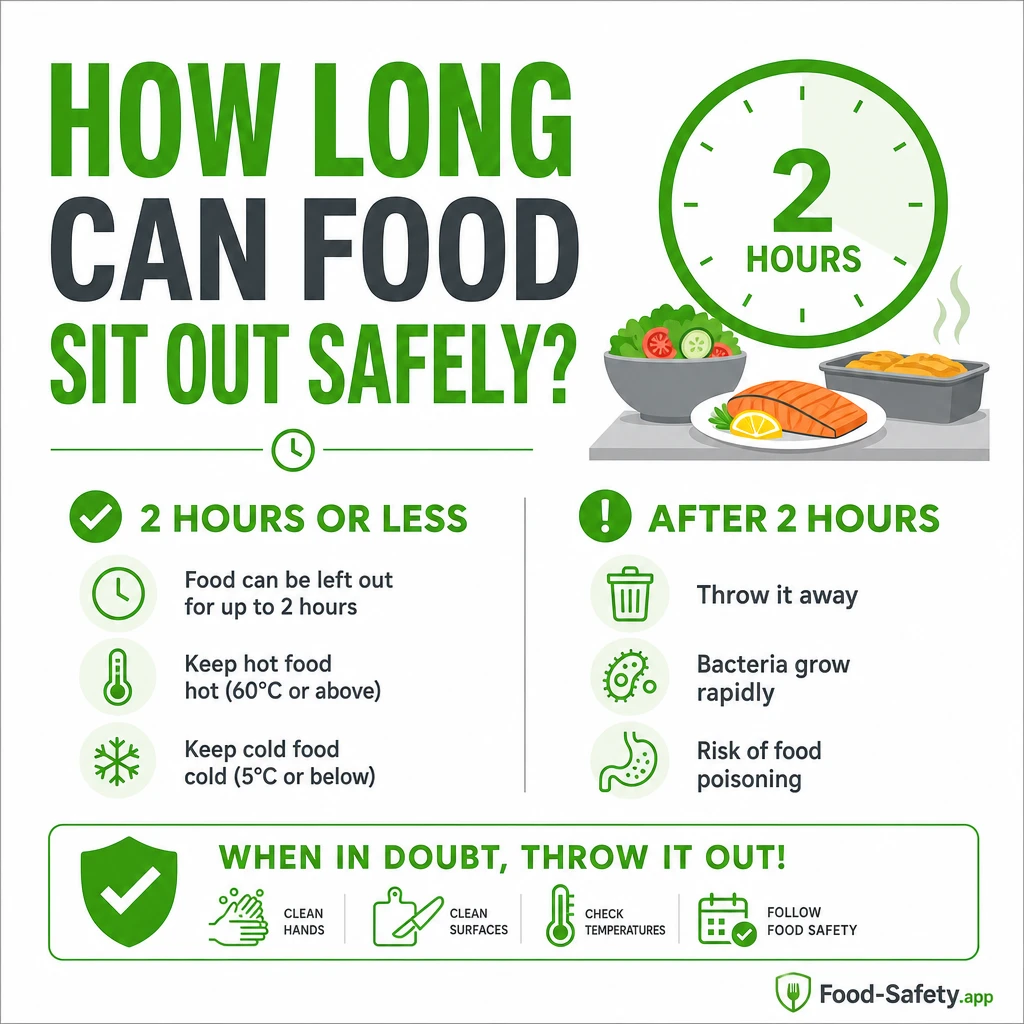
A practical guideline used in many UK catering settings is the 2-hour/4-hour approach governing exposure to the danger zone. In short:
- 0–2 hours: food can remain on display if it’s kept at proper temperatures and monitored.
- 2–4 hours: use or reheat to a safe temperature and keep within service; otherwise discard.
- Over 4 hours: discard.
This rule is a helpful operational aid, not a universal regulation. Always align your policy with local food safety guidance and the equipment you’re using. A few common cautions:
- Do not “top up” or reset the clock on an old tray by adding fresh food on top.
- Treat each display period as a fresh risk window, with a clear discard decision at the end of the window.
- Separate hot and cold or ambient displays to avoid cross-influencing the time and temperature logic.
The two-hour rule is a practical guide; always verify against local rules and the specific risk profile of your operation.
Illustrative workflow:
- Start a display with a fresh batch and note the start time.
- Check temperature at regular intervals (for hot displays, ensure it stays above 63°C; for ambient or cold displays, stay under 5°C where applicable).
- If the display nears the 2-hour mark, reassess: replenish with fresh items, move to hot holding, or discard.
- If moving into the 3–4 hour window, ensure reheating or rapid cooling is feasible, or discard.
Why appearance is not a safe safety check
It’s tempting to rely on how food looks, smells, or feels, but microbes that cause illness often don’t alter appearance or taste in obvious ways. A product can be unsafe even when it appears normal. A thermometer and time-based checks are the reliable guardrails for safety, and they should govern all display decisions.
Don’t judge safety by look or scent alone; microbes can be invisible.
Key habits:
- Use a calibrated thermometer to verify hot vs cold targets during service.
- Treat any tray that has sat out beyond safe windows as a potential discard candidate.
- Train staff to challenge “it looks fine” judgments and escalate when time or temperature thresholds are at risk.
Monitoring, records and staff training during service
A simple, repeatable system beats ad hoc checks. Set up a straightforward logging routine you can follow in a busy kitchen:
- For every display, record the start time and the intended display duration.
- Take periodic temperature readings (e.g., every 30 minutes) and log the results.
- Note discard times and the rationale (e.g., exceeded time window, failed temperature target).
- Maintain a clear rule set for hot holding, ambient display, and leftovers, and ensure staff consistently apply it.
- Use a consistent method to train new staff and audit adherence during shifts.
Keep records of start times, temperatures and discard decisions; they’re essential for audits and resilience after incidents.
Operational tips:
- Use separate trays for hot, cold, and ambient displays to reduce cross-exposure risk.
- Predefine service blocks (e.g., breakfast, mid-morning re-stock) to limit continuous exposure.
- Conduct quick mid-service checks and adjust staffing to avoid rushed, unsafe topping-up or refills.
To support inspections and day-to-day accuracy, many teams now log checks digitally. If you’re exploring a simple, reliable way to manage this, consider a solution like Food-Safety.app to log temperature checks, service times and discard decisions with automatic timestamps and offline capability. It helps you export records for audits and keep structured evidence of your controls.
Start managing your food safety records digitally: Explore Food-Safety.app