Learn how to write corrective actions that actually prove control and show what happened what was done and how the issue was prevented next time.
Table of contents
What a corrective action is
A corrective action is the concrete step or series of steps taken to address a food safety issue and prevent recurrence. It isn’t a vague remark or a temporary patch; it is the documented response that closes the loop between detection and verification. In a busy catering operation, well-defined corrective actions demonstrate controlled handling of problems and support ongoing safety standards.
This aligns with Natasha’s Law for small food businesses.
When to record corrective actions
Record every instance where safety or quality could be affected. Key triggers include:
- Temperature failures: fridge or hot-held items outside safe ranges
- Cleaning misses: an area not cleaned to standard on shift end
- Equipment faults: a fridge door not sealing, mixer not functioning
- Allergen errors: a menu item prepared with the wrong allergen information
- Delivery issues: items arriving warmer than safe or with damaged packaging
- Pest sightings: evidence or sightings in storage or prep areas
- Probe calibration failures: thermometers reading inconsistent values
- Hygiene breaches: hand washing, glove use, or general hygiene lapses
These triggers are not just about compliance; they reflect how fast service pressures can create risk. Recording promptly supports traceability, investigation, and future prevention. For practical steps to avoid cross-contamination in service, see cross-contamination in service.
What a good record should show
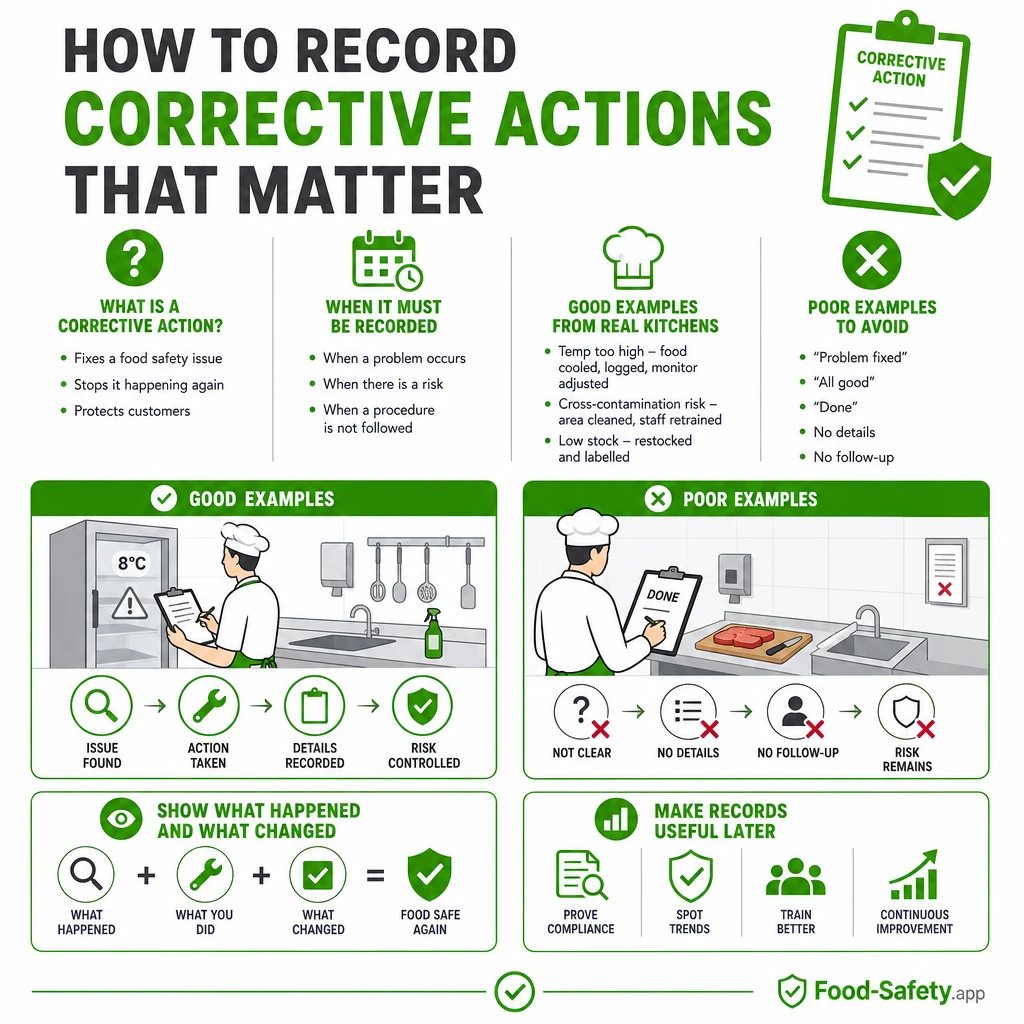
A solid corrective action record captures the full story. Include:
- What happened: a concise description of the issue
- When it happened: date and time
- Who found it: the person responsible for spotting the issue
- What action was taken: steps implemented immediately
- Who is responsible for the action: role or name
- What changed afterwards: follow-up checks or verification results
Avoid vague phrases. The record should allow someone reading it later to understand not just the problem, but how it was controlled and what proof remains that the issue was addressed. For allergen considerations, see clear allergen labelling on packaged food.
Why vague notes fail
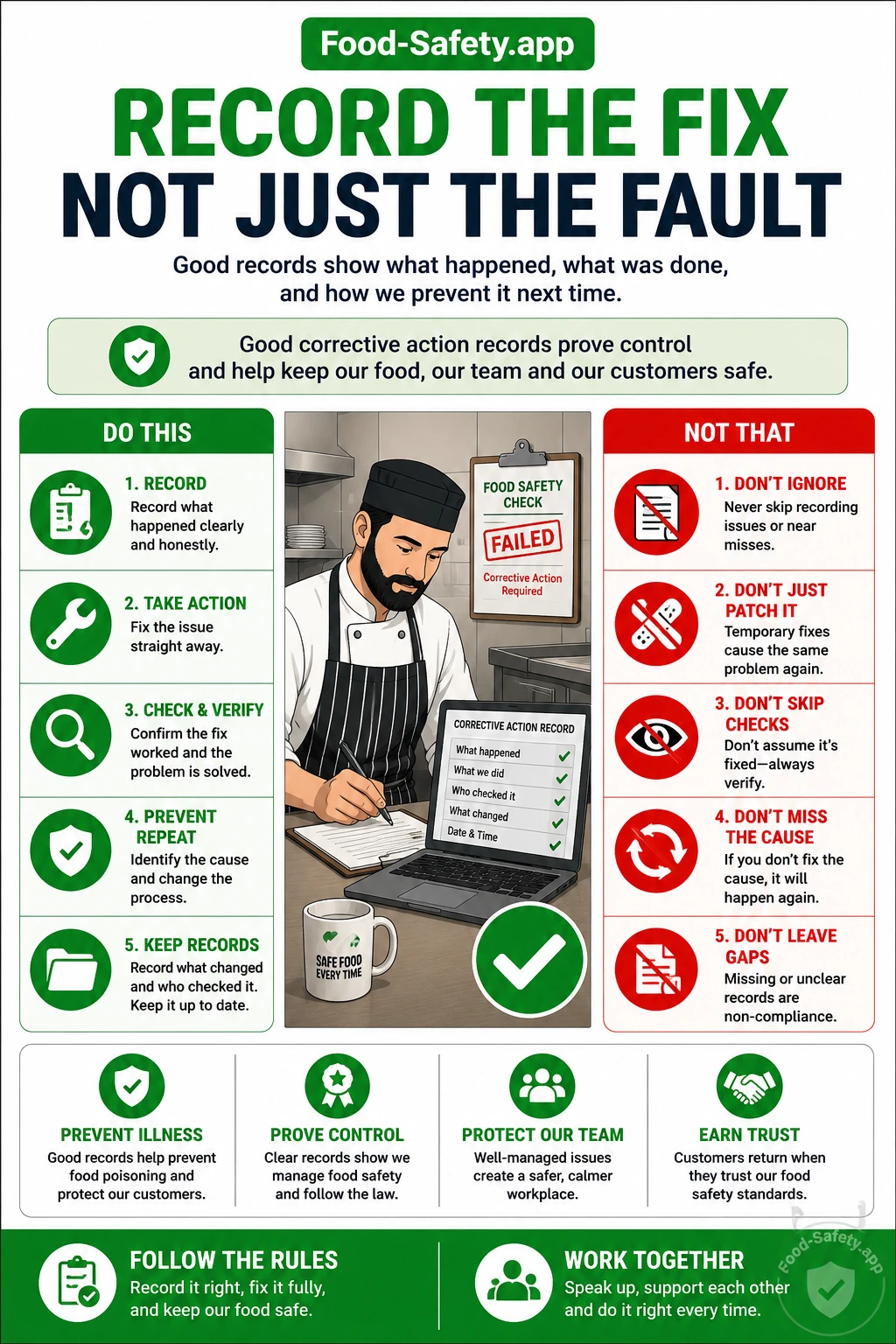
Vague notes like “sorted,” “checked,” or “done” fail because they do not prove control or follow-up. They leave gaps such as when the task was completed, who verified it, whether any repeat checks occurred, or what evidence confirms the issue was resolved. Vague notes hinder audits and slow down improvement cycles in a busy service environment.
For cleaning steps to reduce allergen cross-contact, see how to clean to reduce allergen cross-contact.
For practical cleaning steps to reduce allergen cross-contact, see how to clean to reduce allergen cross-contact. For digital records guidance, see what are digital food safety records and how do they help.
How to make records useful later
Turn records into a reliable source of truth by applying these practices:
- Link the issue to the action: clearly state how the corrective action prevents recurrence
- Keep wording factual: use objective language and specific details
- Note repeat checks or sign-off: record verification steps and who approved them
- Maintain a full history: record should show the progression from first detection to final close
Consider a simple field set that enables quick entry during busy periods, then exports for audits or management review. A structured approach makes it easier to spot repeat problems and prioritise fixes. For digital records guidance, see digital food safety records guidance.
For digital records guidance, see digital food safety records guidance.
Practical scenarios
Realistic examples help teams apply the right mindset. Below are common occurrences and how to document them effectively.
Fridge found above safe temperature
What happened: fridge temperature exceeded the safe limit during a busy service. Action: moved exposed foods to another unit, temperature rechecked, engineer contacted if readings persist. Result: unit monitored and logged every 30 minutes until stable. Record notes: date/time, exact temperatures, who moved items, and supervisor sign-off.
Cleaning task missed in prep area
What happened: cleaning in a key prep area missed during shift handover. Action: area cleaned immediately, cleaning task reissued, supervisor reviewed the rota to prevent recurrence. Result: updated schedule and confirmation of completion. Record notes: who identified the miss, what task was missed, and the follow-up time.
Allergy mistake on a menu item
What happened: an item was prepared with incorrect allergen information. Action: item removed from service, staff briefed, allergen data updated in the menu and system records. Result: review of allergen controls and staff acknowledgement. Record notes: allergen updated, date of briefing, and responsible manager.
Delivery arrives warm
What happened: delivery arrived warmer than safe, packaging compromised. Action: delivery rejected, supplier contacted, note made of temperature and condition, investigation initiated. Result: store checked and monitoring tightened for incoming deliveries. Record notes: temperature readings, packaging condition, and supplier response.
Pest sighting in store room
What happened: evidence logged (rat pelts, droppings, or sightings). Action: contractor informed, affected stock checked, increased monitoring and pest control visits scheduled. Result: pest activity reduced or controlled. Record notes: time, location, action taken, and next inspection date.
For broader food safety risk awareness, see salmonella risks every small kitchen should know.
Implementing a reliable routine
To make corrective action recording part of everyday operations, build a simple, repeatable routine that staff can follow without slowing service:
- Detect and document: capture the basic facts at the moment of discovery
- Immediate containment: implement the shortest immediate control to prevent further risk
- Assign ownership: designate who will lead the corrective action
- Verify and record: record verification steps and outcomes
- Close and review: sign off the case and schedule a review if needed
- Archive for audit: export or store the record in a central location
For a deeper look into HACCP and food safety systems, see what counts as a CCP in a small kitchen.
Digital records guidance
Expand your understanding of digital food safety records and how to implement reliable corrective action documentation across small kitchens today.