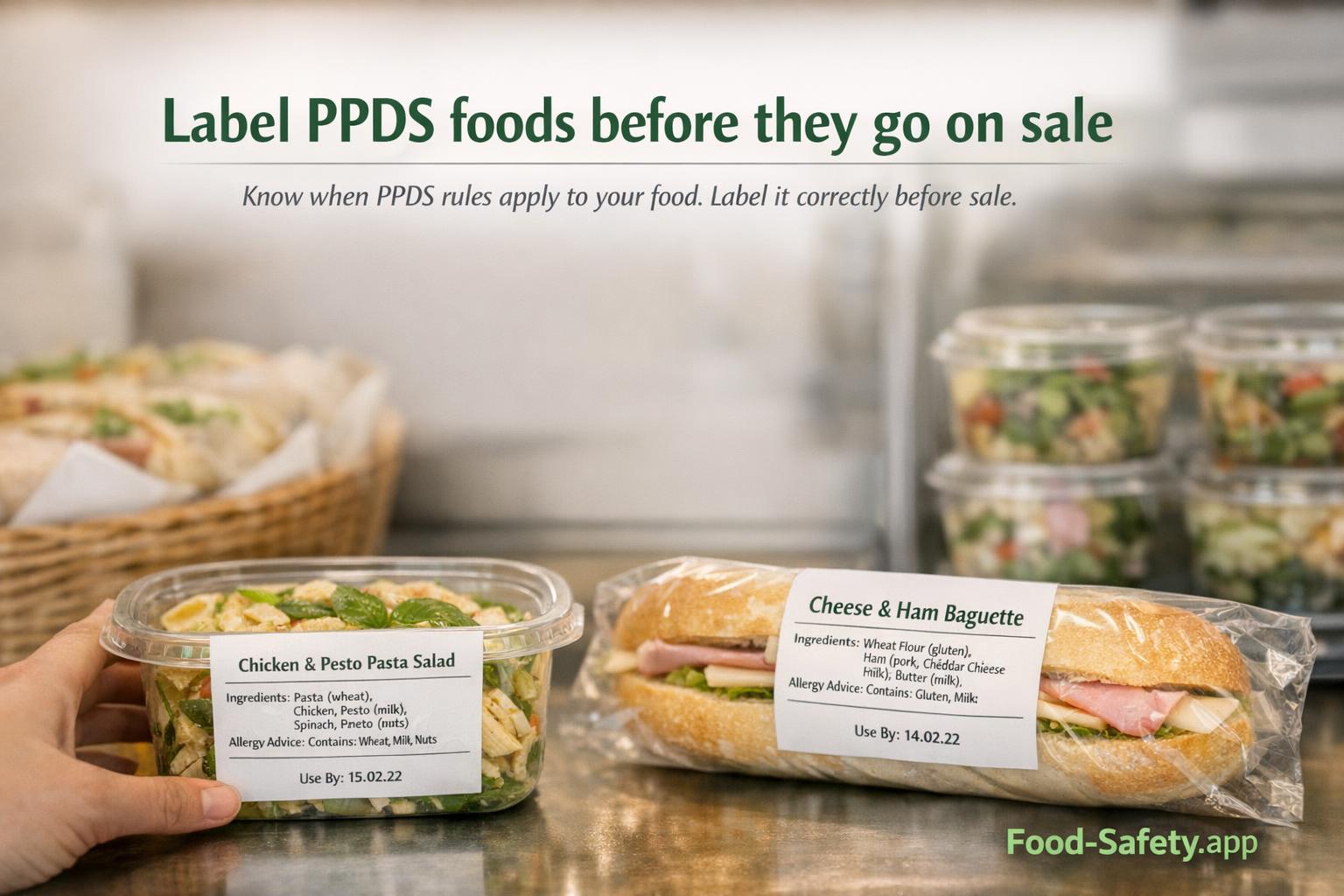
If you run a café, takeaway, hotel kitchen, school canteen or catering business, getting Natasha’s Law for small food businesses right is one of those jobs that can’t be left to “we’ll sort it later”. If you sell food that is made and packed on site for direct sale, the labelling rules may apply, and the label has to be correct before the food leaves the counter, hatch or fridge. The good news is that once your team knows when the rules apply and what needs to go on the label, it becomes a simple routine rather than a daily panic. For a structured approach, see HACCP principles explained.
This guide explains the practical side of Natasha’s Law for small food businesses, using UK guidance. Rules can vary in other countries, so if you operate outside the UK or trade across borders, check the local requirements too. For allergen management, see Allergen management made practical for UK food businesses.
Table of contents
- What Natasha’s Law means for small food businesses
- When the rules apply
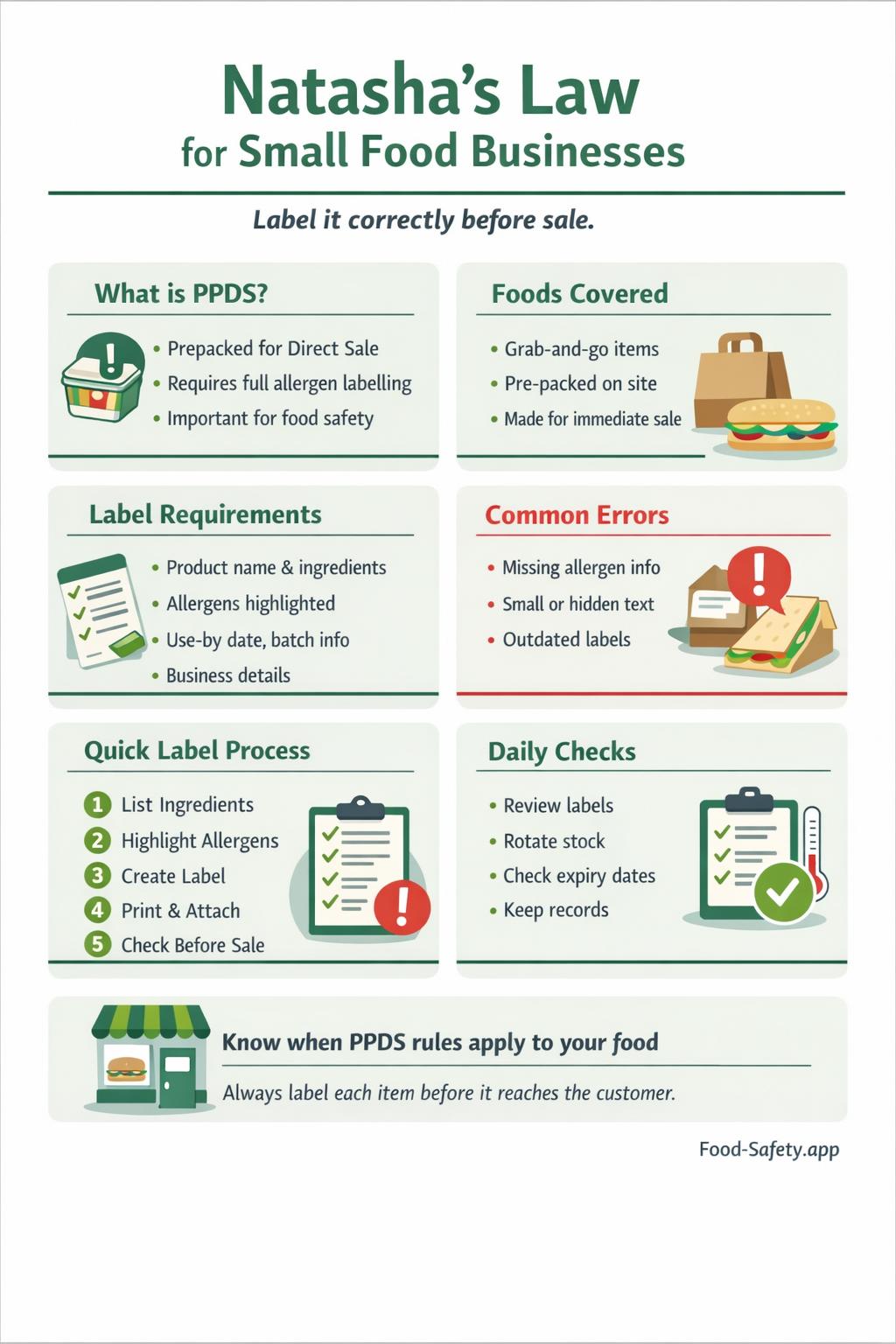
- What the label needs to show
- Small business examples that catch people out
- Practical kitchen routines that make labelling manageable
- Common mistakes and how to fix them
- Staff training and handover checks
- How to handle customer questions confidently
- Frequently asked questions
- Final checklist for service
What Natasha’s Law means for small food businesses
Natasha’s Law is the name many people use for the UK rules that require full ingredient and allergen labelling on foods that are prepacked for direct sale, often shortened to PPDS. In plain English, if you make a food item, pack it before it is ordered, and sell it from the same site, the customer must be able to see what is in it before they buy it. No guessing, no “it’s probably just cheese and lettuce”, and no scraping the sticker off later because someone forgot to print one.
For small food businesses, the big issue is not the law itself, but spotting which products fall under it during a busy shift. A sandwich made in the morning, wrapped, labelled and placed in the chiller for later sale is a classic example. So is a boxed salad, a filled roll, or a dessert packed in advance for display. The label needs to be there before sale, not after the till receipt has been handed over.
When the rules apply
The rules usually apply when all of the following are true:
- The food is prepared and packed on the same premises where it is sold.
- It is packed before a customer selects it or asks for it.
- It is offered for sale as packed food, rather than being assembled or served fresh to order.
This matters in all sorts of businesses:
- A café making grab-and-go lunches for the display fridge.
- A hotel kitchen packing breakfast items for conference delegates.
- A school canteen selling sealed baked items at break time.
- A takeaway preparing chilled side dishes for later collection.
- A caterer packing individual portions for an event buffet.
If food is made to order and handed straight over for immediate consumption, it may not be PPDS. But don’t rely on guesswork in a busy service. If the item is packed in advance and sold from the same site, treat it as if the label matters, because it usually does.
For official UK guidance, the Food Standards Agency is the main authority to check, and additional insights can be found in How cross-contamination happens and how to stop it.
What the label needs to show
A compliant PPDS label needs to tell the customer the name of the food and the ingredients, with allergens emphasised clearly in the ingredient list. The practical aim is simple: a customer with an allergy should not need a magnifying glass, a detective badge, or a spare half hour before lunch.
In day-to-day kitchen terms, your label should normally include:
- The name of the food.
- A full ingredients list in descending order by weight.
- Allergens clearly emphasised within the ingredients list, such as in bold.
- Any other required information your business chooses or needs to include, such as date coding for quality control.
The important point is that the label must be accurate for the exact item inside the pack. If the sandwich recipe changes because the main cook has “improved” it with a different mayo, the label must change too. Allergens are not a place for creative writing.
Keep recipes and labels linked
The safest way to manage Natasha’s Law for small food businesses is to treat every PPDS item like a controlled product. That means a written recipe, a standard label, and a simple process for updating both when ingredients change. If your tuna mayo sandwich suddenly contains mustard because someone added a new dressing, that is not a tiny detail. That is a label update.
Small business examples that catch people out
Some items are obvious. Others are the ones that trip teams up during lunch rush when three orders are firing, the coffee machine is whining, and someone has just asked where the gluten-free tongs have gone.
Example 1: Grab-and-go sandwiches
Prepacked sandwiches are one of the clearest PPDS examples. If they are made in advance and displayed for sale, they need proper labelling. That includes mixed fillings, sauces, garnish and anything tucked away in the recipe that contains an allergen, even if it seems minor.
Example 2: Cakes and desserts
A slice of carrot cake packed in a box for later sale needs the correct ingredient and allergen information. If the cake uses walnuts, eggs or milk, the customer should not have to ask a member of staff who has to ask the baker who made it yesterday after a very long shift.
Example 3: Deli pots and salads
Layered salads, pasta pots and rice bowls often look simple, but they can contain several allergens through dressings, croutons, cheeses or sauces. A packed lunch item can be more complicated than it appears from the outside.
Example 4: School and contract catering
Schools and contract caterers often work with repeated menus, which helps. But it also means labels and recipes can be copied over without being properly checked. If a supplier changes a sauce recipe, the catering team still owns the label.
Example 5: Hotel breakfast and conference food
Hotel kitchens commonly pack muffins, fruit pots, breakfast sandwiches or meeting-room snacks in advance. These are easy to overlook because the focus is often on volume and speed. But if they are packed before sale, they need the right information in place before they hit the display.
Practical kitchen routines that make labelling manageable
The easiest way to stay compliant is to build PPDS labelling into prep, not bolt it on at the end. The best systems are the boring ones, because boring is what keeps service moving and avoids a last-minute scramble.
Use a master recipe sheet
Every PPDS item should have a master recipe sheet with exact ingredients, quantities and supplier names if useful for your team. Keep one version only, and make sure the person updating it can tell a current sauce from a discontinued one. For training newcomers, see Food-safety induction training for new staff.
Set up pre-approved labels
Create label templates for your most common items. For example:
- Egg and cress sandwich.
- Chicken mayo baguette.
- Vegan pasta pot.
- Chocolate brownie.
When the recipe changes, update the template immediately. Don’t leave “temporary” labels hanging around like an old apron nobody admits owning.
Build a daily pack-and-check routine
A simple routine might look like this:
- Check the recipe version before prep starts.
- Print labels after the final ingredients are confirmed.
- Attach the label before the item goes into display or storage for sale.
- Run a final check at the end of prep against the product list.
Keep allergens visible to the team
Use a colour-coded sheet, label board or digital product list so that everyone can see which allergens are in each item. This helps in busy service and makes cover staff less likely to guess. Guessing is not a food safety control. See Allergen management Natasha’s Law for UK food businesses for more detail.
Common mistakes and how to fix them
Changing a recipe but not the label
Problem: The chef swaps one dressing for another, but the printed label stays the same.
Fix: Make recipe changes sign-off only. If the recipe changes, the label is checked before the product can be sold.
Using handwritten labels with missing ingredients
Problem: A quick handwritten sticker leaves out part of the ingredient list because service is busy.
Fix: Use a standard format and print labels where possible. If handwriting is unavoidable, have a second person check the full text before use.
Assuming “everyone knows” the recipe
Problem: Long-serving staff rely on memory.
Fix: Keep written recipes where the team can reach them quickly, not buried under pastry mats and old invoices.
Mixing PPDS items with made-to-order food
Problem: The same product can be sold either packed in advance or assembled fresh, and staff are not sure which rule applies.
Fix: Mark products clearly on the prep list as “PPDS” or “made to order” so the team knows what must be labelled. For cross-contamination prevention tips, see Colour-coded chopping boards in use.
Staff training and handover checks
Small food businesses often depend on flexible teams, which makes training especially important. A good allergen process survives the Tuesday lunch rush, a sick call, and a new starter who has not yet learned the difference between the sandwich shelf and the cake rack.
Train staff to understand:
- Which foods count as PPDS.
- Where to find current recipes and label templates.
- How to spot ingredients that contain allergens.
- What to do if a label looks wrong or missing.
- Who has authority to approve a label change.
Use a short handover checklist between prep teams and service teams. It should cover what has been packed, what labels have been printed, and whether anything changed during prep. That one page can save a lot of awkward conversations at the till.
How to handle customer questions confidently
Even with perfect labels, customers will ask questions. That is normal. What matters is that your team answers clearly and does not wing it.
Helpful habits include:
- Pointing customers to the label first.
- Checking the recipe sheet if they ask for confirmation.
- Escalating any uncertainty to a manager or chef.
- Never guessing about allergens, even if the item “usually” contains them.
If a label is missing or unclear, do not sell the product until it is corrected. It is better to lose one sale than to create a serious allergy risk. That is not overcautious; that is professional.
Frequently asked questions
Does Natasha’s Law apply to all food businesses?
No. It applies to PPDS foods, not every item sold by every business. The key question is whether the food is packed on the same premises before sale and sold from that site.
Do we need to label food made fresh to order?
Usually not in the same way as PPDS, but you still need strong allergen controls, accurate communication and staff who know the menu inside out.
Can we use a generic allergen chart instead of a product label?
Not for PPDS items. The customer needs the information with the food itself before purchase.
What should we do if a supplier changes an ingredient?
Review the recipe, update the label, and brief the team before the product goes back on sale.
Final checklist for service
Before service starts, make sure each PPDS item has:
- A current recipe sheet.
- An accurate ingredient list.
- Allergens clearly emphasised.
- The correct product name.
- A label attached before sale.
- A team member who knows where the master information is kept.
For businesses that want a clearer way to track recipes, labels and approvals, a food safety management system for catering businesses such as Food-Safety.app can help keep the paperwork and the kitchen practice in step.
Natasha’s Law for small food businesses is manageable when you treat it as part of everyday production, not a one-off compliance job. Know which items are PPDS, keep recipes accurate, label before sale, and train the team so nobody has to make an allergic guess at the point of purchase. Do that well, and your customers stay safer, your staff feel more confident, and your service runs with fewer last-minute surprises.
Natasha’s Law practical guide support
Discover how Food-Safety.app can simplify Natasha’s Law compliance for small food businesses. Manage recipes, reduce errors during busy service, and train staff with clear checklists and handover processes. Start improving your allergen controls and labeling accuracy today.