Strong food safety leadership keeps standards high, teams aligned and guests safe. In a professional kitchen, it means turning policy into daily habits: clear decisions, consistent coaching and swift corrective action. Whether you run a restaurant, hotel kitchen, school canteen, café or takeaway, the way you lead shapes compliance, culture and customer trust. See how HACCP principles translate to practical steps.
Contents
- What food safety leadership looks like in practice
- Set the standard: policies, training and accountability
- Lead by data: monitoring, verification and corrective action
- Create a culture where everyone speaks up
- Leadership during incidents and inspections
What food safety leadership looks like in practice
Food safety leadership shows up in the small, repeatable moments of a busy service. It is the head chef taking probe temperatures without cutting corners, the manager stopping service to prevent cross-contamination, and supervisors praising good practice as loudly as they correct poor practice. The goal is consistency when pressure rises.
For practical guidance on preventing cross-contamination in busy kitchens, see how cross-contamination happens and how to stop it.
Quick routine
- Pre-shift: Walk the kitchen. Check handwash stations stocked, sanitiser at correct strength, fridges labelled and within limits.
- Brief: Two-minute huddle on today’s allergens, high-risk dishes and any new starters’ buddying.
- During service: Spot-check hot holding, cooling times and glove-free handwashing technique.
- Close: Verify cleaning down, label rotation, waste logs and pest points.
Corrective actions
- If a critical check fails, stop the task, isolate affected food, re-clean or re-cook as appropriate, record actions, and retrain on the spot.
- Escalate repeat issues to a short root-cause review before the next service.
Set the standard: policies, training and accountability
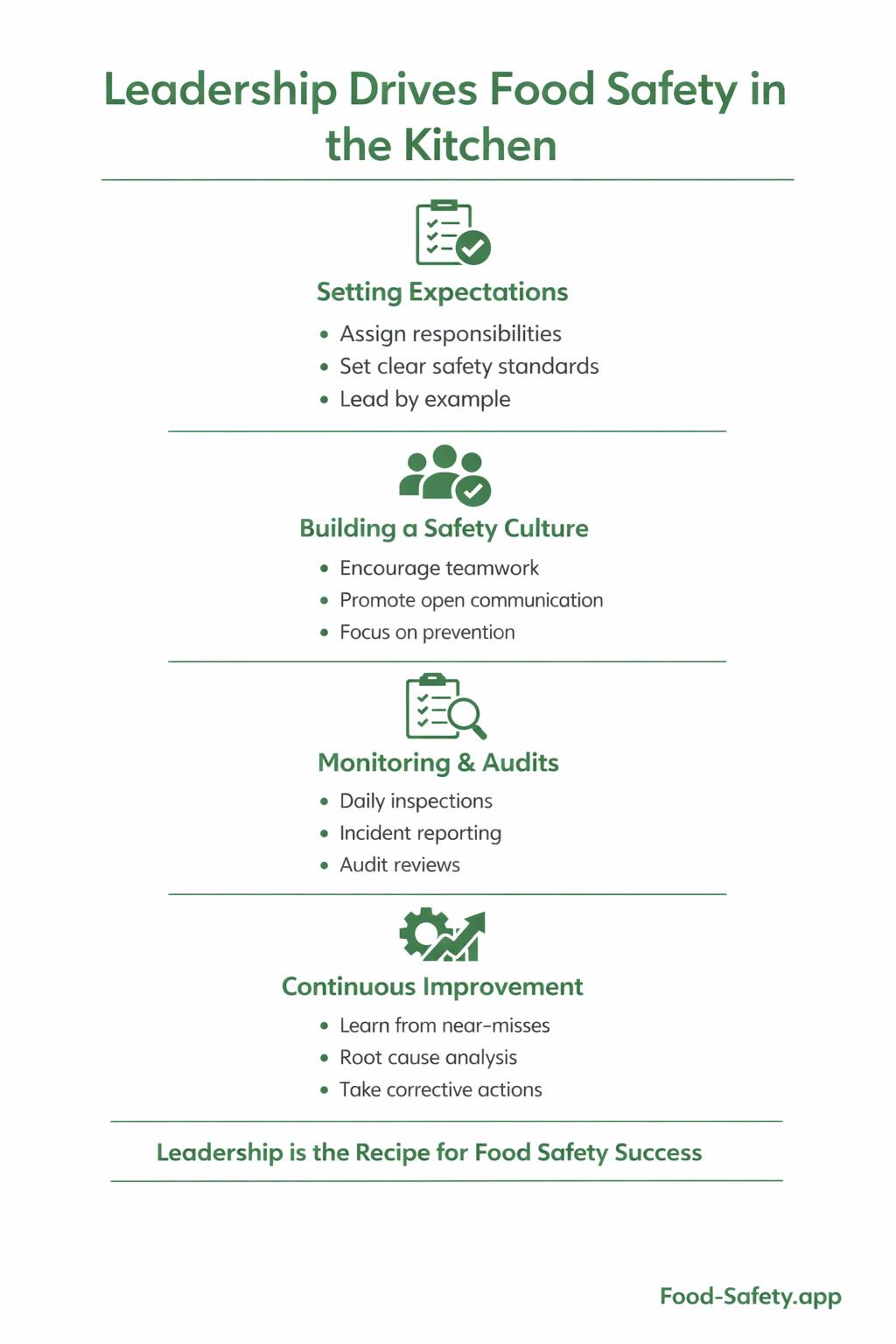
Leaders translate HACCP and house rules into simple, workable routines. Induction is practical, refreshers are regular, and accountability is fair. Make safe behaviour the easiest behaviour.
Practical set-up
- Training matrix: Induction, allergen awareness, personal hygiene, cleaning, temperature control, cross-contamination, delivery and storage.
- Shift tools: Colour-coded boards, separate utensils for raw and ready-to-eat, dated labels, probe wipes at every station.
- Hygiene standards: Clear illness reporting, handwashing steps at sinks, nails short, jewellery policy enforced.
Accountability that works
- Assign owners for fridges, allergen stations and cleaning zones; rotate weekly.
- Use simple pass/fail checks and coach immediately; recognise good practice publicly.
Lead by data: monitoring, verification and corrective action
Effective food safety leadership uses data to prevent problems. Logs and observations should guide decisions, not sit in a folder. Verify, challenge and improve. For temperature control in kitchens, see temperature control in kitchen.
Data you should see daily
- Delivery checks with supplier temperatures and packaging condition.
- Fridge and hot-holding records, plus corrective notes when limits were approached.
- Cooling records for cooked foods, with times and container depth noted.
- Cleaning verification using visual checks and, where appropriate, test strips.
Verification and follow-up
- Calibrate probes routinely and document it.
- Trend issues (e.g., frequent near-limit readings) and adjust the process, training or equipment.
Create a culture where everyone speaks up
Great leaders make it safe to challenge unsafe practices. In a commercial kitchen, seconds matter. A porter, KP or commis must feel confident to pause a task without blame.
Learn about building a strong food safety culture.
Daily behaviours that build culture
- Start shifts with “see it, say it” reminders and thank people who raise issues.
- Make near-miss reporting fast and simple; review highlights in the next briefing.
- Use buddy systems so new starters learn safe shortcuts, not unsafe ones.
Corrective actions
- If someone stays silent about a risk, debrief privately, explore why, and agree one change that would make speaking up easier next time.
Leadership during incidents and inspections
When something goes wrong or an inspector arrives, leadership turns plans into calm execution. Clarity reduces risk and downtime.
Incident playbook
- Identify and contain: Isolate affected food and areas; stop the related process.
- Assess and record: What happened, when, who was involved, and what food is affected.
- Communicate: Inform the duty manager and, if needed, suppliers or customers following your policy.
- Investigate: Find root causes and update procedures, training or equipment.
For clear guidance on managing food safety and documenting controls, see the Food Standards Agency’s business guidance: Managing food safety.
Inspection readiness
- Keep documents current and accessible; ensure today’s reality matches your procedures.
- Nominate a confident spokesperson; answer clearly and demonstrate controls in use.
Conclusion
Food safety leadership is about habits, not posters: brief well, verify often, act fast and learn every day. If you make safe choices the default, your team will follow even under pressure, and compliance will feel natural rather than forced. Digital tools can help keep records tight and trends visible; for example, Food-Safety.app, a food safety management system for catering businesses, can streamline monitoring and follow-up. Lead with clarity and consistency, and your kitchen will protect guests, support your team and safeguard your reputation. For more on food hygiene ratings, see food hygiene ratings.