Learn what good kitchen management looks like in practice, with clear steps to keep your kitchen management safe, organised, and compliant every day.
Table of contents
- Leadership in kitchen management
- Planning and organisation
- Managing kitchen staff effectively
- Daily checks and controls
- Clear communication in the kitchen
- Reviewing and improving performance
Leadership in kitchen management
Good kitchen management starts with strong leadership. Whether you’re running a small café or a large catering operation, the person in charge sets the tone for standards, safety, and consistency. Effective leaders don’t just delegate tasks—they model the behaviours they expect, including hygiene practices, time management, and attention to detail.
Leaders must also understand their legal responsibilities around food safety. This includes ensuring that safe systems, such as HACCP-based procedures, are followed consistently. If something goes wrong, responsibility often sits with management, so having clear oversight is essential. Practical leadership means being visible in the kitchen, supporting staff, and stepping in when standards slip.
How does leadership improve kitchen management?
Strong leadership improves kitchen management by creating accountability and clarity. Staff are more likely to follow procedures when expectations are consistent and enforced. It also helps reduce risks such as cross-contamination, poor temperature control, or missed cleaning tasks, which can all lead to serious food safety issues if left unchecked.
Planning and organisation
Planning is a core part of kitchen management. A well-organised kitchen reduces stress, improves efficiency, and lowers the risk of mistakes. This includes planning menus, stock rotation, cleaning schedules, and staffing levels. Without proper planning, kitchens can quickly become chaotic, especially during busy service periods.
Effective planning also involves understanding food safety risks. For example, preparing raw and ready-to-eat foods at different times or in separate areas helps prevent contamination. Scheduling deliveries and ensuring correct storage conditions are equally important to maintain food quality and safety.
Many businesses now use digital tools to support planning. For example, Food-Safety.app, a food safety management system for catering businesses, can help organise daily tasks, track records, and ensure nothing is missed. This reduces paperwork and helps maintain consistency across shifts.
What should kitchen planning include?
Good kitchen management planning typically covers:
- Daily prep schedules and task allocation
- Stock control and rotation (FIFO)
- Cleaning and sanitation routines
- Equipment maintenance and calibration
- Food safety monitoring procedures
Managing kitchen staff effectively
Staff play a central role in kitchen management. Even the best systems will fail if staff are not properly trained or supported. Every team member should understand basic food hygiene, personal hygiene requirements, and their specific responsibilities within the kitchen.
Training should be ongoing, not a one-time activity. New staff need induction training, while experienced staff benefit from refreshers and updates when procedures change. Clear documentation and accessible guidance help reinforce good practices. You can explore more on this in training staff development resources.
Motivation also matters. A well-managed team is more likely to follow procedures carefully and take pride in their work. This reduces errors and improves overall food safety outcomes.
How does staff management support kitchen management?
Effective staff management ensures that tasks are completed correctly and consistently. It reduces reliance on supervision alone and builds a culture where food safety is part of everyday behaviour, not just a checklist item.
Daily checks and controls
Checks are a critical part of kitchen management. They provide evidence that food safety procedures are being followed and help identify problems before they escalate. These checks should be simple, consistent, and built into daily routines.
Common checks include monitoring fridge and freezer temperatures, verifying cooking and reheating temperatures, and completing cleaning records. These are essential for controlling hazards such as bacterial growth, which thrives in unsafe conditions. For more on this, see temperature control and the danger zone.
Accurate record-keeping is just as important as completing the checks themselves. If records are incomplete or inconsistent, it becomes difficult to demonstrate compliance during inspections.
What checks should be included in kitchen management?
Typical daily checks include:
- Opening and closing safety checks
- Temperature monitoring for storage and cooking
- Cleaning and sanitation records
- Allergen control verification
- Equipment condition and calibration
Digital systems can simplify this process by automatically recording timestamps and highlighting missed tasks, making it easier to stay inspection-ready.
Clear communication in the kitchen
Communication is often overlooked but is essential for effective kitchen management. In a busy environment, misunderstandings can lead to errors, delays, or even safety risks. Clear communication ensures that everyone knows what needs to be done and how to do it safely.
This includes verbal communication during service, written procedures, and visual reminders such as signage. For example, clear allergen information must be communicated accurately to prevent serious health risks. According to the World Health Organization, unsafe food handling remains a leading cause of illness worldwide, often linked to poor communication and training.
Regular team briefings can help reinforce expectations and address any issues before they become problems. Encouraging staff to speak up when something seems wrong also strengthens overall safety.
How can communication improve kitchen management?
Good communication reduces confusion, improves teamwork, and ensures that safety procedures are followed consistently. It also helps create a more supportive working environment where staff feel confident raising concerns.
Reviewing and improving performance
Kitchen management doesn’t stop at daily operations. Regular review is essential to identify what’s working well and what needs improvement. This includes reviewing records, analysing incidents, and updating procedures when necessary.
Inspections, whether internal or external, provide valuable insights into compliance levels. Instead of viewing them as a burden, they should be used as an opportunity to strengthen systems and address gaps. Reviewing trends, such as repeated temperature issues or missed cleaning tasks, can highlight underlying problems.
Continuous improvement is a key principle of food safety management. Small changes, such as adjusting workflows or updating training materials, can have a significant impact over time.
What does effective review look like in kitchen management?
Effective review involves regularly checking records, identifying patterns, and taking corrective action. It also means staying up to date with current guidance and adapting processes as needed to maintain compliance and safety.
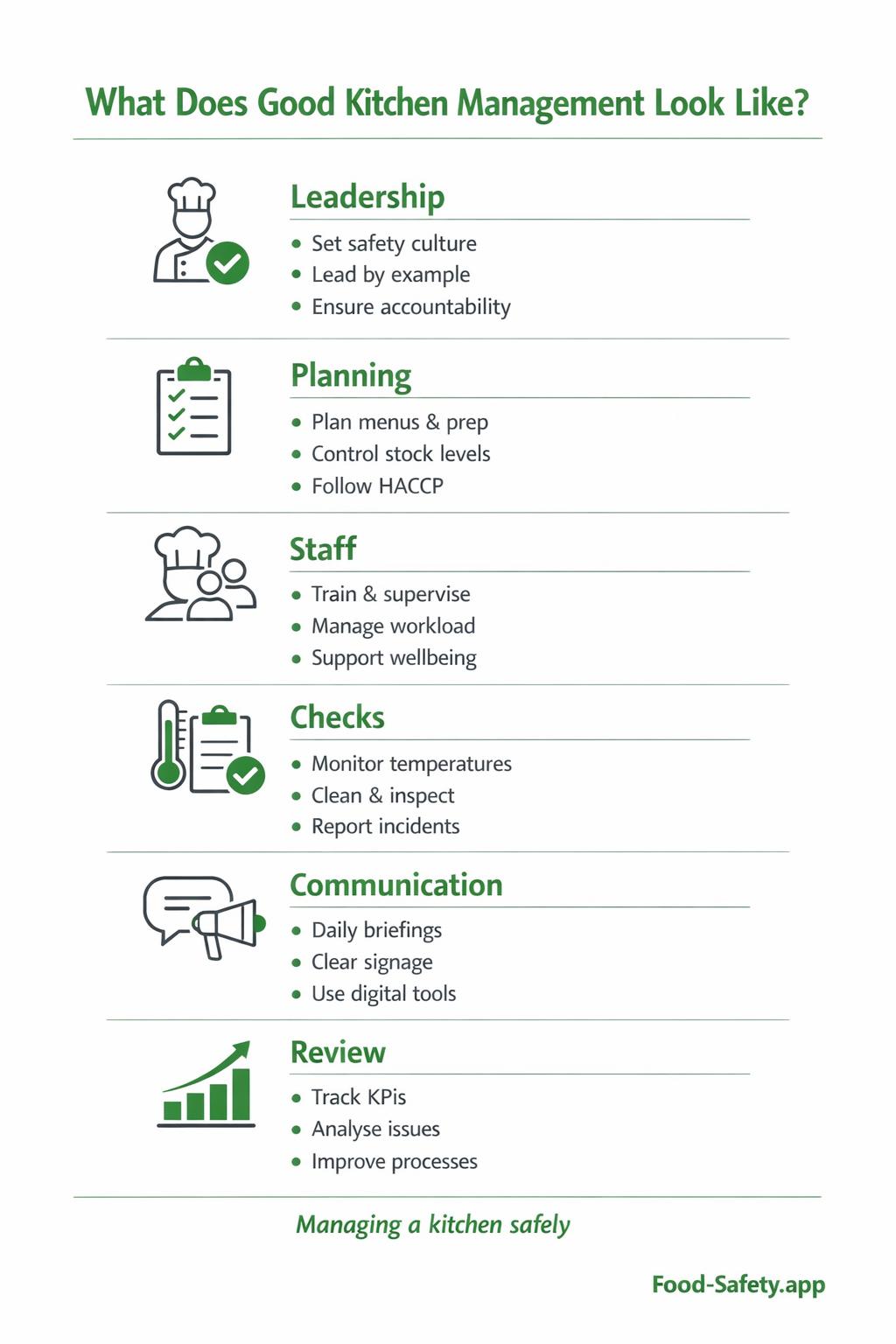
Ultimately, good kitchen management is about consistency. When leadership, planning, staff, checks, communication, and review all work together, the result is a kitchen that runs smoothly, meets legal requirements, and keeps customers safe.