
Menu Changes and Allergen Control
Menu changes can make allergen information wrong very quickly, especially when service pressure is high and the team is trying to keep up with prep, updates and customer questions. HACCP principles explained can help structure these controls. If you manage a busy professional kitchen, the safest approach is to treat menu changes and allergen control as one process, not two separate jobs. A simple swap of bread, sauce, garnish or supplier can change the allergen picture for a dish, and if that change is not captured straight away, the wrong information can reach the customer.
This is a practical guide for restaurants, cafés, hotels, school canteens, takeaways and catering teams in the UK. Managing allergens safely in a busy kitchen can help teams apply best practices, as food hygiene and allergen expectations can vary by country, so always follow the rules and guidance that apply where you operate.
Table of contents
- Why menu changes break allergen control
- The changes that catch teams out
- Before you change a dish
- How to update allergen info fast and safely
- Service day controls that stop mistakes
- Training and communication that actually work
- What to do when something changes at the last minute
- Final checklist for safer menu changes
- Conclusion
Why menu changes break allergen control
Allergen control works best when the dish on the menu matches the dish on the pass, the prep table and the customer-facing information. The problem is that menu changes often happen in the middle of real business pressure: a supplier is out of stock, a chef substitutes an ingredient, a special is added for the weekend, or a recipe is tweaked to suit margins.
The biggest risk is assumption. Teams assume the new sauce is fine because it is “basically the same”, or that a replacement bread is safe because it comes from the same supplier. In practice, that is how menu changes and allergen control fall apart.
In a commercial kitchen, this is especially dangerous because several people may touch the information. Unless there is one clear update process, the old version often stays in circulation.
The changes that catch teams out
Some changes are obvious, such as swapping a dessert for one with a different filling. Others are easy to miss because they happen in the background.
Supplier substitutions
When a supplier changes an ingredient or packaging, the allergen profile may change too.
Recipe tweaks
Adding butter to mash, using a different mustard in dressing, or changing the crumble topping can all alter allergen content.
Specials and limited-time dishes
Specials are often created quickly and may not go through the same approval route as core menu items.
Off-menu requests and staff improvisation
Using what’s available can be sensible operationally, but it must trigger an allergen review every time.
Different versions of the same dish
A vegan version, children’s portion or buffet version may share the same name, but the ingredient list can be very different.
Before you change a dish
The safest kitchens treat every menu change as a controlled task. Before a dish goes live, ask these questions:
- Has any ingredient changed, including garnish, sauce, coating or side?
- Does the new ingredient have a different allergen profile from the old one?
- Has the supplier specification been checked and saved?
- Has the recipe card been updated by the person who owns the dish?
- Has the customer-facing information been updated everywhere it appears?
- Has the front-of-house team been briefed?
- Has anyone checked for cross-contact risks during prep and service?
If the answer to any of these is “not yet”, the change should not be treated as complete.
A useful habit is to assign one person responsibility for sign-off. That might be the head chef, kitchen manager or allergen lead.
How to update allergen info fast and safely
Speed matters, but speed without control creates mistakes. The goal is to update allergen information quickly enough for service, but carefully enough that the whole team can trust it.
Use one source of truth
Keep a master allergen matrix, spec sheet or recipe pack that contains the current version of each dish. For a simplified HACCP plan for UK catering businesses, see HACCP plan made simple for UK catering businesses.
Record the date and version
Version control is simple but powerful. Even a basic date stamp helps staff see which sheet is current.
Check the whole route to the customer
Allergen information may appear in several places: on the menu, on a label, on the till screen, on the specials board and in verbal handover notes.
Use plain, specific language
Avoid vague wording such as “may contain” unless it is based on a real risk assessment. Also avoid staff saying “it should be fine” or “I think it doesn’t contain nuts”.
For general UK guidance on allergen information and responsibilities, the Food Standards Agency guidance for food businesses is a useful starting point.
Service day controls that stop mistakes
Service day is where good systems are tested. Even well-run kitchens can slip if the update is not clear to the people actually serving the food.
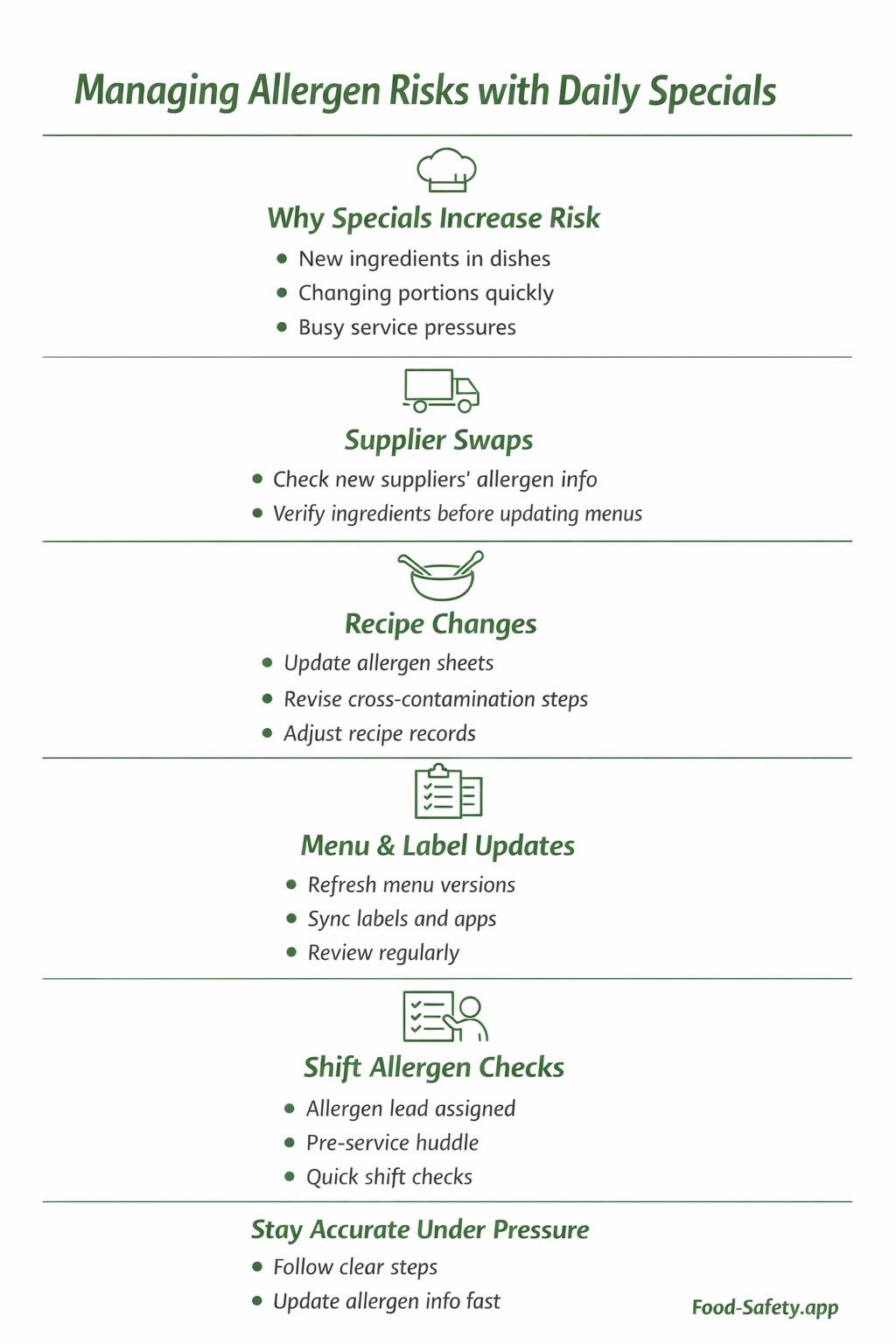
Run a pre-service allergen briefing
- Any recipe changes since the last service
- Any missing ingredients and approved substitutes
- Any specials or temporary items
- Any dishes that should be removed from sale
- Any high-risk allergens that need extra care today
Keep the pass and front of house aligned
The kitchen may know a dish has changed, but if front of house is still using an old sheet, the customer gets the wrong answer.
Separate safe update from guesswork
If a dish has changed but the allergen check has not been completed, take it off sale until the update is confirmed.
Watch buffet and batch service closely
In school canteens, hotel breakfast service and buffet catering, menu changes can be missed because the same labels are used repeatedly.
Training and communication that actually work
Training works best when it is practical, short and linked to the dishes the team handles every day.
Train people to stop and check
Every team member should know what to do when an ingredient changes. The correct response is to stop, check the updated recipe or allergen record, and escalate if unsure.
Use change logs
Teams should record what changed, why it changed, who approved it, when it was updated, and where the change was communicated.
Make verbal communication consistent
Front-of-house staff should use the same language each time they answer allergen questions. If they are unsure, they should not improvise.
What to do when something changes at the last minute
Last-minute changes are common in catering. Deliveries are short, suppliers fail, or the kitchen runs out of a key item. Cross-contamination controls are essential during these moments.
If an ingredient is swapped
Check the replacement product before it is used. Review the specification, update the recipe and allergen record, and brief the team.
If a dish is no longer safe to describe accurately
Remove it from the menu, specials board or POS system straight away.
If a customer asks a question and the team is unsure
Do not guess. Stop, check the current information and only serve when the answer is confirmed.
If a mistake has already happened
Act quickly. Stop serving the dish, identify what was wrong, correct every version of the information, brief the team, and review how the error slipped through.
Final checklist for safer menu changes
- The new recipe has been checked against the old one
- All allergen information has been updated in every format
- Printed copies and old sheets have been removed
- The front-of-house team has been briefed
- The kitchen team knows the approved version
- Specials and temporary dishes are listed separately and clearly
- Any cross-contact risks have been reviewed
- There is a named person responsible for sign-off
For training resources, see food safety induction training for new staff.
Conclusion
Menu changes do not have to create allergen problems, but they will if the update process is informal or left to memory. The safest kitchens build a routine: check the change, update one master record, communicate it to every part of the service, and stop the dish from being sold until the information is current.
When menu changes and allergen control are managed properly, the team can adapt quickly without losing accuracy. In a busy professional kitchen, that is the difference between a controlled change and a costly mistake. For ongoing success, Building a strong food safety culture that works helps sustain these practices.
Keep allergen updates under control
Manage kitchen changes with clearer food safety systems.